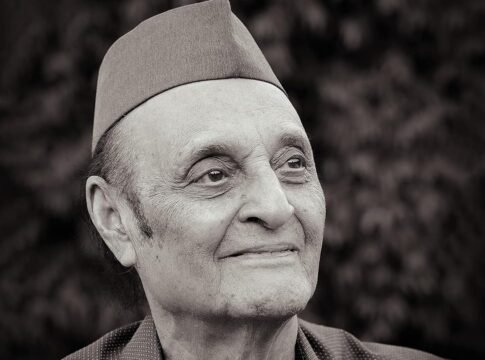
Harbans Singh’s A Statesman and a Seeker: The Extraordinary Life and Legacy of Dr. Karan Singh is a significant and intellectually stimulating contribution to modern Indian biographical literature. Moving well beyond the conventional confines of political biography, the work emerges as a nuanced and reflective exploration of the life, ideas, and public career of one of independent India’s most distinguished statesmen, scholars, and cultural personalities. Rich in historical insight, elegant in narrative construction, and marked by analytical balance, the book presents Dr. Karan Singh not merely as a political actor, but as a civilisational thinker whose life and thought intersected with some of the most critical political, cultural, and intellectual transformations of modern India in general, and Jammu and Kashmir in particular.
The central strength of the book lies in its ability to weave together the multiple dimensions of Dr. Karan Singh’s personality with remarkable coherence. Harbans Singh portrays him simultaneously as a constitutional figure, parliamentarian, diplomat, philosopher, author, and spiritual seeker. Such a multidimensional treatment is particularly important in the case of Dr. Karan Singh, whose public life cannot be adequately understood through the narrow lens of politics alone.
The early chapters dealing with the princely state of Jammu and Kashmir and the tumultuous years surrounding Indian independence are especially noteworthy. The narrative carefully reconstructs the complex political environment in which the young Dr. Karan Singh assumed responsibilities of immense historical significance. Harbans Singh handles these sensitive themes with commendable restraint and academic sobriety. Rather than indulging in political sensationalism or retrospective polemics, the author adopts a measured historical approach that foregrounds institutional transition, constitutional responsibility, and the personal burden of leadership during a period of profound uncertainty.
An equally important contribution of the work is its sustained engagement with Dr. Karan Singh’s intellectual and spiritual journey. Harbans Singh successfully demonstrates that Dr. Karan Singh’s engagement with Indian philosophy, Vedantic thought, comparative religion, and civilisational discourse was not peripheral to his political life but integral to his worldview. The chapters dealing with his association with spiritual traditions, interfaith dialogue, and Indian cultural thought are written with clarity and depth, revealing the author’s sensitivity to the philosophical dimensions of public life. This aspect of the book significantly elevates it beyond the genre of routine political memoirs or administrative biographies.
The treatment of Dr. Karan Singh’s parliamentary and ministerial career is equally impressive. The author presents a detailed account of his contributions in areas such as education, culture, tourism, civil aviation, and diplomacy. The narrative reflects the image of a public intellectual who consistently sought to integrate governance with cultural refinement and ethical responsibility. Particularly noteworthy is the manner in which the book highlights Dr. Karan Singh’s role in articulating India’s civilisational identity on global platforms while simultaneously remaining committed to democratic and secular values.
Stylistically, Harbans Singh writes with elegance, lucidity, and scholarly discipline. The prose is accessible without compromising intellectual seriousness. The work is supported by substantial historical material, references to contemporary political developments, and reflections on wider national concerns. The author’s admiration for Dr. Karan Singh is evident throughout the text; however, it remains dignified and restrained, allowing the biography to retain its academic credibility and analytical balance.
Another notable feature of the biography is the way it captures the changing ethos of Indian public life across decades. Through Dr. Karan Singh’s interactions with major political leaders, intellectuals, diplomats, and spiritual personalities, the reader encounters a broader narrative about postcolonial India itself. The biography therefore functions not only as an account of an individual life but also as a reflection on the moral, intellectual, and institutional evolution of the Indian republic.
Harbans Singh compellingly demonstrates that Dr. Karan Singh’s life cannot be confined within the limits of a conventional political biography; rather, it emerges as a prism through which one may understand the complex interplay between monarchy and democracy, tradition and modernity, spirituality and statecraft, and regional identity and national integration. The biography powerfully captures these tensions and continuities while situating Dr. Karan Singh at the centre of these historic processes with remarkable depth and sensitivity.
The work will be of immense value to historians, scholars of Jammu and Kashmir, students of political thought, and readers interested in the dynamic intersection of politics, spirituality, culture, and public ethics. Harbans Singh has crafted a narrative that moves beyond the boundaries of biography and enters the realm of historical reflection. In documenting the extraordinary public life of Dr. Karan Singh, the author simultaneously recovers an older tradition of leadership marked by intellectual refinement, moral seriousness, cultural rootedness, and democratic responsibility.
The book leaves the reader with a powerful reminder that public life, at its finest, can still be shaped by dignity, scholarship, philosophical depth, and civilizational consciousness. It evokes a generation of leadership for whom political engagement was inseparable from intellectual refinement, cultural rootedness, and ethical responsibility.