
On a tense Monday in April 2026, the deadline imposed by President Donald J. Trump for a naval blockade of Iranian ports slipped past without immediate fireworks, yet the strategic waters of the Strait of Hormuz remained a theater of high-stakes confrontation. What began as a limited military campaign in late February has morphed into a broader contest over one of the world’s most vital energy arteries, testing the limits of a shaky ceasefire, diplomatic patience and the willingness of global powers to intervene.
The United States, backed by Israel, has moved to enforce a partial blockade aimed squarely at Iranian shipping, even as Tehran insists it maintains control of the narrow passage and warns of dire consequences for any perceived aggression. Peace talks in Islamabad over the weekend, the most significant direct engagement between Washington and Tehran in nearly half a century, collapsed amid mutual recriminations, leaving the region on edge and global energy markets unsettled, Diplomat Digital reported earlier.
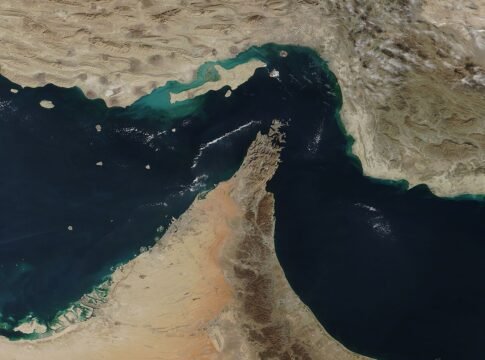
The origins of the crisis trace back to Feb. 28, when American and Israeli strikes against Iranian targets prompted Tehran to effectively seal off the Strait of Hormuz, a chokepoint that normally carries about one-fifth of the world’s seaborne oil and liquefied natural gas. The move paralyzed shipping, stranded tankers and sent shock waves through economies dependent on Gulf energy supplies. A two-week ceasefire, negotiated recently, offered a momentary pause, but it has held only tenuously, with Iran allowing limited, vetted vessels to pass — sometimes reportedly in exchange for payments — while blocking broader traffic.
On Sunday, after more than 21 hours of negotiations in Pakistan’s capital, the talks ended without agreement. Iranian officials, including Foreign Minister Abbas Araghchi, portrayed their side as having negotiated in good faith, coming within “inches” of a potential memorandum of understanding before encountering what they described as American “maximalism,” shifting demands and an abrupt turn toward blockade. Mr. Araghchi suggested that a phone call from Prime Minister Benjamin Netanyahu of Israel to Vice President JD Vance, made while the talks were underway, redirected attention toward Israeli priorities and undermined progress. American officials have not publicly addressed the allegation.
President Trump responded swiftly, ordering the Navy to begin blockading ships entering or leaving Iranian ports in and around the strait, effective around 2 p.m. Greenwich Mean Time on Monday. The U.S. Central Command clarified that the measure would not interfere with neutral vessels transiting the strait to or from non-Iranian destinations. But any unauthorized vessel approaching the blockaded zone, officials warned, would face interception, diversion or capture.
In characteristically blunt language, Trump posted on Truth Social that Iran’s navy had been “completely obliterated,” with 158 ships sunk, leaving only a handful of fast-attack vessels that he vowed would be “immediately ELIMINATED” if they neared the American position. He likened the enforcement to operations against drug-smuggling boats and boasted that similar tactics had stopped 98.2 percent of seaborne drug flows into the United States. Speaking to reporters, he described Iran as “desperate,” its military and air forces in ruins, and insisted the country would neither sell its oil nor develop nuclear weapons under sustained pressure.
Israeli leaders voiced strong support. Netanyahu told his cabinet that Israel backed the American “firm position” and remained in constant coordination with Washington. In southern Lebanon, Israeli forces reported encircling the strategic town of Bint Jbeil after intense fighting that killed more than 100 Hezbollah fighters, describing the operation as part of building a deeper security buffer along the border.
Iran’s response blended defiance and calculated warning. The country’s armed forces declared that security in the Persian Gulf and Sea of Oman was “either for everyone or no one,” threatening that any threat to Iranian ports would render “NO PORT in the region” safe. The Revolutionary Guards asserted full control over traffic in the strait and cautioned that any misstep by adversaries could trap them in a “deadly vortex.” Iran’s navy chief dismissed Trump’s threats as “ridiculous,” while state media released video footage of Iranian forces radioing a U.S. warship — identified by hull number — to “alter course” and retreat to the Indian Ocean or face targeting.
Parliament Speaker Mohammad Bagher Ghalibaf took a more pointed approach, sharing images of current gasoline prices near the White House and warning Americans they would soon “miss” the relatively modest $4 to $5 per gallon rates. He accompanied the post with a cryptic mathematical equation suggesting rising oil costs would follow any blockade.
For its part, the United States has framed the blockade as a necessary lever to force Tehran back to meaningful concessions on its nuclear program and full reopening of the strait. Yet the move has drawn criticism from international bodies and allies wary of further escalation. The secretary general of the International Maritime Organization, Arsenio Dominguez, stated unequivocally that no country has the legal right under international law to close an international strait or impose tolls on navigation, calling such actions a dangerous precedent. He urged de-escalation as the only path to restoring normal shipping and suggested that, given the already limited traffic, the additional American measures might not dramatically worsen the situation in the short term.
European leaders sought to chart an independent course. President Emmanuel Macron of France and Prime Minister Keir Starmer of Britain announced plans to co-host a summit this week focused on a “strictly defensive” multinational mission to safeguard shipping in the strait, separate from the warring parties. Britain explicitly ruled out joining the American blockade, emphasizing instead a broader effort involving more than 40 nations to restore freedom of navigation once conditions allow.
China, through its top diplomat, told Pakistani officials that maintaining the ceasefire remained an “immediate priority” and pointed to a joint China-Pakistan peace plan as a potential guide. Japan’s prime minister expressed support for Pakistan’s mediation efforts and stressed the importance of de-escalation for global energy security. Pakistan’s Prime Minister Shehbaz Sharif described the ceasefire as “holding” and said efforts continued to reach a lasting agreement.
The economic stakes are enormous. Even if the strait were to reopen fully, analysts caution that confidence among tanker operators and insurers remains badly eroded. A fragile, two-week ceasefire offers little reassurance that vessels entering the Gulf would not become trapped for weeks or longer. Without new ships willing to risk the passage to load fresh cargoes, the benefit of allowing stranded tankers to exit would prove short-lived, prolonging the global oil and LNG crunch.
India, heavily dependent on Gulf supplies for nearly 90 percent of its liquefied petroleum gas imports, has found itself navigating the crisis with careful diplomacy. Its shipping ministry reported coordination with the foreign ministry to secure the safe return of 15 Indian-flagged or owned vessels currently stranded. One vessel, the Jag Vikram, carrying more than 20,000 metric tons of LPG, successfully transited the strait on April 11 and is expected to dock in Kandla, Gujarat, on Tuesday — a modest but welcome breakthrough. More than 2,100 Indian seafarers have been repatriated so far, with no reported incidents involving Indian ships in the past day. Indian ports continue to operate normally, officials said.
Inside Iran, the external pressure coincides with deep internal fractures. Reza Pahlavi, the son of the deposed shah, positioned himself during a visit to Stockholm as a potential unifying figure for the country’s divided opposition in exile. He outlined four principles he believes should underpin any democratic transition: territorial integrity, separation of religion and state, equality before the law, and mechanisms for free and fair elections. Yet his open encouragement of American and Israeli military action, combined with his reluctance to disavow his father’s autocratic legacy, has alienated segments of the opposition, including prominent voices such as Nobel Peace Prize laureates Narges Mohammadi and Shirin Ebadi.
A joint report by two human rights organizations released Monday painted a grim picture of domestic repression, noting that Iranian authorities carried out at least 1,639 executions in 2025 — the highest annual total since 1989 — with 48 of the executed being women. The groups warned that, should the Islamic Republic survive the current crisis, capital punishment could be wielded even more aggressively as a tool of control.
As night fell on Monday, the blockade was in motion, yet the broader contours of the conflict remained uncertain. Operations had resumed at a major gas facility in Iraq’s Kurdish region after weeks of disruption. Iran reported progress in repairing war-damaged rail lines. Tankers, meanwhile, continued to steer clear of the strait in anticipation of heightened risks.
The coming days will test whether the combination of American pressure, European diplomatic initiatives and mediation by regional players like Pakistan can produce a sustainable path forward, or whether the fragile ceasefire will unravel under the weight of competing demands and naval posturing. For now, the Strait of Hormuz — long a symbol of global interdependence — stands as a stark reminder of how quickly economic lifelines can become theaters of confrontation, with consequences that ripple far beyond the waters of the Persian Gulf.
(Inputs from NDTV and various other reports)