
Road safety is one of the most important challenges today. Every day, thousands of people travel on roads for work, education, business, healthcare and other essential activities. While roads connect communities and support economic development, they can also become dangerous when road conditions and environmental factors combine to create a risk of serious accidents. The danger becomes even greater in hilly and mountainous regions, where steep slopes, sharp curves, deep valleys, unstable terrain and narrow roads leave very little room for error. In such areas, a properly designed and correctly installed crash barrier can be a lifesaver.
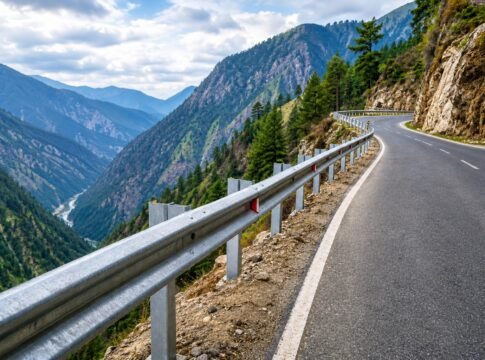
A crash barrier is not merely a metal structure placed along the side of a road. It is an important road-safety device designed to reduce the severity of crashes and prevent vehicles from leaving the roadway. On a mountain road, where a vehicle leaving the carriageway may plunge down a steep slope or into a gorge, a crash barrier can mean the difference between a minor accident and a tragedy.
When people look at a road, they generally focus on the road surface, width, potholes, traffic signs and traffic movement. However, on hilly roads, the area immediately beyond the edge of the carriageway can be just as important.
A vehicle can leave the road for many reasons. A driver may lose control while negotiating a curve, a vehicle may suffer a mechanical failure, a tyre may burst, a driver may fall asleep, or another vehicle may force a sudden change in direction. Rain, snow, fog, landslides and poor visibility can further increase the risk.
On a plain road, a vehicle leaving the carriageway may stop on a relatively flat shoulder or open area. On a mountain road, the consequences can be dramatically different. A vehicle may fall several metres, roll down a slope, strike trees or rocks, or enter a river or gorge. Passengers may have little chance of survival.
This is where a properly designed roadside safety barrier becomes critical.
The simplest way to understand the importance of a crash barrier is to imagine a vehicle approaching the edge of a mountain road after losing control. Without a barrier, the vehicle may cross the road edge and continue down the slope. With an appropriately designed and installed barrier, the vehicle may be redirected or contained, depending on the crash conditions and the type of barrier.
Therefore, the primary purpose of a safety barrier is not simply to “stop” every vehicle. Its purpose is to reduce the severity of a dangerous roadside departure and provide a safer outcome when a vehicle leaves its intended path.
A crash barrier can prevent or reduce the risk of vehicles falling from high embankments. However, a barrier must be selected, designed, installed and maintained correctly. An improperly designed barrier can itself become a hazard.
The need for roadside protection is particularly strong in the Himalayan and other mountainous regions of India. Roads in such areas often pass through difficult terrain where construction is challenging and available road width is limited.
In districts with mountainous terrain, roads may include hairpin bends, steep gradients, deep valleys, bridges, culverts, high embankments and sections exposed to landslides. During monsoon conditions, water can also wash soil and debris onto the road, making driving more difficult.
A momentary loss of control on such a road can have devastating consequences.
Consider a bus carrying students or passengers travelling along a narrow hill road. If the driver loses control near a steep drop, there may be no recovery space. A strong, correctly designed roadside safety system can provide an important protective layer.
For this reason, road development in hilly areas should not focus only on constructing the carriageway. Roadside safety must be treated as an integral part of road engineering.
It is important to understand that crash barriers alone cannot eliminate road accidents.
Road safety is a system. It involves road design, vehicle condition, driver behaviour, speed management, signs and markings, drainage, lighting, pedestrian safety, emergency response and roadside protection. A crash barrier is one component of this system.
A dangerous curve should first be designed as safely as practical. Proper signs, markings, sight distance and speed management should be provided. If the roadside is dangerous and needs protection, a suitable barrier must be installed.
This approach is important because a barrier should not be used simply to compensate for poor road design.
One of the biggest misconceptions is that any steel railing placed beside a road is a crash barrier. That is not necessarily true.
A roadside barrier is a safety system that must perform under specific impact conditions. Its strength, geometry, terminals, posts, connections, working width, deflection characteristics and foundation all matter.
The barrier must also be suitable for the road environment and the type of risk being addressed.
Poorly installed barriers may fail to perform as intended. For example, inadequate anchoring, incorrect spacing, damaged components, unsuitable terminals or insufficient clearance can compromise safety.
Therefore, road authorities and contractors should follow the applicable road-safety standards and specifications rather than treating barrier installation as a routine civil-work item.
The most obvious benefit of a crash barrier is preventing a vehicle from leaving the road at dangerous locations.
This is particularly important where the roadside contains a steep drop, deep valley, river, railway line, bridge, large fixed obstacle or other hazard.
The barrier creates a controlled roadside boundary. When a vehicle strikes it, the barrier system is intended to manage the collision in a way that is less dangerous than allowing the vehicle to continue into the hazard.
This can be especially valuable on roads where the consequences of leaving the carriageway are severe.
Every road accident represents more than a number in a government report.
Behind every fatal crash is a family that loses a parent, child, spouse, brother, sister or friend. Serious injuries can leave people permanently disabled and can create financial hardship for families.
The economic cost of crashes also includes medical treatment, loss of income, vehicle damage, emergency response and long-term rehabilitation.
Preventing even a single fatal crash can therefore have enormous social value.
A crash barrier may appear to be a relatively small investment when compared with the cost of constructing a road, but its potential safety benefit can be enormous at high-risk locations.
Installing a crash barrier is only the beginning. Like every other road-safety facility, it requires regular inspection and maintenance.
After a crash, a damaged barrier should be inspected and repaired or replaced promptly. Bent rails, broken posts, damaged connections and missing components can reduce the protective capability of the system.
Road authorities should conduct periodic safety inspections, particularly before and after severe weather conditions.
Mountain roads are exposed to landslides, rockfalls, heavy rain and snow. These events can damage roadside barriers even when no vehicle has collided with them.
A neglected crash barrier can create a false sense of security. Therefore, maintenance must be included in the road-management system from the beginning.
Good drainage is another essential part of road safety.
Water flowing across the carriageway can make the surface slippery, damage the road foundation and contribute to erosion. In hilly areas, blocked drains can cause serious damage to road edges and embankments.
If the ground supporting a barrier becomes unstable because of poor drainage or erosion, the barrier may not perform as intended during a crash.
Therefore, drainage, slope protection and roadside barriers should be considered together during road design and maintenance.
Bridges and culverts are locations where roadside protection is particularly important.
At a bridge, the road may be immediately adjacent to a drop, river or other hazardous feature. A vehicle leaving the carriageway at such a location can face extremely serious consequences.
Crash barriers and bridge parapets should therefore provide appropriate continuity and protection, with suitable transitions between different safety systems.
Special attention is also required at barrier terminals. A poorly treated barrier end can become a dangerous obstacle. Proper terminal and transition treatments are essential components of a complete roadside safety system.
Crash barriers also have an important relationship with pedestrian safety.
In populated areas, pedestrians often walk along roads because dedicated footpaths may not exist. However, barriers should not be installed in a way that creates unnecessary obstacles or forces pedestrians into traffic.
Road authorities should consider the needs of pedestrians, cyclists, two-wheelers and local communities when designing roadside protection.
In villages and towns along mountain roads, safety measures should be integrated with pedestrian crossings, footpaths, bus stops and access points.
Rural roads play an important role in connecting villages with markets, schools, hospitals and administrative centres. In mountainous districts, these roads often serve communities located in difficult terrain.
Road connectivity is meaningful only when it is safe connectivity.
On rural and PMGSY roads, safety provisions should therefore receive appropriate attention at locations where roadside hazards are significant. Steep embankments, sharp curves, bridges, culverts and exposed sections should be assessed during road design and safety audits.
The objective should not be to install barriers everywhere. Instead, resources should be directed towards locations where a roadside departure could result in serious injury or death.
Government budgets are always limited, and road authorities must prioritise expenditure. But road safety should not be viewed only in terms of construction cost.
The cost of installing a safety barrier at a dangerous location can be small compared with the human and economic cost of a fatal crash.
A few metres of properly designed roadside protection may protect dozens, hundreds or thousands of road users over its service life.
The question should therefore not simply be, “How much will the barrier cost?”
The more important question is: “What will be the cost if we do not install it?”
For many years, road safety discussions have focused heavily on what happens after an accident: ambulances, hospitals, police response and compensation.
Emergency response is essential, but preventing a crash or reducing its severity is even better.
A crash barrier represents this preventive philosophy.
It stands quietly beside the road every day. Most drivers may never notice it. But when a vehicle suddenly loses control, that apparently ordinary structure can become a critical safety device.
Its greatest success may be an accident that never becomes a fatality.
Human beings make mistakes. Drivers can misjudge a curve, lose concentration, face mechanical failure or encounter unexpected road conditions. Roads must therefore be designed to reduce the consequences of human error.This is one of the fundamental principles of modern road safety.
A crash barrier cannot prevent every accident, but at the right location, a properly designed and maintained barrier can prevent a vehicle from entering a much more dangerous environment. On mountain roads, that difference can be enormous.
A road edge overlooking a valley, river or steep slope is not simply a boundary; it can be a life-threatening hazard. A crash barrier can provide an additional layer of protection between that hazard and the people travelling on the road.
Therefore, crash barriers should not be seen merely as roadside metalwork or an additional construction expense. They are life-saving infrastructure.
Every road project, particularly in hilly and mountainous areas, should give serious attention to roadside safety. High-risk locations should be identified through proper engineering assessments and safety audits. Appropriate barriers should be selected and installed according to relevant standards, and damaged systems should be repaired without delay.
Ultimately, the success of a road is not measured only by how quickly it connects two places. It should also be measured by how safely people can travel between them.
A crash barrier may cost money to install, but a human life is priceless. Where a barrier can prevent a vehicle from going over the edge, it is not an expense; it is an investment in life.