

New Delhi: The Enlightenment, that grand intellectual project of the eighteenth century, has long been celebrated as the philosophical wellspring of modernity: the source of reason, secularism, universal rights, and the very ideals that supposedly underpin the liberal international order. Yet, as a provocative new book argues, this narrative of progress and emancipation conceals a more troubling reality.
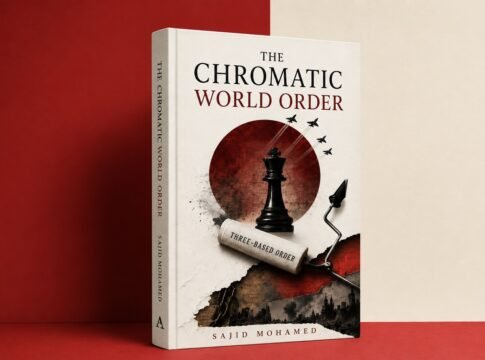
‘The Chromatic World Order: The Fiction That Rules Our World: A Brief History of its Genesis and Other Stories’, authored by Sajid Mohamed and published by Aakar Books, offers a searing indictment of how the very ideals that proclaimed human equality were simultaneously deployed to justify imperial domination and racial exclusion.
Mohamed, a practising lawyer and law firm founder, has produced a work that challenges readers to view modern history from a different perspective and question the systems that continue to shape the global order. The book argues that the idea of white superiority has played a major role in European imperialism, colonialism, neocolonialism and the global systems that followed, questioning whether the end of colonial rule truly ended the influence of racial hierarchies in the world.
At the heart of this critique lies a fundamental contradiction. The Enlightenment, which cast itself as the heir to the Greco-Roman tradition, constructed what the excerpt calls a “fictive civilizational continuity”, the White or Caucasian race, and retroactively tethered it to the inventions of its time. This racial category, forged under the guise of scientific rationality, provided Europeans with a unifying identity and a common standard of moral superiority.
Colour-coding became, as the text argues, a powerful political tool used to justify excluding non-Europeans from the very rights and liberties championed for Europeans. In doing so, the Enlightenment enshrined what scholars have termed a logic of racial exclusion that denied the universality of its own ideals, creating what the excerpt calls “a wall of Whiteness, a racialised border demarcating who could partake of the prosperity of the Enlightenment’s promises, and who would remain perpetually on the outside.”
This argument aligns with a growing body of critical scholarship that has re-examined the Enlightenment’s legacy. Intellectual historians have shown that the Scottish Enlightenment, in particular, played a crucial role in constructing ideas of belonging that justified British imperial rule.
Studies have shown how philosophical debates over what it meant to belong to a nation, civilisation, and humanity itself intersected with the mass population movements of the eighteenth century, the forging of new trade routes, war, disease, enslavement, and displacement, to consolidate a discourse of ‘home’ and ‘exile’ that was central to the construction of racial difference.
These debates, playing out across poetry, political pamphlets, travel writing, and philosophy, offer a unique insight into how whiteness became central to liberal imperialism’s understanding of belonging, with emotional attachment and the perceived ability to belong becoming key concepts in constructions of racial hierarchy.
The excerpt takes this critique further by linking the Enlightenment’s ideological contradictions to contemporary geopolitical realities. It opens with a striking vignette from the US-Israel war on Iran that began on 28 February 2026, a conflict that authoritative international legal bodies have classified as a war of aggression.
Pete Hegseth, serving as US Secretary of Defence, approaches a Pentagon podium carrying a Bible stamped with a Jerusalem Cross and inscribed with the Crusader battle cry “Deus Vult.” He prays for enemies to be “delivered to the eternal damnation prepared for them,” citing the Psalms to frame a military campaign that has resulted in over 1,500 Iranian casualties and a strike on a girls’ school in Minab. This fusion of the world’s most powerful state with religious justification, the excerpt argues, stands in “complete antithesis to the principles of the Treaty of Westphalia” and would likely alarm Enlightenment secularists like Rousseau.
The ideological inconsistency is further exposed through the figure of US Vice President J. D. Vance, who speaks on free speech in Europe while emphasising “shared civilizational values” and centring the persecution of Christians. In this discourse, Enlightenment language serves a civilizational narrative tied to Western exceptionalism. The excerpt argues that what emerges is “a vocabulary of convenience that is deployed when convenient to justify dominance and maintain global hierarchies.” Far from developing a stable ethical tradition, the Enlightenment has become a pliable instrument whose ideals are invoked to defend the very imperialisms, racisms, and exclusions it ought to have opposed.
When one considers the contradictions between the Enlightenment’s stated ideals and their practical implementation, the American Revolution offers an instructive example. One of the earliest movements inspired by Enlightenment principles such as liberty, equality, and natural rights, it coexisted with chattel slavery.
Enslaved individuals could be, without needing an extraordinary example or explanation, constitutionally counted as three-fifths of a person for purposes of representation. Solomon Northup’s Twelve Years a Slave, a well-noted critique of the inconsistency of American democracy, challenged early on the point made here that, within the superficial universality of Enlightenment ideals in a racial order, Black or, by extension, coloured lives were expendable.
The excerpt concludes by observing that the Enlightenment’s prime products reason, secularism, universal rights—have been “starkly impotent in addressing today’s global injustices.” In a world where reason is “routinely guillotined and human slaughter is streamed in real time,” one might concede a grim resonance with the conservative philosopher Joseph de Maistre’s vision of human history as an unending cycle of bloodshed.
What remains most obscured in the popular imagination, however, is the Enlightenment’s profound entanglement with racism an entanglement that, as this work demonstrates, continues to shape the Chromatic World Order of the present day.
At the heart of this critique lies a fundamental contradiction. The Enlightenment, which cast itself as the heir to the Greco-Roman tradition, constructed what the excerpt calls a “fictive civilizational continuity”, the White or Caucasian race, and retroactively tethered it to the inventions of its time. This racial category, forged under the guise of scientific rationality, provided Europeans with a unifying identity and a common standard of moral superiority.
Colour-coding became, as the text argues, a powerful political tool used to justify excluding non-Europeans from the very rights and liberties championed for Europeans. In doing so, the Enlightenment enshrined what scholars have termed a logic of racial exclusion that denied the universality of its own ideals, creating what the excerpt calls “a wall of Whiteness, a racialised border demarcating who could partake of the prosperity of the Enlightenment’s promises, and who would remain perpetually on the outside.”
This argument aligns with a growing body of critical scholarship that has re-examined the Enlightenment’s legacy. Intellectual historians have demonstrated that the Scottish Enlightenment, in particular, played a crucial role in constructing ideas of belonging that justified British imperial rule.
Studies have shown how philosophical debates over what it meant to belong to a nation, civilisation, and humanity itself intersected with the mass population movements of the eighteenth century, the forging of new trade routes, war, disease, enslavement, and displacement, to consolidate a discourse of ‘home’ and ‘exile’ that was central to the construction of racial difference. These debates, playing out across poetry, political pamphlets, travel writing, and philosophy, offer a unique insight into how whiteness became central to liberal imperialism’s understanding of belonging, with emotional attachment and the perceived ability to belong becoming key concepts in constructions of racial hierarchy.
The excerpt takes this critique further by linking the Enlightenment’s ideological contradictions to contemporary geopolitical realities. It opens with a striking vignette from the US-Israel war on Iran that began on 28 February 2026, a conflict that authoritative international legal bodies have classified as a war of aggression. Pete Hegseth, serving as US Secretary of Defence, approaches a Pentagon podium carrying a Bible stamped with a Jerusalem Cross and inscribed with the Crusader battle cry “Deus Vult.”
He prays for enemies to be “delivered to the eternal damnation prepared for them,” citing the Psalms to frame a military campaign that has resulted in over 1,500 Iranian casualties and a strike on a girls’ school in Minab. This fusion of the world’s most powerful state with religious justification, the excerpt argues, stands in “complete antithesis to the principles of the Treaty of Westphalia” and would likely alarm Enlightenment secularists like Rousseau.
The ideological inconsistency is further exposed through the figure of US Vice President J. D. Vance, who speaks on free speech in Europe while emphasising “shared civilizational values” and centring the persecution of Christians. In this discourse, Enlightenment language serves a civilisational narrative tied to Western exceptionalism.
The excerpt argues that what emerges is “a vocabulary of convenience that is deployed when convenient to justify dominance and maintain global hierarchies.” Far from developing a stable ethical tradition, the Enlightenment has become a pliable instrument whose ideals are invoked to defend the very imperialisms, racisms, and exclusions it ought to have opposed.
This analysis resonates with scholars who have explored the “interlocking relation between the political rationality of colonial power and modernity.” Enlightenment reason, resting on the belief that non-modern ways of life are irreconcilable with Western models of progress, has served as the connecting tissue between colonial and modernist discourses. The signifiers of the Enlightenment project: progress, modernisation, universalism have functioned as legitimising categories in colonial power’s civilising mission. As one scholar noted, the formation of universal humanism’s ideal was predicated upon a racist gesture: to be able to proclaim its humanity, the West needed to create its others as enslaved people and monsters.
The excerpt concludes by observing that the Enlightenment’s prime products: reason, secularism, and universal rights have been “starkly impotent in addressing today’s global injustices.”
In a world where reason is “routinely guillotined and human slaughter is streamed in real time,” one might concede a grim resonance with the conservative philosopher Joseph de Maistre’s vision of human history as an unending cycle of bloodshed. What remains most obscured in the popular imagination, however, is the Enlightenment’s profound entanglement with racism, an entanglement that, as this work demonstrates, continues to shape the Chromatic World Order of the present day.