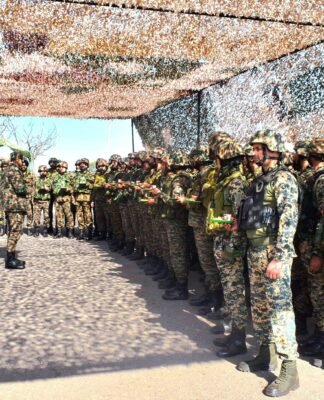
When most people think of the Indian Army, they picture soldiers guarding borders against external threats—a role that is both accurate and deeply respected. The Army’s primary mission remains national defence. Yet, in the districts of the Jammu region—from the hinterlands of Doda and Kishtwar to the border belts of Rajouri and Poonch—the Army also serves as the first responder in times of crisis.
At the heart of this responsibility is the Indian Army’s XVI Corps, known as the White Knight Corps. Headquartered in Nagrota, it oversees a vast and sensitive area encompassing Rajouri, Poonch, Doda, Kishtwar, Ramban, Reasi, and rural Jammu. These districts are strategically vital but geographically demanding, with high mountains, deep valleys, dense forests, fast-flowing rivers, and unpredictable weather. In this terrain, resilience is essential, and crises are a regular part of life.
Through initiatives such as #HumAapkeSaathHain, the White Knight Corps has bolstered both humanitarian outreach and security measures across the region. While its core focus is countering threats and ensuring stability, this operational readiness also enables swift humanitarian responses. The same capabilities that protect borders serve as a lifeline for civilians in remote hinterland and border villages.
In a recent example from February 19, 2026, troops achieved two notable successes in the Rajouri sector along the Line of Control (LoC). Late on Wednesday night, an Army patrol apprehended a terror associate in the Raipura Bhatta area of Nowshera. The individual, a resident of Sehar village near the LoC, was found with two foreign-made pistols—one Turkish (TISAS Zigana 9mm) and one Chinese (TT-30 Norinco)—along with four magazines and 15 rounds of ammunition. Preliminary investigations linked him to a trans-border weapons racket involving Pakistan-based elements.
In a separate incident in the early hours of the same day, suspicious terrorist movement was detected in the Nathua Tibba area of the Sunderbani sector based on intelligence and surveillance. Troops responded with swift, calibrated fire, successfully foiling the infiltration attempt. Follow-up searches under Operation Jwala recovered war-like stores, including one AK-47 rifle, two magazines with ammunition, three rucksacks, blankets, rations, and clothing. Blood-stained tracks indicated serious injuries to the terrorists. Operations continue with heightened vigilance and integrated ground-aerial domination of the area.
In these border zones, threats rarely come alone. Villages may face cross-border shelling one season and heavy snowfall the next. Monsoons trigger landslides that block roads, flash floods destroy footbridges and crops, and winter snow isolates communities. Time is critical in such emergencies—quick action saves lives and eases suffering.
Civil administration and disaster management authorities lead relief and rehabilitation, but reaching remote areas often takes time due to damaged roads, failed communications, or adverse weather. The Army, already deployed and trained for extreme conditions, frequently responds immediately.
During cross-border shelling in Rajouri and Poonch, soldiers evacuate civilians from vulnerable villages, provide immediate medical aid, and offer stability until civil agencies take over. Their disciplined presence calms panic and reassures families.
Natural disasters pose similar challenges. The Jammu–Srinagar highway near Ramban often sees landslides during heavy rain, stranding vehicles for hours or days. Army teams clear debris, distribute food and water, and assist vulnerable travellers to safety.
In Doda and Kishtwar, where narrow mountain roads connect villages, heavy rains can cut off entire areas. Soldiers trek on foot to deliver supplies and medical help. Flash floods in Rajouri have seen troops form human chains to rescue trapped people, including children near swollen streams, and clear damaged homes while arranging temporary shelters.
Heavy snowfall in high-altitude areas like Peer Gali and Sawjian blocks roads, preventing ambulances from reaching patients. Troops have carried the sick and elderly through deep snow for kilometres and evacuated pregnant women needing urgent care. Helicopters are deployed when weather allows for critical transfers.
These operations rely on the Army’s robust logistics: terrain-capable vehicles, engineering units for temporary bridges, reliable communications, and medical teams trained for remote emergencies.
Beyond immediate responses, the White Knight Corps supports communities year-round through civic action programmes. Medical and veterinary camps provide free check-ups, medicines, and livestock care in remote villages. Winter relief distributes blankets and essentials. Youth initiatives, including sports events and motivational sessions, encourage education and positive pursuits, helping channel energy constructively and strengthening ties between locals and security forces.
The psychological impact is profound: In uncertainty, the Army’s organised relief reduces panic, protects families, and reassures children. It signals that the nation stands with border communities.
Yet, long-term resilience requires effective governance. The Army delivers immediate aid, but lasting solutions demand reinforced infrastructure, resilient bridges and drainage, community bunkers in shelling-prone zones, and functional healthcare and education. Seamless coordination among the Army, civil authorities, police, and disaster agencies—through joint exercises and clear protocols—is essential for efficient responses.
The White Knight Corps exemplifies the Indian Army’s dual commitment: safeguarding security while extending compassion. From landslide clearance in Ramban to rescues in Rajouri and patient evacuations through snow in Peer Gali, soldiers serve as a lifeline.
A poignant illustration came when minor Anayat Hussain from Arai suffered a serious accident involving an Army vehicle near Mandi in Poonch. Soldiers rushed him to Sub-District Hospital Mandi, then to District Hospital Poonch and GMC Rajouri. For advanced care, the Army arranged his transfer to Amandeep Hospital in Amritsar, with senior officers monitoring his progress. The Army provided full financial support and arranged around ten units of blood. After recovery, Anayat’s father publicly thanked the Army for standing by the family in crisis.
Beyond the battlefield, the Indian Army—particularly the White Knight Corps in the Poonch–Rajouri sector—guards both territory and people. In hinterland and border villages of Jammu, it is not only a shield against threats but a symbol of support, strength, and reassurance. When crisis strikes, it is often the soldier who arrives first—steady, disciplined, and ready to help.