
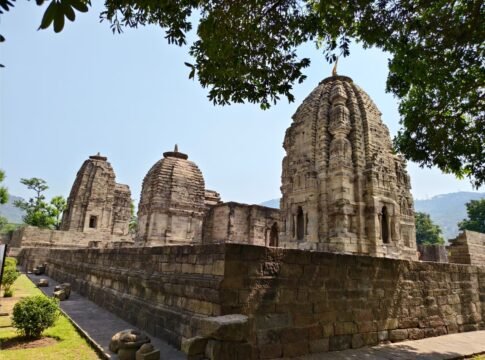

Udhampur, J&K (India): In the quiet cradle of the Shivalik foothills, where the air smells of crushed pine and the Birunala stream hums a rhythmic, ancient prayer, the stones of Krimchi do not merely sit—they speak.
Known to the world as the Krimchi Group of Temples, but held in the hearts of locals as the “Pandav Mandir,” this majestic cluster of seven sandstone shrines represents one of the most profound, yet tragically overlooked, heritage corridors in the Union Territory of Jammu and Kashmir.
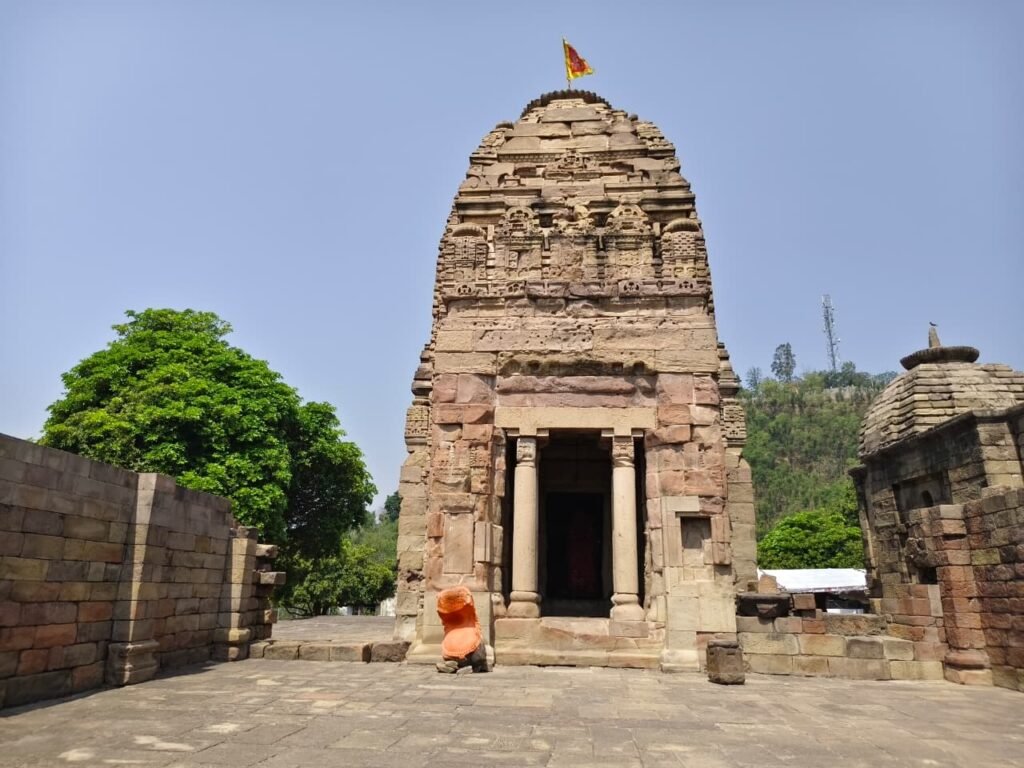
Located a mere twelve kilometers from the bustle of Udhampur and sixty-five kilometers from the city of Jammu, the journey to these temples marks a transition from the frantic pace of the twenty-first century into a landscape governed by the slow, deliberate clocks of the gods. As the road narrows and the urban hum dissolves into the rustle of mustard fields, the temples emerge from a massive stone platform like a secret the earth has finally decided to share.
These structures, with their soaring shikhara towers reaching nearly fifty feet toward the heavens, carry within their weathered reliefs a thousand-year-old dialogue between faith, fallen kingdoms, and the lingering shadows of the Mahabharata.
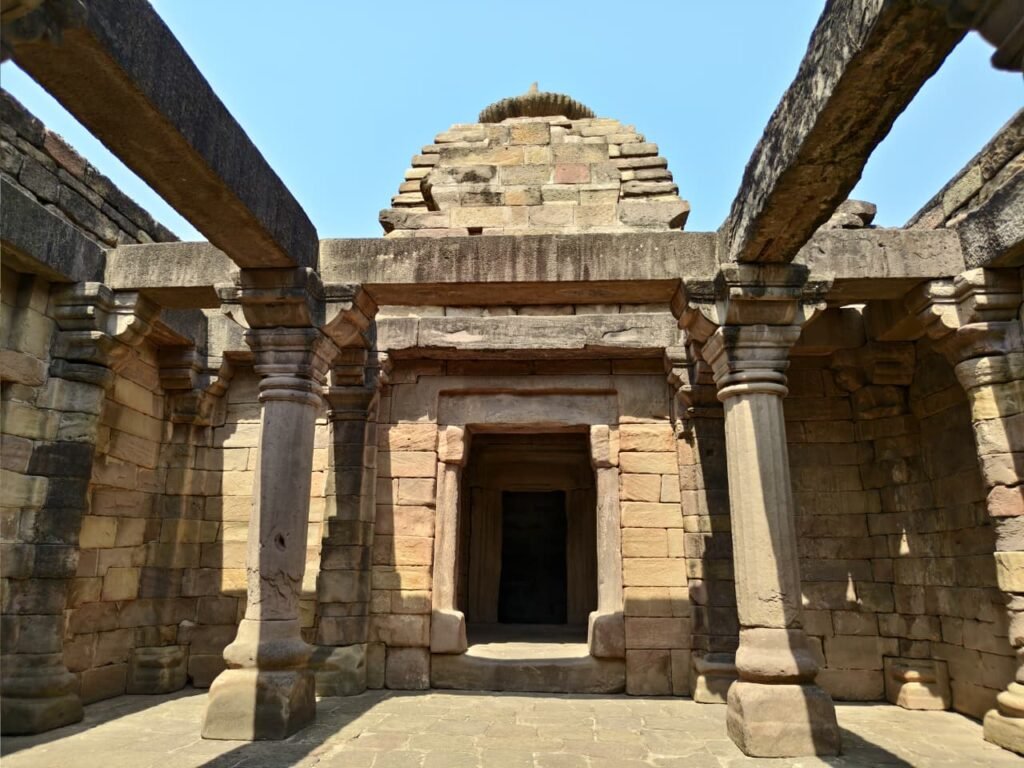
To walk among these temples is to traverse a living fossil of Indian history, where the lines between documented archaeology and oral legend blur into a singular, breathtaking reality of devotion and defiance.
The name “Krimchi” itself serves as a linguistic bridge to a mythological age, deeply rooted in the Sanskrit traditions of the North. Local folklore and historical accounts suggest that the village was originally christened “Kunti Nagar,” named in honor of Queen Kunti, the mother of the five Pandava brothers.
Over millennia, the fluid nature of local dialects saw “Kunti” soften into “Krimchi,” but the association with the epic heroes remains unshakable. According to these enduring legends, it was here—amid the rugged beauty of the Shivalik range—that the Pandavas sought sanctuary during their thirteen-year exile from the Kuru kingdom of Hastinapur.
Accompanied by their wife Draupadi and their mother Kunti, the brothers are said to have found rare solace in the valley of the Birunala. In a gesture of gratitude for the protection provided by the wilderness, they are believed to have raised these monuments to Lord Shiva, seeking divine strength for the inevitable war that lay ahead. This deep-seated belief transforms the site from a collection of “monuments” into a “Pandav Mandir” for the local community. To the villagers, these are not merely archaeological remnants of the 8th century, but the very altars where Bhima, Arjuna, and Yudhishthira once bowed their heads in prayer.
However, the mythological tapestry of Krimchi is woven with darker, more complex threads than just the arrival of the Pandavas. The origins of the town are often attributed to the enigmatic Raja Kichak, a figure whose presence creates a fascinating paradox within the site’s history. In the Mahabharata, Kichak was the formidable commander-in-chief of the Matsya kingdom—a man of immense power but equal arrogance—who met his end at the hands of Bhima after attempting to dishonor Draupadi.
Local tradition holds that it was Kichak who first established the kingdom of Krimchi, building its initial fortifications and perhaps even commissioning the earliest versions of the shrines. This creates a haunting historical irony: the very man who founded the town provided the stage for his own eventual destruction by the heroes he inadvertently hosted.
After Kichak’s violent demise, the region reportedly remained without a sovereign for centuries—a period of royal silence that even the British archaeologist Alexander Cunningham noted during his nineteenth-century surveys. Cunningham’s research into a potential “late Pandava dynasty” ruling in Jammu and Kashmir provides a rare bridge where Western scholarly skepticism meets the unwavering conviction of Indian oral history, suggesting that the legends of Krimchi may be grounded in a forgotten political reality.
Beyond the veil of myth, the physical architecture of the Krimchi complex tells a story of a globalized ancient world that modern history books often fail to capture. While the Archaeological Survey of India (ASI) officially dates the current structures to the 8th and 9th centuries CE—linking them to the Dev dynasty of Jammu—the artistic DNA of the site suggests a far older and more diverse lineage.
Scholars have pointed to a profound architectural idiom present in the stone carvings that reflects the region’s long exposure to external influences, including the legacy of Hellenistic artistry that filtered into the Himalayan foothills following ancient campaigns.
Guarding the temple thresholds are lion sculptures with stylized, curling manes carved in a distinct style—a visual language born from the marriage of diverse aesthetics and Indian spirituality. The intricate doorframes, adorned with motifs that would look at home in both an ancient Hindu sanctum and a classical villa, suggest that Krimchi once stood at a cultural crossroads where the Silk Road’s trade met the spiritual highways of the plains. This synthesis of styles makes the complex a unique laboratory of art history, reflecting a time when regional boundaries were porous and artisans of the Shivaliks spoke a visual language that resonated across continents.
The layout of the complex is a masterclass in classical Hindu temple planning, consisting of seven distinct shrines—four larger structures facing the rising sun in the east and three smaller temples oriented toward the west. Each follows the traditional tripartite plan of the garbhagriha (the sanctum sanctorum), a mandapa (a pillared assembly hall), and the shikhara (the tower).
Temple No. 3 is widely regarded by historians as the oldest of the group, a pioneer in stone that set the template for the others, while Temple No. 1 remains the most ornately decorated, its walls teeming with the divine pantheon. Though Temples No. 6 and 7 were lost to the ravages of time and earthquakes centuries ago, their ruins only add to the site’s poignant atmosphere of “beautiful decay.”
Inside the sanctums, the focus remains primarily on the Shaiva tradition. Sacred Shivalingas stand as silent witnesses to over a thousand years of ritual, while intricately carved depictions of Goddess Parvati, Lord Ganesha, and Lord Vishnu occupy the outer niches, ensuring that the cosmic cycle of creation and dissolution is fully represented within these stone walls.
Following the legendary era of the Pandavas, historical accounts identify King Dayakaran—son of King Puran Karan—as a pivotal figure who allegedly extended his influence from Jammu into Kashmir, where his descendants are said to have ruled for fifty-five generations.
Later, King Som Dutt established the principality of “Bhuti” with Krimchi as its capital, a kingdom that endured through twelve generations of Rajput rulers. Evidence of this royal past can still be seen on the “garh,” or hilltop overlooking the temples, where the remnants of the Krimchi Fort stand.
From these elevated battlements, rulers like King Bahadur Singh and King Himmat Singh—who governed during the 17th-century reign of Maharaja Ranjit Dev of Jammu—would have looked down upon the same temples we see today, recognizing them as the spiritual heart of their realm. The fort and the temples together form a complete landscape of power and piety, representing a society where the defense of the land and the worship of the divine were inextricably linked.
Archaeological excavations at Krimchi have further validated the site’s significance, unearthing a wealth of artifacts that offer a glimpse into the daily lives of its ancient inhabitants. From finely crafted stone idols to iron arrowheads and humble earthen pottery, the soil of Krimchi has revealed evidence of a multi-layered civilization that was as prepared for war as it was devoted to art.
These findings have drawn the attention of international heritage advocates and local residents alike, who have begun a campaign to have the Krimchi Group of Temples recognized as a UNESCO World Heritage Site. Their argument is compelling: a site that harmonizes the mythology of the Mahabharata, the artistic legacy of ancient trade routes, and a continuous tradition of active worship for over a millennium is a rarity that transcends national borders.
Every year, during Kul Devta Diwas, the complex transforms into a vibrant center of devotion as families from across Jammu and Kashmir return to their ancestral roots—proving that Krimchi is not a “dead” monument, but a living sanctuary.
In a world of high-speed travel and overcrowded tourist itineraries, Krimchi offers something increasingly rare: stillness. It asks for no grueling trek or expensive ticket—only a short drive from Udhampur and a modest entry fee. Yet, the reward is a profound sense of stepping outside ordinary time.
Krimchi remains a testament to the enduring truth that while kingdoms fall and kings are forgotten, prayers carved in stone continue to echo through eternity.