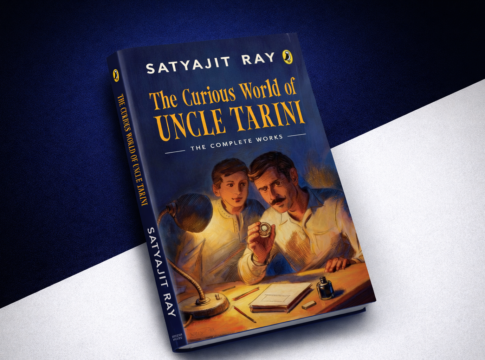

New Delhi: The Curious World of Uncle Tarini by Satyajit Ray, published by Puffin Books, offers a fertile entry into a literary world shaped by generational creativity, cultural memory, and evolving Bengali storytelling traditions. The book is not just a story but a carefully curated cultural artefact. It places Ray’s narrative imagination within the broader tradition of Bengali literary writing and returns it to modern readers through translation, editorial choices, and visual design. The material, from the foreword and acknowledgements to the biographical notes and interpretive essays, shows a project deeply aware of its heritage and its responsibility to pass that heritage across languages, generations, and readers.
In the foreword, Sandip Ray places the work at the start of a family and historical continuum. The recollection that Sandesh magazine was revived in 1961 by his father and Subhas Mukhopadhyay underscores that children’s literature is at the core of the Ray family’s creative identity.
The reference to Sukumar Ray, whose nonsense verse has continued to form the backbone of Bengali literary culture, reinforces the point that Satyajit Ray’s storytelling did not spring into existence but was nurtured in a rich, multi-generational artistic environment.
Such contextualisation is essential because it does not merely place Uncle Tarini in a position as a fictional character, but as a result of an extensive history of mischievous, imaginative, and ethically questioning storytelling.
The foreword also points out how young readers responded to the character, indicating that the skill Ray had to combine the unreal with the supernatural appealed to readers keen on a story where the rules of realism were broken without compromising emotional and cultural realism.
The interpretive essays further place Uncle Tarini within the broader context of Ray’s work. Frequent references to the Arabian Nights, operatic clichés, and Ray’s interest in mysterious characters show how Uncle Tarini reflects many themes found throughout Ray’s films and writing.
Uncle Tarini’s role as a raconteur, whose stories blend reality and the unreal, aligns with Ray’s fascination with the uncanny, the morally ambiguous, and the psychologically complex.
The essays also highlight the performative quality of Uncle Tarini’s storytelling, with its digressions, exaggerations, and conversational style that draw the audience into a shared creative space. This orality is important, as it connects the stories to the wider South Asian oral narrative tradition, where the storyteller’s charisma and interpretive choices matter more than the narrative itself.
The pages also predict the influence of translation in shaping the modern reading of Ray’s stories. The credits are in honour of Gopa Majumdar and Malobika Chaudhuri, whose translations of the Bengali originals have enabled Ray’s work to reach readers worldwide beyond Bengal’s linguistic periphery. The fact that Indrani Majumdar is both translator and contributor also speaks volumes about this being a collaborative project.
Translation, in this case, is not a mechanical process of language conversion but a form of cultural care, where attention is paid to tone, rhythm, and the delicate balance between humour and suspense that helps define Ray’s prose.
The work of translators gives the stories their unique colloquial flavour and makes them readable and interesting to English-speaking audiences. This is especially necessary in light of the voice being so core to Uncle Tarini’s narration personality; otherwise, the charisma and uniqueness of his narration would be killed or drowned.
The biographical notes on Satyajit Ray, Gopa Majumdar, and Indrani Majumdar also reinforce the volume’s academic value. Ray’s roles as filmmaker, illustrator, designer, composer, and writer show a multidimensional approach to creativity.
His literary work, often overshadowed by his film success, is given the prominence it deserves here. The translators’ credentials highlight their expertise and long engagement with Bengali literature lending credibility to the English version and placing it within the broader field of translation studies.
These biographical materials are not merely supplementary; they are integral to the book’s academic context and encourage readers to see the narratives within a web of cultural, historical, and linguistic connections.
The book also has scholarly and aesthetic value, as indicated by its visual and material elements, alluding to the pages displayed. The mention of original illustrations by Satyajit Ray and design work by Mihir D. and Pinaki De indicates that the visual identity of the stories was not deliberately lost.
Ray’s skill in capturing mood and the tension of character and story, with a sparse use of line and wit, is well known in his illustrations, and the presence of these here adds to the multimodality of his narrative.
The collector edition’s emphasis on the rarity of the works of art and careful design positions the book not only as a literary work but also as an object of cultural preservation.
The essays explore themes such as the tension between truth and embellishment, the interplay of scepticism and faith, and the storyteller’s moral ambiguity, prompting deeper academic reflection. Uncle Tarini’s tales exist in a liminal space between reality and fiction.
This narrative technique aligns with broader postcolonial and modernist works in South Asia, where storytelling questions certainty and explores new ways of knowing. The recurring figure of the sceptic listener, like Napla, adds a dialogic element, encouraging readers to question narrative authority and be critical of the storytelling process itself.
The essays also examine the emotional and psychological depth of Uncle Tarini. His impatience, inability to hold a job, and wandering nature recall other Ray characters, such as Manmohan Mitra in Agantuk.
This intertextual link suggests Ray’s ongoing interest in the figure of the stranger, curious, watchful, and morally uncertain. Uncle Tarini thus joins a long line of characters who defy social norms, resist easy categorisation, and reflect the tensions between tradition and modernity.
The Puffin Books editorial framing makes the volume both a scholarly resource and a work of popular literature. The biographical notes, interpretive essays, foreword, and acknowledgements show an effort to contextualise the stories for the target audience without losing their original beauty.
This balance between academic rigour and reader enjoyment adds value to the book’s study in university courses, especially in South Asian literature, translation studies, children’s literature, and narrative theory.
Taken together, the book shows a publication that is careful about its cultural roots, aesthetic qualities, and educational impact. Ray’s storytelling, the translators’ meticulous work, the editors’ contextual framing, and the designers’ visual contributions make the book intellectually stimulating and artistically engaging.
It not only invites readers to enjoy the stories but also encourages them to consider the broader mechanisms of literary tradition, translation, and cultural transmission that make such a volume possible.