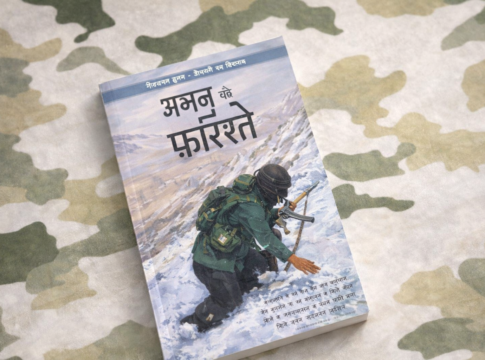
New Delhi: Aman Ke Farishtey (2026) by Brigadier Sushil Tanwar reaches an inquisitive point of conflict in the Indian literary production. On the one hand, there is a market inundated with what can be termed barrack-room realism, and it is the stories of valour penned by retired or serving military people that often border on memoir and fiction.
Conversely, Hindi literature still quietly points in the same direction, through an absence of any real account of insurgency in the Jammu region as compared to the much-publicised Kashmir Valley.
In his second novel, after the popular story collection Mukhbir, Tanwar seeks to fill this gap and, at the same time, offer a more personal reflection on trust, technology, and the very feel of counter-insurgency operations in the pre-digital age.
The novel’s premise is created through a purposeful narrative economy. Young Captain Ashish Chauhan, who is starting his first posting with Military Intelligence in the Surankote region of Poonch district has to operate within the field of operation, where his immediate predecessors had or had not managed to serve their country by the grace of their neighbours, not by the courtesy of satellites or the signal intelligence, but by the sheer currency of human relations.
The time frame is worth noting: about 20 years earlier, when cross-border militancy was at its climax and the technological machinery currently assumed to be in existence was mostly non-existent.
It is the historical framing that allows Tanwar to explore what now seems nearly outdated: the laborious nurturing of informants, the decoding of silences and movements, and the gradual building of trust that existed during those years of language, classes, and mutual suspicion.
The enigma of Aman Ke Farishtey, compared to the traditional military thrillers, is that the local people are denied the designation of a backdrop or background instrumental assistance.
The fact that this novel is dedicated to Abdul Hamid, a young resident of the area who was killed during his confrontation with militants, indicates an ethical commitment that the novel remains committed to in most parts.
In addition to Hamid, figures such as Abdul Qayyum, Rashid Master, and Ashraf Ghazi are not waiting to be under the protection of the security forces; they are active actors themselves, making their own decisions with moral and personal impact.
Prose in less refined but textured Hindi makes Tanwar succeed in projecting the common sense dignity of these characters without romanticising them. They are not portrayed as saints in the common use of the word, but as men who, when faced with impossible decisions in a zone of conflict, chose one way or another and lived or died by those decisions.
Such emphasis on the local dimension has an analytical connotation.
Based on historical evidence, Tanwar points out in the book’s introductory materials that the success of security forces in their operations in Jammu and Kashmir was made possible to a large extent by the people’s cooperation. However, this collaboration is rarely the subject of a prolonged literary investigation.
Focusing his story on the dynamics between Captain Ashish and his circle of informants, Tanwar provides a right to the stories that depict counter-insurgency as a matter of firepower and tactical prowess.
The novel implicitly suggests that intelligence work, in essence, is a kind of social labour, requiring patience, empathy, and the ability to see beyond the institutional viewpoint of the individual doing the work.
The author’s biography, of course, cannot be seen out of context with the text’s statements about its authenticity. Brigadier Tanwar has a long career in Jammu and Kashmir of about seventeen years; hence, he knows his job well.
This does not take the form of huge declarations of strategy or politics, but of the minute details of everyday life in a small town such as Surankote, of the rhythm of patrolling and intelligence-gathering, of the very types of weariness and elation which are attendant with this service.
The way the novel deals with the conflicts of Captain Ashish, his questions of the rightness of lying, his emotional involvement with his sources, and the process of their hardening, which the profession appears to demand, is indicative of an author who has reflected on the psychological aspects of this profession.
It is worth exploring the connection of the narrative to the genre. Aman Ke Farishtey falls into the genre of spy thriller, providing narrative satisfactions typical of the genre: suspense, danger, and the slow disclosure of threats.
At the same time, the text alludes to questions beyond the generic frames. The novel suggests reflecting on how non-combatants survive in the world of militancy, the types of agency ordinary people have in extraordinary situations, and the moral issues of intelligence activities.
These thematic concerns place the text in a position of interaction beyond strictly literary issues, opening a space for interdisciplinary debate.
The novel has a useful recuperative role on the geographical level. Militancy in the Jammu region, especially in places such as Poonch and Rajouri, has not been given a lot of literature and scholarly focus as compared to the Kashmir Valley.
The landscape Aman Ke Farishtey captures in focus is this forgotten landscape, revealing the activities of security agencies and the social life of people trapped between two or more forces.
The reading, therefore, offers a more comprehensive map of the conflict in the area, resisting the synecdochic tendency to allow the Valley to represent the whole.
The novel asks fruitful questions concerning the relationship between institutional position and narrative authority to academic readers.
Tanwar writes as an insider of the security forces; though he is subtle in his approach, he writes as one, within a range of parameters. The attackers are not well distinguished; their motivations are not studied, and their humanity is not examined.
The bigger picture of politics, the causes of militancy, the role of the state in the development of militancy, and the daily violence that is subjected to the civilian population are background rather than objects.
Such decisions are not signs of failure of imagination but points of generic commitment and institutional location, which manifest themselves in the novel and define the type of knowledge the text generates.
Aman Ke Farishtey turns out to be a self-sustaining success. It sheds light on an overlooked geography and history, reminding readers that the experience of conflict in the Jammu region deserves as much attention as the more written-about arenas.
It provides a subtle account of the human connections behind the intelligence work, connections that technological progress has made difficult to understand but not replace.
And it suggests, by the devotion which it shows towards Abdul Hamid, and by the concern which it takes over his fellow villagers, a silent but incessant reminder that the angels of peace in this tale are not only those in uniform.
This novel is a valuable resource for students of contemporary Indian literature, military history, or the politics of Jammu and Kashmir, a work that is informative whilst engaging.