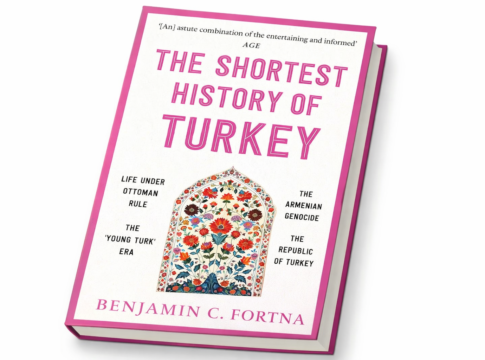
New Delhi: The issue of what defines a nation, especially one that is constructed out of the fragments of a large multi-ethnic empire, is never resolved so easily. Not only outsiders but, more urgently, the country’s citizens themselves pose this question, to which they often give quite different responses. The new book by Benjamin C. Fortna, a professor of history and director of the School of Middle Eastern and North African Studies at the University of Arizona, presents an excellent summary of this question, formulated with reference to the land and people of present-day Turkey.
The author of the previous learned work, Fortna, in his turn writes to what he calls the intelligent layman, and the result is a book which is at once easy and scholarly, and follows the winding and often painful path of a nomadic principality to the conflicting republic.
Published by Picador India, the book navigates the perilous waters of Turkish history without losing sight of its darker parts and still retains a clear eye on the nation’s long-held fascination.
The author’s main thesis is developed from the very first pages and is based on the apparently small yet very symbolic event: the recent directive by President Recep Tayyip Erdoğan, who wants the world to refer to the country as Türkiye.
Fortna cleverly unravels this instant not as diplomatic spleen but as an intense expression of a century of concern about the image of the nation, especially in the West, and how it connects with a vast, imagined global past. This demand for a name and the local appeal to the tradition of a thousand-year-old state are the antithesis of the ethos of the republic itself, which, under Mustafa Kemal Atatürk, had to be radically and emphatically discontinued in favour of the republic itself.
This inherent conflict of a Kemalist urge to forget the past and an Islamist-tilted urge to recover it, or even to create a more extended, more grandiose Turkic ancestry all the way back to the Huns, is the focal point around which all the events of the narrative spin. Fortna shows with great proficiency that this is not just a political issue between individuals but a deeply rooted cultural and existential clash over the very soul of the nation.
Among the most useful approaches used in this study is the insistence on viewing the Turkish Republic not as a clean slate but as the direct, if frequently disowned, descendant of the Ottoman Empire.
The book offers the much-needed base of understanding Ottoman history, reminding the reader that the empire, which officially was called the Sublime Ottoman State, was more than half a millennium a highly diverse place, housing Albanians, Greeks, Armenians, Kurds, Arabs, and hundreds of other ethnic groups long before the conquest of the Turkish ethnicity. Even its name is a European corruption of the founder’s name, Osman, indicative of the stratified, contrived identity in this part of the world.
The population structure of the empire, which in its former area extended from Austria to Ukraine and across the Arab world, became an inconvenient truth for the nation-state that took its place, and Fortna skilfully demonstrates this.
The homogenisation project of the republic, its effort to forge a nation in a territory lacking demographic distinction, is thus presented as direct and, in some ways, traumatic, in response to the empire’s demise and the demand to hold together in the face of external aggression and internal heterogeneity.
The story has never evaded facing the most agonising part of this history, especially the destiny of the Armenians. The subject of the Armenian Genocide is addressed with the prudent and professional seriousness it deserves, but without employing polemic to make the statement of historical facts understandable.
Fortna makes the wartime censorship of news concerning the destiny of the people of Anatolia Armenians, linked to the later decades-long inability of the republic to reconcile with this underlying violence. He explains that the past, however strong the attempts to hide it, is always inclined to resurrect.
The case of the memoir My Grandmother by Fethiye Çetin, which brought to light the case of an Armenian genocide survivor brought up as a Turk, is used as a potent example of this repressed coming out. In the same vein, the revelation of an Armenian-inscribed fountain in the grounds of the presidential palace in Ankara in 2007 produced a powerful icon of the hidden, overlapping histories that are literally right under the skin of the modern, homogenised state. These are not presented as separate occurrences, but rather as much-needed testaments to a tricky history that is definitely not buried but still lingers in the present.
In addition to the problem of ethnic cleansing and historical amnesia, the book is a thorough discussion of the political and ideological oscillation that has dominated the modern history of Turkey.
Fortna follows the line of the Kemalist republic and points at its inherent contradictions: it was simultaneously modernising and repressive, anti-religious and reliant on a specific notion of Turkishness that was implicitly Islamic and both Westernising and highly suspicious about the West. The military, this “guardian state” whose military was dedicated to securing a frequently undefined secularism, was unable to perpetuate its leadership after 1950 when true democratic contestation was introduced.
This analogy of the military as the physician of the sick child of secularism, which General Çevik Bir uses as a memorable metaphor, best summarises the paternalism and ultimately unsustainable nature of this Kemalist paternalism. The military interventions, which become regular about once every decade, are depicted as totally incompatible with democratic practice and have created a political vacuum that was nearly vacated by a populist, right-of-centre party with its roots in the Islamist movement of the country.
The second part of the book discusses the period of the Justice and Development Party (JDP) and the long rule of Erdoğan, and attempts to bring historical analysis to the most recent events, including the disastrous February 2023 earthquake and the ensuing elections.
Fortna is reasonable and thoughtful in his approach. Though he does not shrink from pointing out the mistakes that the JDP later made, especially in its handling of the earthquake, which was a terrible response to the speech of the celebratory centennial, and which cast considerable doubt on the issue of cronyism as well as expertise.
The fact that the JDP, despite its enormous benefits in media coverage and a large electoral base, ended up losing in polls and having to engage in a historic run-off election, hints at the weakening of its previously unconquerable aura.
The author suggests that the same historical processes that dissolved the Kemalists will, in turn, necessitate entering the realm of democratic processes rather than attempting to impose top-down visions of it, and that this will also intervene in the Islamists. Whether Turkish rulers can absorb the richness and promise of history is a question that, Fortna concludes, remains highly debatable.
Ultimately, this brief history accomplishes something very impressive. It offers a logical and convincing storyline that links the Ottomans’ nomadic roots to the modern political situation in Erdoğan’s Turkey, and does so with a subtle understanding of the complexity and disputes characteristic of this history.
The book is especially good at evoking memory and forgetting, between the modern state’s wish for a clean, unitary identity and the tenacity of a stratified, many-faced past. Fortna bears the tone of a scholar who is well aware of the material he is writing about but has managed to make it comprehensible to a wider audience without resorting to scholarly jargon or insincere polemic.
His fascination with Turkey and its people is clear throughout, but it is also mixed with a clear understanding of the country’s failure to face its own past. This book is a valuable, highly readable reference for anyone who wishes to understand the historical undercurrents that have driven modern Turkey and may still be shaping its politics and society.
It is a piece that should be read by a broad audience, not only by those interested in Turkey and Middle Eastern affairs, but by everyone who is thinking about the troubled relationships amid history, nationhood, and the elusive prospect of a democratic future.