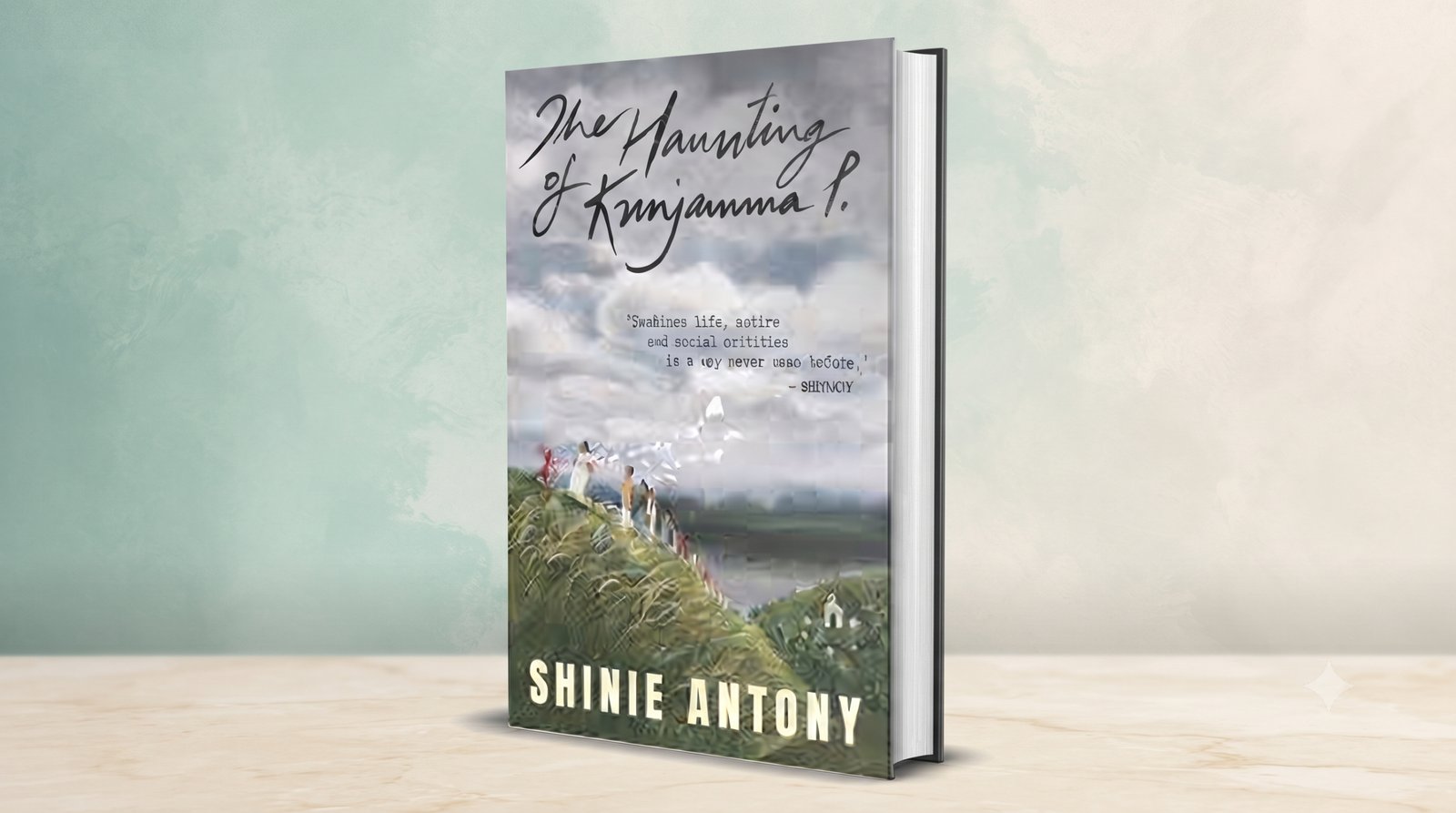

New Delhi: The premise is so simple, and so absurd, that it is a wonder nobody thought of it sooner. A god-fearing woman in Kerala, devout to the point of exasperation, finds herself inhabited by a devil who has literary ambitions and a memoir to finish.
She, being a woman of unshakeable faith, interprets the entire arrangement as a divine commission and concludes that she has been chosen to write the Fifth Gospel.
Shinie Antony’s new novel, The Haunting of Kunjamma P., published by Hachette India, takes this premise and does not so much develop it as detonate it, producing a satire that manages to take on God, sex, sin, salvation, small-town gossip, and Malayali masculinity in the same breath.
Antony is not a writer given to restraint, and her reputation precedes her. Her previous novella, Eden Abandoned, won the Laadli Fiction Award, with the jury acknowledging her willingness to use fiction as a tool for social commentary and reclamation. That same willingness is on full display here, though the register has shifted from the mythic to the farcical.
The novel is set in a Kerala that will be immediately recognisable to anyone who has spent time in its towns and villages, a place where the church is both a spiritual centre and a social sorting mechanism, where piety is performed as much as it is felt, and where everyone knows everyone else’s business before they know it themselves.
Kunjamma P., the novel’s protagonist, is a creation of considerable comic precision. She is not a hypocrite, which is what makes her so funny. She genuinely believes.
She sweeps the church courtyard, she observes her fasts, she tends to a household that does not appreciate her, and she does so with the grim satisfaction of a woman who has decided that suffering is a form of devotion. When the devil moves into her body, her response is not horror but interpretation.
She reads the intrusion as a calling, and begins to compose what she believes is sacred text. The gap between what is actually happening to her and what she thinks is happening to her is the engine that drives the novel, and Antony exploits it ruthlessly.
The supporting cast is drawn with the kind of broad, unsparing strokes that suggest a writer thoroughly enjoying herself. There is a husband who is useless in a way that feels almost structural, a mother-in-law whose longevity seems to defy not just biology but theology, a daughter whose transgressions are catalogued with a kind of horrified relish, and a local clergy that responds to the unfolding chaos with the bewildered inefficiency of men who have never had to deal with anything genuinely supernatural.
Each of these figures is familiar, even archetypal, but Antony animates them with enough specificity that they never feel like mere caricatures. They are the kinds of people one actually meets, exaggerated just enough to be funny and not so much that they become cartoons.
What makes the novel work, beyond its premise and its cast, is Antony’s prose. She writes with a kind of rollicking energy, packing her sentences with puns and wordplay that could easily become exhausting but here feels like part of the novel’s essential texture.
She is not a writer who trusts silence or understatement. She goes for the joke, and more often than not, the joke lands. This is a style that will divide readers, and there will be those who find the relentlessness of the humour wearing. But for those who appreciate satire that is willing to be genuinely irreverent, to risk offence rather than settle for mild observation, Antony’s approach is bracing.
The novel’s treatment of religion is where it is most likely to provoke, and also where it is most interesting. Antony is not writing a polemic. She is not interested in dismantling faith, and the novel does not read as an attack on belief.
What it targets, rather, is the way belief gets entangled with social performance, with hierarchy, with the small cruelties that people justify in the name of piety.
Kunjamma’s tragedy, if it can be called that, is not that she believes, but that her belief has made her useful to everyone around her and fulfilled for no one, least of all herself. The devil, when he arrives, is almost a liberating figure, though the novel is too clever to push that reading too far.
There is also a distinctly regional texture to the comedy that is worth noting. Antony writes Kerala with an insider’s familiarity, and the novel’s humour is frequently rooted in the particularities of that place: its religious pluralism, its gender dynamics, its relationship with its own modernity.
Readers from outside the region will still find plenty to enjoy, but there is an extra layer of recognition available to those who know the terrain. The novel is not parochial, but it is rooted, and that rootedness gives it a specificity that distinguishes it from the more generic satire that tends to dominate the market.
At a little over two hundred pages, the book is compact and fast-moving, and it does not overstay its welcome. Antony has written a novel that is funny, sharp, and willing to take risks that more cautious writers would avoid.
It will not appeal to every reader, and there will be those who find its treatment of religious themes uncomfortable. But discomfort is part of the point. The Haunting of Kunjamma P. is a devilishly entertaining book, and one that suggests Antony is a writer worth taking seriously even when she is making you laugh.