
New Delhi: Grief is a strange companion. It sits quietly in the background, shaping the way a person moves through the world, until a moment arrives when it can no longer be ignored.
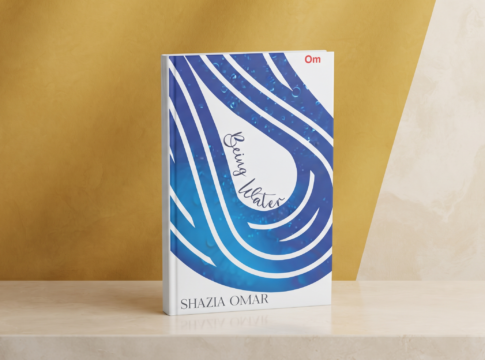
Shazia Omar’s third novel, Being Water, published by Om Books International, is an exploration of precisely that kind of lingering, unquiet grief and the long, often ugly process of learning to breathe around it.
Omar, a yoga teacher of more than twenty-five years and the founder of a wellness retreat platform, brings to the novel an awareness of the body as a site where trauma accumulates and, occasionally, begins to dissolve.
This is not a book that treats healing as a clean, linear ascent. As Omar herself put it at the novel’s launch, healing “isn’t gentle. It breaks you before it remakes you”.
The novel follows Nora, a twenty-nine-year-old corporate litigation lawyer in London, who is suffocating under the weight of fourteen-hour billable workdays and a grief she has spent years refusing to name.
On the advice of her therapist, she embarks on a month-long retreat in a secluded villa near Galle Fort in Sri Lanka, a place framed by bougainvillaea and colonial ramparts, where she hopes to find stillness and escape from herself.
Her plans to travel with her lifelong friend Beth are derailed when Beth becomes pregnant, and in her place arrives Mel, Beth’s twenty-one-year-old American cousin, whose relentless optimism and eagerness to fill her first passport stand in stark contrast to Nora’s guarded cynicism.
What follows is not a conventional story of recovery. Nora does not arrive in Sri Lanka and discover a tropical cure. The island is, for her, a “Ghost Land,” where buried family secrets wait to be exhumed, and where the Ramayana runs beneath the narrative as a recurring motif of captivity, waiting, and release.
Sita’s imprisonment in Lanka becomes a quiet parallel to Nora’s own sense of being held captive, not by chains, but by the weight of what she has refused to confront.
Omar’s decision to let Nora’s narration begin in short, bitter sentences is a deliberate one, and it makes the early chapters difficult to inhabit. The prose is claustrophobic, filtered through a voice that despises its own cruelty and yet cannot stop inflicting it on the people around her.
Nora has built what the author describes as a “fortress built on self-loathing,” using work and alcohol to numb a wound that traces back to a family tragedy that fractured her home and left her parents’ marriage in ruins.
It is only as the novel progresses that the tone begins to thaw. The shift is subtle at first, then unmistakable. Sri Lanka works on Nora in ways she does not notice.
She takes surfing lessons from a local instructor named Fish, and in the repeated act of tumbling through waves, of being pushed under and coming up for air, something begins to loosen.
An Ayurvedic practitioner diagnoses her as “fire” and tells her she needs more water, more forgiveness. The metaphor is not subtle, but it is earned.
The supporting cast matters here. Parker, an Australian medical practitioner working with refugees, carries his own trauma from serving in Sri Lanka during the final phases of the civil war. He does not flinch at Nora’s pain, and his steady, unjudging presence becomes a counterweight to her instinct to push everyone away.
Mel, meanwhile, turns out not to be the naive child Nora assumes her to be. She is hopeful rather than ignorant, and her softness is a form of strength that Nora cannot easily dismiss.
What makes Being Water effective is its refusal to sentimentalise the process it depicts. The healing is not clean. Nora’s defences do not disappear; they loosen. There is a moment, described with real precision, where a tight “clamp” under her breastbone releases, and she experiences a fleeting peace that is all the more credible for being so small.
Omar’s background in yoga and somatic practice informs passages like these, where the psychological and the physical are inseparable.
The novel’s engagement with the Ramayana adds a layer of mythic resonance that keeps it from becoming merely a contemporary story of burnout and recovery.
Galle itself, with its layered history of empire, trade, and migration, becomes a character in the book, a place where the past is always present and where escape from oneself, as Nora discovers, is the one journey nobody completes.
Being Water will appeal to readers who appreciate fiction that trusts its audience to sit with discomfort. It is not a fast read, and Nora is not immediately likeable, but that is rather the point.
Omar has written a novel that understands how grief hardens people, how it makes them cruel, and how the process of softening is neither quick nor guaranteed.
For anyone who has carried loss for longer than they care to admit, this book offers something rare: an honest account of what it costs to begin again.