New Delhi: There is a particular kind of forgetting that happens to women’s writing. It is not always deliberate erasure, though sometimes it is. More often, it is a quiet slippage: the handwritten memoir tucked into a trunk, the privately printed booklet shared among relatives, the story told and retold until it becomes a family legend rather than a historical record.
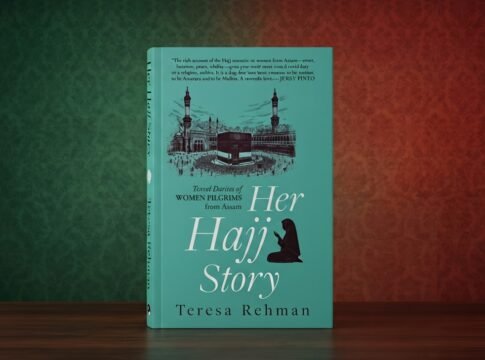
Teresa Rehman’s new book, Her Hajj Story: Travel Diaries of Women Pilgrims from Assam, published by Speaking Tiger Books, is an act of recovery against that forgetting.
Rehman, an award-winning journalist who founded and edits Thumbprint Northeast magazine, has spent years documenting the lives of women in India’s Northeast. Her previous books include The Mothers of Manipur and Bulletproof. But Her Hajj Story represents something different: a literary excavation. The book brings together the Hajj memoirs of eleven Assamese Muslim women, translated from Assamese and Bengali, and frames them with historical context and oral histories gathered from families and acquaintances.
The tradition Rehman uncovers is remarkable. In Assam and Meghalaya, Muslim women have long written accounts of their pilgrimage to Mecca, known as Hajj yatras or Hajj kathas. These were not published for a mass audience.
Most were written in longhand, typeset manually, and printed for private circulation among family and friends. They were heirlooms as much as books. And over time, many simply disappeared.
Rehman’s search for these memoirs is itself a story worth telling. She describes raiding homes in old Muslim neighbourhoods, scavenging through forgotten trunks and dusty cupboards, begging and borrowing and almost stealing whatever she could find. Most families had only a single copy; they reluctantly parted with photocopies. The result is a collection that feels genuinely rescued rather than merely assembled.
What emerges from these eleven narratives is a portrait of pilgrimage that is far more textured than the ritualistic account one might expect. These women were widows and actors, botanists and poets, social workers and scholars. One completes the Hajj after her husband dies and is buried in Medina. Another struggles to find a mahram, the male family member required as a companion for the journey. A poet stands on the deck of a ship, watching the moonlit Red Sea. A botanist searches for a deeper fragrance of faith beyond the mechanics of ritual.
The memoirs are practical as much as they are spiritual. The women write about the unbearable desert heat, the fear of losing oneself in the overwhelming crowds, the lack of adequate toilets, the challenges of food and hygiene.
They discuss menstruation during the pilgrimage, a topic that religious narratives typically avoid, revealing how women navigate the tension between bodily reality and spiritual obligation. These are not sanitised accounts. They are documents of endurance.
Rehman’s curation does more than preserve individual stories. It reveals a literary tradition that has been overlooked precisely because it was practised by women, in their mother tongues, for private audiences. The memoirs were never intended for the public sphere, and that is partly why they have been so easily forgotten. But their very privacy gave the women a freedom to write honestly, to discuss taboos, and to create what one scholar describes as a “sisterhood” of shared experience.
The book also raises uncomfortable questions about whose stories are deemed worth preserving. Rehman notes that a memoir written by a woman in the 1970s had not been taken seriously enough to be preserved, despite the author having spent most of her life in service to others. The implication is clear: women’s religious writing has been treated as domestic ephemera rather than historical testimony.
Her Hajj Story arrives at a moment when Muslim women’s voices are frequently discussed but rarely centred. Rehman’s approach is not polemical. She does not impose a feminist reading on the memoirs, nor does she treat them as sociological data.
She simply lets the women speak, and the cumulative effect is quietly powerful. These are journeys of faith, certainly, but they are also journeys of self-encounter, undertaken by women who wrote because they had something to say and no platform to say it on.
For readers interested in the literature of pilgrimage, in Muslim women’s life writing, or in the cultural history of Assam, this book is an essential contribution. It reminds us that history is not only recorded in official archives. Sometimes it is recorded in photocopied booklets, passed from hand to hand, waiting for someone to notice. Rehman noticed.