New Delhi: Behind every voice that commands a concert hall, there is often someone who spent years in the wings, waiting, believing, and showing up.
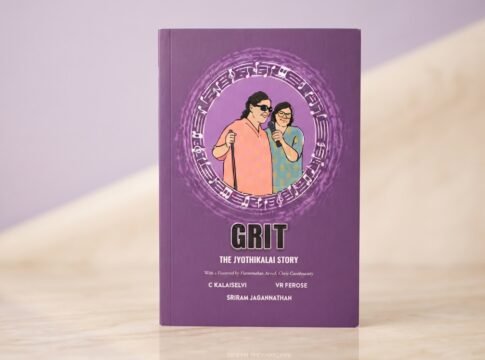
In the case of National Award-winning playback singer Jyothi Kalaiselvi, that someone is her mother. The story of that quiet, relentless devotion is now the subject of a new graphic memoir, GRIT: The JyothiKalai Story: A Graphic Memoir of Disability and a Mother’s Unshakeable Belief, published by Hachette India and authored by C. Kalaiselvi, V.R. Ferose, and Sriram Jagannathan.
The book, the third in the GRIT series from Hachette India, arrives at a moment when India is engaged in an increasingly urgent conversation about inclusion, disability rights, and the invisible labour of caregiving.
This conversation often celebrates the person who overcomes, while leaving the person who made the overcoming possible in the shadows.
This is the story of Jyothi, born visually impaired and later diagnosed with autism, who found her way into music and, eventually, onto a national stage.
She is today a National Award recipient honoured by the President of India and a playback singer whose voice was recognised by the composer G.V. Prakash. Those are the facts that make headlines. What the book chooses to foreground is something else entirely: the decision of her mother, Kalai, to build a future around belief at a time when circumstances offered little reason for it.
The authors are a study in complementary strengths. C. Kalaiselvi is Jyothi’s mother, a Chennai-based woman who has spent over twenty-five years raising, teaching, and empowering her daughter, turning what the publisher describes as “seemingly impossible challenges into a story of hope, resilience, and achievement”.
V.R. Ferose is the founder of the India Inclusion Foundation, a Bengaluru-based nonprofit dedicated to bringing inclusion to the forefront across Indian sectors, and the author of several books on disability, including The Invisible Majority: India’s Abled Disabled and Gifted: Inspiring Stories of People with Disabilities.
Sriram Jagannathan is a Chennai-based creative director, illustrator, and designer with twenty-five years of experience across branding, storytelling, and graphic novels, and the artist behind the earlier GRIT instalments.
That combination matters. Ferose brings the institutional and conceptual framework of the inclusion movement; Kalaiselvi brings the lived, unglamorous reality of caregiving; and Jagannathan brings the visual language to make both legible.
The result, according to the publisher’s description, is an “evocative graphic memoir of caregiving and the transformative power of belief” that traces Jyothi’s journey from a childhood defined by limitation to a life defined by music.
What distinguishes this book from a conventional inspirational biography is its deliberate choice of protagonist. The GRIT series, which began in 2019 with The Major Story: the account of Major D.P. Singh, India’s first blade runner and continued with The Vishwas Story in 2022, has consistently turned to graphic form to tell stories of disability.
In those earlier volumes, the focus was on the individual whose grit carried them through. Here, the frame shifts. The title itself, The JyothiKalai Story, announces the book’s central proposition: that this is a story with two names, because the achievement belongs to two people.
The press note accompanying the book makes the point explicitly, observing that it “puts a mother’s patience and perseverance at the centre of the frame, in a genre that usually celebrates the star alone.”
It is a true story, the note continues, “about the overlooked labour of caregiving, and what it takes to raise a gifted child in the face of doubt.” In a country where disability support systems remain patchy, and families bear the bulk of the burden, this is not a niche concern but a widespread, under-acknowledged reality.
The graphic memoir format is well-suited to the material. At 152 pages, the book is substantial enough to give the narrative room to breathe, while the visual storytelling allows for the kind of emotional register that prose sometimes struggles to achieve: the exhaustion of a parent, the small victories of a child learning to navigate a world not built for her, the cumulative weight of years of showing up.
The earlier GRIT books were praised for their ability to merge words and illustrations smoothly, and Jagannathan’s work here continues that tradition.
The book’s publication arrives at a time when the language of inclusion has become commonplace in policy documents and corporate statements, even as the practical realities of caregiving remain largely invisible.
GRIT: The JyothiKalai Story does not pretend to solve that problem. What it does is something more modest but perhaps more necessary: it insists on the dignity of the unseen work, and on the idea that behind every celebrated voice there is often another person whose belief was the precondition for everything that followed.
For parents, caregivers, and anyone who has ever kept faith with someone who could not yet see the road ahead, this book is likely to resonate.
It is not a manual, nor a policy document, nor a triumphalist account of overcoming adversity. It is, instead, a portrait of persistence, of the kind of love that does not announce itself, and the kind of grit that is measured not in medals but in mornings.
The book is available in paperback and ebook formats, priced at INR 499