

New Delhi: Why does a black cat signify misfortune in one culture and good fortune in another? What is it about the humble owl that makes it a symbol of wisdom in some traditions and a harbinger of death in others?
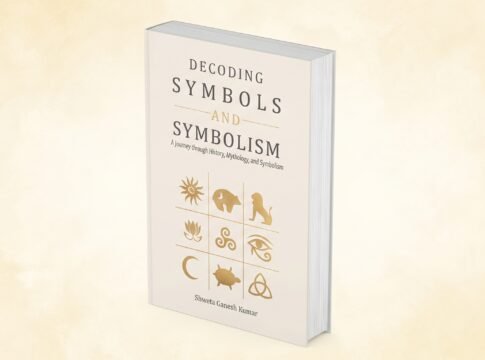
Shweta Ganesh Kumar’s new book, Decoding Symbols and Symbolism: A journey spanning history, mythology, and geography, published by Hachette India, takes up these questions with the curiosity of a storyteller and the rigour of a researcher. The result is a work that is less an encyclopaedia of signs and more an invitation to look at the world differently.
Shweta is well placed to write this book. An award-winning blogger who received the UNFPA-Laadli Media Award for Gender Sensitivity in 2017, she has written fiction for both adults and children, with her children’s books translated into more than eighteen languages and featured at the New York Public Library’s World Literature Festival.
She currently hosts a podcast where she retells Indian myths for modern audiences, and in her day job she works as a senior developmental editor at Forbes Books. This range of experience, myth, children’s storytelling, developmental editing, shapes the book’s approach, which is accessible without being simplistic and engaging without being superficial.
The central premise of Decoding Symbols and Symbolism is disarmingly simple: we are surrounded by symbols whose meanings we have absorbed without ever questioning where those meanings came from.
As the publisher’s note puts it, “An image becomes a symbol when you follow the invitation to look beyond the mere visual and comprehend the meaning it stands for. Yet they don’t presume to tell you what they mean but ask you instead to interpret what they stand for”.
Shweta takes this a step further, tracing not just what symbols mean today but how those meanings came to be, and why they diverge so dramatically across cultures and geographies.
The book is structured into three sections. The first, Animal Kingdom, examines the creatures that populate our myths and metaphors: from cats and owls to snakes and peacocks and the wildly divergent associations they carry.
The second, Symbols from Nature, turns to the elements, plants and celestial bodies that have been invested with meaning across civilisations.
The third, Abstract Symbols, tackles the signs and gestures we encounter in daily life, from the red thread tied on a wrist to the numbers we consider lucky or cursed.
Each chapter promises to trace historical origins, examine associated myths, and unpack the cultural detours that have shaped a symbol’s meaning over centuries.
What distinguishes this approach from a conventional reference work is its narrative quality. Shweta’s background as a writer of fiction and a reteller of myths is evident in her willingness to follow a symbol’s story wherever it leads, rather than simply cataloguing meanings.
The book turns what could have been a dry exercise in comparative symbology into something closer to a collection of detective stories, each one tracking a sign or an image through the labyrinth of human history and arriving at an explanation that is as much about culture as it is about the symbol itself.
The publisher’s description emphasises that the book is designed to turn ordinary encounters with symbols into moments of reflection. A temple carving, a wedding ritual, or a tattoo choice becomes, in Shweta’s hands, a story worth telling. This is a useful corrective to the way many of us move through the world, absorbing visual and cultural cues without pausing to consider their provenance.
The black cat that crosses our path, the owl that hoots at night, the red thread tied around a wrist: these are not random occurrences but artefacts of centuries of belief, migration, and cultural exchange.
The book’s appeal lies in its breadth. Shweta does not confine herself to a single tradition or a single region. She draws on Indian and Western sources, but also on the myths and folk traditions of other cultures, acknowledging that symbols rarely stay put. They travel, they mutate, and they acquire new meanings as they move between communities.
The same image that signals danger in one place may signal protection in another, and understanding why requires attention to history, geography, and the stories people have told themselves for generations.
For readers in India, the book offers a particularly rewarding experience, since so many of the symbols Shweta examines carry meanings that are simultaneously familiar and foreign.
We know the red thread, the owl, the black cat, but do we know why we respond to them the way we do? Decoding Symbols and Symbolism suggests that the answer is rarely straightforward, and that the search for it is its own reward.
At 352 pages, the book is substantial without being daunting, and its structure makes it easy to dip into or read from cover to cover. It will appeal to readers interested in mythology, cultural history, semiotics, and the ways in which meaning is made and transmitted.
In a moment when so much of our symbolic vocabulary has been flattened by the speed of digital communication, Shweta’s book is a welcome reminder that symbols carry the weight of centuries, and that understanding them is a way of understanding ourselves.