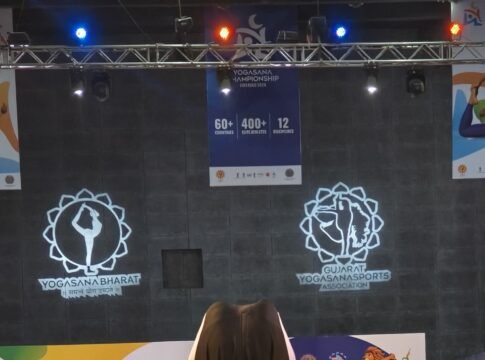
Ahmedabad: The participation of athletes, coaches and officials from several Muslim-majority countries at the inaugural World Yogasana Championship in Ahmedabad is challenging long-held assumptions about yoga’s acceptance in parts of the Islamic world.
Bringing together more than 500 athletes from 78 countries, the championship has emerged as a platform not only for sporting competition but also for cultural exchange, highlighting how yoga is increasingly being embraced as a discipline focused on health, fitness and athletic excellence rather than religious identity. Over the last decade, Yogasana has steadily expanded its footprint across the Middle East, Africa and other Muslim-majority regions. Wellness centres, schools, sports clubs and community organisations have introduced yoga programmes, while the emergence of competitive Yogasana has opened a new avenue for young athletes looking to pursue the discipline as a sport.
Salha Hakeem, President of Oman Yogasana Association, who said yoga’s acceptance in Oman has grown significantly as people become more aware of its physical and mental health benefits.
She said despite facing backlash initially by the society, in her school named as ‘Positive Energy’ she trains students and now the acceptance is more. We doing it as exercise on routine basis. It is approved support yet by the government,” she said.
“Many people initially associated yoga only with stretching or relaxation, but that perception is changing. Families, students and working professionals are discovering that Yogasana helps improve flexibility, concentration, mental well-being and overall fitness. Once people experience these benefits themselves, many misconceptions disappear naturally,” Hakeem said.
She said the emergence of competitive Yogasana has generated fresh interest among young athletes. We are holding twice classes in a week.
“Young people are increasingly attracted to Yogasana because it combines discipline, strength, flexibility and competitive spirit. They see it not just as an exercise but as a sport where they can represent their country, compete internationally and achieve excellence. Championships like this give athletes confidence that they are part of a growing global movement,” she said.
The championship has also attracted participants from Africa, including Mohammad Awal Gamboo Abubakar of Nigeria, who is currently studying at Mewar University in Rajasthan, where he has been learning yoga and Yogasana. Abubakar said his journey into yoga began after arriving in India for higher studies.
“Before coming to India, I knew yoga existed but I did not fully understand its depth or its benefits. Living and studying here gave me the opportunity to learn from experienced teachers and practitioners. Over time I realised that yoga is not just about physical postures; it also helps improve concentration, discipline and overall well-being,” he said.
Participating in the World Yogasana Championship, he said, has been a transformative experience.
“Competing alongside athletes from different countries has opened my eyes to the global nature of this sport. I have learned new techniques, observed different styles of training and built friendships with athletes from across the world. This kind of exposure is extremely valuable for young athletes because it motivates us to work harder and improve,” Abubakar said.
He believes yoga has strong potential to grow in African countries if awareness is increased.
“People everywhere are looking for ways to stay healthy and manage stress. Yogasana offers both physical and mental benefits. If more awareness programmes and training opportunities are created, many young people in Nigeria and other African countries will be interested in learning and practising it,” he said.
Deputy Competition Manager from Bahrain, Yousuf Jarrah Al Dosari, said that countries across the world are making their best efforts to promote and strengthen Yogasana as a competitive sport.
He said the growing participation in international championships reflects the dedication of athletes, coaches and national federations towards the sport.
Al Dosari said sustained efforts are being made to expand Yogasana’s reach, improve training standards and encourage greater youth participation, expressing confidence that the discipline will continue to grow globally in the coming years. “People are becoming more conscious about preventive healthcare, mental wellness and physical fitness. Yoga fits naturally into that conversation. We have organised workshops, demonstrations and training sessions to introduce Yogasana to new audiences, and the response has been very encouraging,” he said.
He further said that exposure to world-class events accelerates learning and motivates athletes to take their training more seriously.
Lucky Rehman, a participant from Bangladesh, said she has been practicing Yogasana for the past seven to eight years and that the discipline has become an integral part of her daily life.
She credited her family for being a constant source of encouragement throughout her journey, saying their positive support motivated her to pursue Yogasana at a competitive level.
Lucky said the event has provided a valuable platform to interact with athletes from different countries and learn from their experiences.
“International championships not only test athletes’ skills and discipline but also promote friendship, cultural exchange and mutual understanding among participants from diverse backgrounds. I hope the growing popularity of Yogasana will encourage more young people in Bangladesh to take up the sport and embrace a healthy lifestyle,” she added.
Yogasana Bharat President and World Yogasana Vice-President Udit Sheth said the sport’s growing acceptance across diverse regions demonstrates that yoga has evolved into a universal platform for health and athletic development. “One of our biggest advantages is that yoga is already present in almost every country. We are not starting from zero. What we are doing now is adding the sporting ecosystem on top of that foundation by training athletes, coaches, judges and technical officials,” Sheth said.
He said the federation is working through Indian missions abroad, cultural institutions and international sporting networks to expand Yogasana’s reach to 150 countries in the coming years. “We are seeing encouraging participation from countries that began training only recently. Some teams have been practising competitive Yogasana for just a few months, but their progress has been remarkable,” he said.
“Yogasana is a great diplomatic tool. Through events like this, countries come together, athletes learn from each other and new partnerships are formed. It allows India to share a part of its heritage while creating a global sporting community,” he said.
According to Sheth, the championship has shown that interest in Yogasana is no longer confined to traditional centres of yoga. “The response from different parts of the world, including the Middle East and Africa, shows that people are embracing the sport because of its benefits, discipline and competitive opportunities. That is a very positive sign for the future of Yogasana,” he said.
Dr Jaideep Arya, Secretary General of World Yogasana, said the championship reflects how the sport has moved beyond geographical and cultural boundaries, attracting participants from regions that were once considered unlikely centres for yoga.
“Today, athletes from different faiths, cultures and nationalities are competing on the same platform. That itself shows that Yogasana is being accepted as a global sport. The focus is on health, discipline, performance and human excellence,” Arya said.
According to Arya, one of the federation’s priorities has been to ensure that Yogasana is accessible to people from diverse backgrounds by developing standardised rules, coaching systems and judging mechanisms that can be adopted internationally.
“When athletes from Oman, Bahrain, Nigeria or other countries come here and compete alongside athletes from India, Japan or Argentina, they become ambassadors for the sport in their own countries. They return home with knowledge, experience and confidence, which helps create new ecosystems for Yogasana,” he said.
Arya noted that the growing participation from the Middle East and Africa demonstrates that young people are increasingly viewing Yogasana through the lens of sport and wellness. “The younger generation is looking for activities that improve physical fitness, mental resilience and overall well-being. Yogasana offers all of that. Once people understand its benefits, acceptance comes naturally,” he said.
He added that international competitions play a crucial role in breaking stereotypes and fostering cultural understanding. “Sport has always been a bridge between societies. When athletes train, compete and interact together, they realise they have more in common than differences. Yogasana is creating those connections across the world,” Arya assed.