https://www.youtube.com/watch?v=9zahTYlmEdQ&t=2s
Hello and welcome to Roportage. This is Danish bin Nabi. In today’s episode, I have with me Rasheed Kidwai to talk about his new book DK Shivakumar, which is published by Hay House Publications. More from the author.
Mr. Kidwai, I just want to understand… first, my question, which I need to understand, is: why have you written a book on Shivakumar? Why not some other leader of Congress?
Thank you. Thank you. And it’s actually a privilege and honor to be with you—somebody who’s not only an avid book reader, but who is a very good book lover and you have such a good understanding of contemporary politics, history, literature, and so many things. So many compliments to you. Thank you.
You know, in the Indian political system, many living people are not written about. We have a lot of books about people who are no longer there—about Jawaharlal Nehru, about Savarkar, about Deendayal Upadhyaya, about many people. And many people write some kind of hagiographical account about certain political leaders, but that does not have that kind of academic rigor or the kind of, even I would say, journalistic scrutiny that is required for writing this book.
My purpose is to write about living politicians, practicing politicians who are stakeholders in society and who impact our life.
So, like when we go to buy any consumer durable—we go to buy a washing machine, we go to buy a fridge or a TV or any other product—we do a lot of evaluation, we do a lot of market research. We see whether it’s a front-loading machine or a top-loading machine, what is the kind of power consumed. But when it comes to voting, we just get swayed by caste, or sometimes religion, and sometimes region.
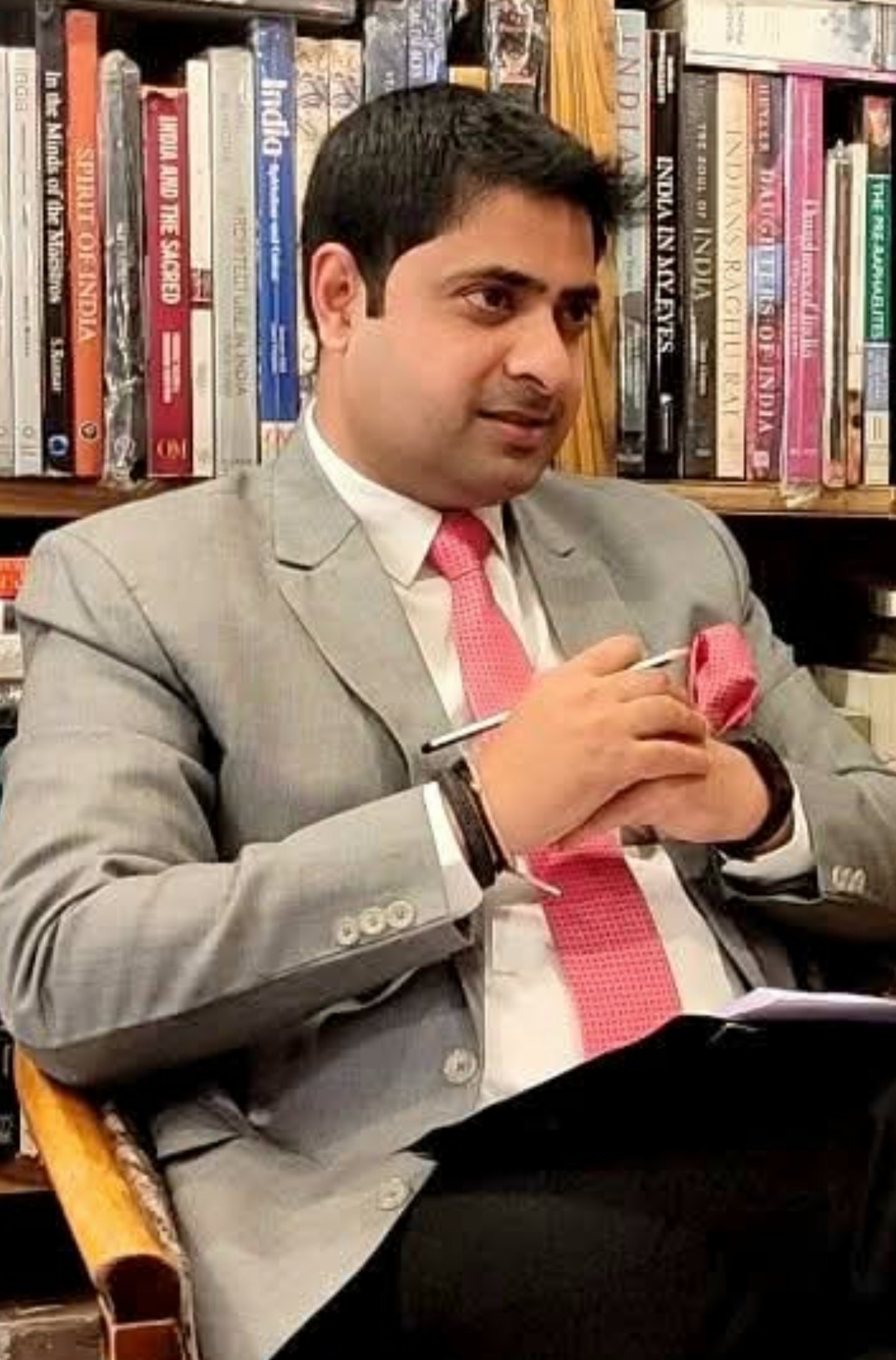
So I feel that in a healthy democracy like Indian democracy, voters should have an informed choice. So that is the idea. And books are not written for the politician; they are written for the readers. It may be about politicians—you can see in my backdrop, it has a lot of books I have written on Indian politics and politicians—but it is not about them. It is about the general reader, the common citizen, so that they have an informed choice.
So when I looked around and I wanted someone who has a present and a future also, I had actually drawn a list of 10 leaders—and one day I will share that also when my second or third book comes. As it happened, while I was working on this book, a political transformation took place and he became, from deputy chief minister, he became chief minister. So it was more of a coincidence.
Therefore, since the book came out in a bit of a hurry, I feel as an author that it has certain shortcomings as well. Perhaps a more critical evaluation should have been done. But my idea is to bring public figures before our readers so that they get to know their plus points, their life history, orientation, their ideology, and judge for themselves.
Daanish Bin Nabi: Sir, before we come to 2023—which is an important year for Shivakumar—let’s move back a bit to 2017. You have written in the book about 2017 when Ahmed Patel was to be nominated as a Rajya Sabha member. Was it at that time that Shivakumar got very close to Sonia Gandhi?
Rasheed Kidwai: Yes, I think 2017 was a very important year in the life of DK Shivakumar because he got into the national limelight due to that election you are referring to: Ahmed Patel’s Rajya Sabha election.
On the one side was what we call the Chanakya of Indian politics, Amit Shah. He wanted Ahmed Patel—who was a Congress strategist and political secretary to Sonia Gandhi—defeated. There were a lot of moves and counter-moves, like in a game of chess (shah-mat). MLAs’ political loyalties were bought and sold, and all kinds of drama ensued.
That is where Shivakumar acted as a trusted lieutenant and saved the situation. So he became close to Ahmed Bhai, Sonia Gandhi, and others. The country came to know much more about him than what was already known, realizing that the Congress also has a leader who is very astute. In that sense, Ahmed Patel’s election in 2017 was a very important milestone. His equation with the Congress leadership was already very good, but very few people knew about it until they suddenly realized who DK Shivakumar was, creating a lot of curiosity.
Daanish Bin Nabi: So in 2019, when he was in Tihar, Sonia Gandhi goes and meets him in Tihar Jail, right? Talk a bit about that episode. That’s an interesting anecdote in his life.
Rasheed Kidwai: Well, that was of course a very interesting occurrence. As we know, in India many politicians face legal scrutiny and sometimes have to go to jail. The Congress—and particularly Sonia Gandhi—traditionally had a very pious hands-off policy: if somebody becomes “tainted” or goes to jail, they might extend some legal help or support behind the scenes, but keep their distance publicly.
In the case of DK Shivakumar, Sonia Gandhi did the unthinkable. She made it a point to make a very visible, very pronounced gesture by visiting him in Tihar Jail to inquire about his personal and physical well-being. It was a gesture that was deeply political in nature, showing that DK Shivakumar is a very special and important person to the party.
In Congress history, several people have faced legal challenges—even high-profile leaders like P. Chidambaram and others—but Sonia Gandhi never took such an unprecedented step. I think this must have been her first visit, and hopefully her last, to see someone in jail.
Daanish Bin Nabi: And on the flip side of it, this very step seems to have helped the Congress high command in 2023 when there was a division over the chief ministership between Shivakumar and Siddaramaiah. That’s why I think Shivakumar did not rebel when he asked for the chief ministership after Congress won the 2023 elections.
Rasheed Kidwai: Danish, I really admire your political understanding! Out of a 200-plus page book, you pick up on things that carry a lot of political flavor and messaging.
In this instance, you see, loyalty in Indian politics is often transactional, and it is demanded of different people at different times. For instance, Mr. Shivakumar—who was loyal to Ahmed Patel and loyal to Sonia Gandhi—got recognition in a very public sense from her. But when it came to the selection of the Chief Minister in 2023, Mr. Rahul Gandhi also became a key decision-maker. Because of Shivakumar’s loyalty, he was essentially benched. He was told, “Please sit down, don’t contest this now; we have plans for you.”
In that sense, his loyalty became a kind of liability for him. If you look at Congress history, many leaders had to pay a similar price: Sachin Pilot in Rajasthan, Jyotiraditya Scindia in Madhya Pradesh, TS Singh Deo in Chhattisgarh, and DK Shivakumar in Karnataka. Jyotiraditya left the Congress and is now part of the BJP, but Shivakumar had to pass that test of patience.
For over two to two-and-a-half years, he remained Deputy Chief Minister and exercised patience—much like Leo Tolstoy’s famous quote that Rahul Gandhi once cited to Sachin Pilot and Jyotiraditya Scindia: “Patience and time are the two most powerful warriors.”
Though not everybody is so patient, DK Shivakumar remained steadfast. He paid the price of being loyal in the sense that what he felt was rightfully his in 2023 was only given to him later in 2026.
Daanish Bin Nabi: But the Congress high command also kept its word with Siddaramaiah. He was supposed to step down around November, but they extended his tenure up to May so that he could become the longest-serving Chief Minister of Karnataka.
Rasheed Kidwai: Yes, that’s a very interesting observation you have made. It highlights a side of Rahul Gandhi that people rarely see. On television, he is often perceived as angry, aggressive, or very matter-of-fact, but this episode showed how tactful he can be.
What happened was that when November rolled around and the two-and-a-half-year mark was reached, Mr. DK Shivakumar came to Delhi with his supporters and MLAs, demanding that the leadership honor the original power-sharing agreement. Rahul Gandhi asked him to stay calm and wait.
Meanwhile, then-Chief Minister Siddaramaiah also came to Delhi seeking extra time. He pointed out that by early January, he would cross a major milestone to become the longest-serving Chief Minister of Karnataka, and requested to be allowed to complete that term.
Rahul Gandhi essentially “killed him with generosity.” He told him, “No problem, stay on until May,” extending his tenure until after certain local elections.
Daanish Bin Nabi: And there was also that important bill which Rahul Gandhi wanted him to pass first.
Rasheed Kidwai: Yes, exacty. Rahul Gandhi wanted him to operate with a sense of gratitude—using that gratitude as political leverage.
Because Siddaramaiah got those extra five or six months, he had zero reason to revolt. On top of that, his son, Yathindra, was inducted into the cabinet by DK Shivakumar.
As a result, the transition of power between Siddaramaiah and DK Shivakumar was remarkably smooth—unlike what happened in Rajasthan between Ashok Gehlot and Sachin Pilot, which turned ugly and ultimately cost Congress the state. In Karnataka, they managed to safeguard the government. It reflects Rahul Gandhi’s evolving leadership, Siddaramaiah’s maturity, and DK Shivakumar’s immense patience.
Daanish Bin Nabi: As a student of politics, I want to understand something about the Congress internal dynamics. In almost every state other than Karnataka, Congress has two or three competing leaders who are constantly at loggerheads. Karnataka is the sole example of a smooth transition and an amicable understanding between the high command and two rival leaders. What makes the Karnataka Congress and its leadership so different?
Rasheed Kidwai: There are two important dimensions to your question.
First, how does a party manage multiple ambitious aspirants? Congress is currently struggling with this in states like Punjab, where there are several contenders, while facing a hawkish BJP ready to pounce on potential defectors. Look at two high-profile Chief Ministers—Himanta Biswa Sarma in Assam and Subhendu Adhikari in Bengal (who was with Congress before joining TMC)—both came from the Congress fold, as did several Union Cabinet ministers and BJP leaders. Congress urgently needs a sustainable organizational model. The old era—where regional satraps fought locally, gathered MLAs, played musical chairs, and relied on Indira Gandhi or Rajiv Gandhi to arbitrate—no longer works. Today, a Chief Minister is merely a “first among equals.”
Second, Karnataka has a distinct political culture with deep socio-political roots. Power isn’t restricted to a single group; it relies on broad alliances involving Dalits, Muslims, and powerful landed communities like the Vokaliggas. When regional dynamics are balanced like this, party management becomes much smoother.
Look at neighboring Telangana, for instance: Congress won 68 out of 117 assembly seats without a single Muslim candidate winning an MLA seat initially (until Mohammad Azharuddin won a later by-election). Yet the media narrative often falsely paints Congress as purely driven by identity politics. Karnataka’s structural balance helped prevent that kind of polarization.
Daanish Bin Nabi: Speaking of Siddaramaiah—if the Congress ever comes to power at the Centre, do you see a national role for him in Delhi?
Rasheed Kidwai: Realistically, age is not on Siddaramaiah’s side. While he has been drafted into the Congress Working Committee (CWC), a national role isn’t particularly viable or appealing for him. The CWC has over 84 members; if everyone speaks for two minutes, a meeting takes three hours! Very few grassroots leaders are genuinely satisfied with just a CWC seat.
Instead, the Congress high command offered Siddaramaiah a graceful exit strategy by accommodating his son, Yathindra, in the state cabinet. In Indian politics, leaders often care deeply about securing their legacy through their children; promoting the son keeps the veteran satisfied and contented.
Daanish Bin Nabi: And Siddaramaiah seems completely happy and content with that arrangement?
Rasheed Kidwai: Absolutely. Yathindra is a minister, and Siddaramaiah is content.
On the other hand, DK Shivakumar is an exceptionally consummate, hands-on politician who knows how to keep everyone happy. Do you know he has around 20 Officers on Special Duty (OSDs)? Normally a Chief Minister has two or three! That shows his political maneuverability and his desire to accommodate people.
He is deeply people-oriented. Unlike leaders who remain aloof or hard to meet—as Siddaramaiah sometimes was—Shivakumar is extremely approachable. Just recently in Delhi, he hosted a dinner for around 150 journalists covering the Congress party. From 8 PM to 11 PM, I watched him go to every single table, sharing stories, exchanging pleasantries, completely relaxed without looking at his watch or rushing off.
He possesses extraordinary physical stamina—working 16 to 18 hours in the field without worrying about food or rest. In my book, I noted that it is often ordinary people who accomplish extraordinary things, and DK Shivakumar is a prime example of that.
Daanish Bin Nabi: In the book, you have also mentioned other southern states. How important is Shivakumar for the Congress as far as South India is concerned?
Rasheed Kidwai: If you look at the political map of India, Southern India is crucial for the Congress. Altogether, the southern states account for roughly 135 Lok Sabha seats. If the Congress can secure around 90 of those 135 seats from the South—and add another 50 to 60 seats from the rest of the country—reaching a 150-seat mark puts them in a commanding position.
Hitting 150 seats for Congress means the BJP would be pushed down well below 200 seats, which creates a completely dynamic political situation at the Centre. The party’s mathematical path to power relies heavily on the South: they are in power in Telangana and Karnataka, they hold a commanding position in Kerala, and they have a strong coalition with the DMK in Tamil Nadu.
That primarily leaves Andhra Pradesh. While Andhra Pradesh is a bit more challenging, there is scope to negotiate with leaders like Y.S. Jagan Mohan Reddy or N. Chandrababu Naidu. Someone like DK Shivakumar has the political weight and personal rapport required to open lines of communication.
Daanish Bin Nabi: And remember, in 2019 Chandrababu Naidu was actively working on the INDIA bloc/opposition alliance side as well.
Rasheed Kidwai: Precisely! And there is another interesting detail about DK Shivakumar that I mentioned in the book: there is hardly a state in India—even including Jammu & Kashmir—where he doesn’t have a personal footprint or network. In almost every state, he personally knows 8 to 10 key political figures or local influencers.
Wherever he goes—whether it’s Himachal Pradesh or other non-southern, Hindi-speaking states—he brings a very practical, hands-on political understanding.
When Siddaramaiah became Chief Minister, some in the party organization felt he was originally from the Janata Dal fold and viewed him somewhat as a regional figure. But Shivakumar built a pan-India political identity. People know him in Uttar Pradesh and Madhya Pradesh. Whenever he visits major temple towns like the Mahakaleshwar Temple in Ujjain or Maheshwar, people recognize him.
He is deeply religious, and as I noted in the book—which might amuse you—he once recited lines from the RSS anthem inside the Karnataka State Assembly! Think about the irony: while Rahul Gandhi and the RSS are at constant loggerheads with endless defamation cases, here is a core Gandhi family loyalist and Congress minister reciting the RSS anthem on the floor of the House.
Daanish Bin Nabi: And he has also mentioned attending RSS shakhas when he was a child!
Rasheed Kidwai: Yes! He doesn’t hide his background or past associations. From a political analyst’s point of view, that is very effective.
What is the BJP’s core USP, apart from Prime Minister Modi’s leadership? It’s their strong appeal to majoritarian values and muscular nationalism. If the Congress wants to break through that, a purely left-liberal approach isn’t always enough. What DK Shivakumar practices is a pragmatic, broad-spectrum approach that offers a way forward for the Congress.
Daanish Bin Nabi: There is ongoing chatter about Chandrababu Naidu potentially shifting alignments again in the future. Can Shivakumar play a key role in facilitating that?
Rasheed Kidwai: Absolutely. Shivakumar is one of the few leaders in the Congress today who possesses cross-party relationships and the deal-making pragmatic energy needed to bridge those political divides.
Rasheed Kidwai: Yes, I think Shivakumar is a politician’s politician. He sizes people up well. He had links with M.K. Stalin when Stalin was coming up, and now Vijay has also entered Tamil Nadu politics. Similarly, Shivakumar’s equation with N. Chandrababu Naidu is very personal—one of mutual affection and admiration.
If there is a chance in 2029 where the BJP doesn’t cross 200 seats on its own, there will be intense political maneuvering. Naidu has been a chief architect—a field marshal—when the United Front government was formed between 1996 and 1998. If Naidu had wanted to, he could have become Prime Minister three times over. Naidu is a unique political phenomenon whose influence cuts across party lines.
I remember back in October 2019, sitting at Sharad Pawar’s residence with Arvind Kejriwal present. Someone questioned the point of meeting Rahul Gandhi, and Naidu simply picked up his phone, dialed Rahul Gandhi directly, and within half an hour, Rahul Gandhi arrived. That is the level of proximity Naidu shares with key opposition figures, and DK Shivakumar is uniquely positioned to negotiate with him.
Daanish Bin Nabi: What about his wealth? You have written in the book that he is among the wealthiest politicians, with steady growth in his assets over time.
Rasheed Kidwai: Acquiring wealth isn’t a disadvantage if you have legitimate businesses and full transparency. If you look at the current Lok Sabha MPs, the number of crorepatis is staggering. Up until the 1980s or early 1990s, out of 100 MPs, maybe only five were crorepatis. Today, nearly 75% to 80% are crorepatis. So, having legitimate wealth is now viewed politically as an asset rather than a liability.
Daanish Bin Nabi: So it works to his advantage?
Rasheed Kidwai: Exactly. On a pragmatic level, elections require significant resources, and all political parties need funds and logistics.
To put it into perspective: the average cost of securing a single vote in states like Madhya Pradesh, Rajasthan, or Chhattisgarh ranges between ₹3,000 and ₹4,000. In southern states like Karnataka, Tamil Nadu, and Telangana, it reaches ₹7,000 to ₹8,000 per vote. Where do parties mobilize these resources? Having legitimate personal wealth and financial leverage matters tremendously in modern election engineering.
Daanish Bin Nabi: You have followed and written extensively about the Congress party. If the Congress wins the 2029 election and forms the government, and you were an advisor to Rahul Gandhi, which ministry would you recommend for Shivakumar at the Centre?
Rasheed Kidwai: You want me to speculate, but I don’t see myself in an advisory role!
Daanish Bin Nabi: Not speculating—just as an observer who has studied him closely. Which portfolio suits him best?
Rasheed Kidwai: Look, if a government is formed and led by Congress, Rahul Gandhi will be Prime Minister if Congress wins around half of the 272 majority mark on its own strength. However, if Congress ends up around 120–140 seats and relies heavily on regional partners, Rahul Gandhi might choose not to take the Prime Minister’s post. In that case, the party would look for an acceptable consensus leader.
That far-fetched possibility exists for someone like DK Shivakumar because he is not viewed as a threat by regional satraps. Remember 1996 when the United Front government was formed—leaders like Lalu Prasad Yadav, Mulayam Singh Yadav, and others chose H.D. Deve Gowda, who was also a Vokkaliga leader from Karnataka.
For Shivakumar to even be in that conversation for 2029, winning the 2028 Karnataka Assembly election decisively is an absolute prerequisite.
Daanish Bin Nabi: To put it bluntly—do you see DK Shivakumar as a potential Prime Minister of India?
Rasheed Kidwai: Every elected representative is a potential Prime Minister in our Westminster model of parliamentary democracy.
For Shivakumar, he would need to brush up on his Hindi, but he already brings vast administrative experience. What he needs to do now is transform Bengaluru into a visible benchmark—similar to how Narendra Modi projected the “Gujarat Model.” Bengaluru faces major infrastructure challenges. If Shivakumar can fix the city’s infrastructure deficit—build secondary airports, upgrade roads, and boost the IT hub—it creates a strong governance story for him.
If Rahul Gandhi becomes Prime Minister, Shivakumar would likely be drafted into a top Cabinet portfolio at the Centre—such as Home Affairs or Rural Development. Though within Karnataka, there are other contenders like M.B. Patil or Priyank Kharge who also have chief ministerial ambitions.
Daanish Bin Nabi: Mr. Kidwai, let’s end our discussion on this positive note as we look ahead to 2028 and 2029. Let me hold up your book D.K. Shivakumar: Congress’s Crisis Manager, Karnataka’s Kingmaker published by Hachette India once again so that our viewers can pick up a copy. It was a absolute pleasure talking to you, sir.
Rasheed Kidwai: Thank you, Danish. The pleasure was entirely mine.