DD Correspondent
Jammu, The two-day J&K GCC Summit 2026, organized by the Indian Institute of Management Jammu in collaboration with the Government of Jammu & Kashmir and NASSCOM, concluded at IIM Jammu with deliberations centred on technology and innovation, talent and workforce transformation, investment, and the roadmap for positioning Jammu & Kashmir as an emerging destination for Global Capability Centres (GCCs).
The concluding day brought together senior industry leaders, technology experts, human resource professionals, policymakers, entrepreneurs and academic stakeholders, building on the discussions of Day One and focusing on the key capabilities and ecosystem enablers required to support GCC growth in the region. The deliberations highlighted the potential of Tier-2 and Tier-3 locations, the importance of future-ready talent and the need for sustained government-industry collaboration to translate J&K’s potential into investment, employment and economic opportunities.
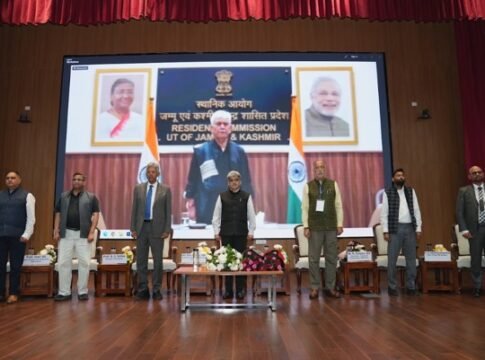
The valedictory session of the J&K GCC Summit 2026 reflected on the key deliberations and opportunities for positioning Jammu & Kashmir as an emerging destination for Global Capability Centres (GCCs). Hon’ble Lieutenant Governor of Jammu & Kashmir, Shri Manoj Sinha graced the occasion as Chief Guest on virtual mode. Shri Atal Dulloo, Chief Secretary, J&K; Padma Bhushan Shri Rajendra Singh Pawar, Chairman, NIIT; Prof. BS Sahay, Director IIM Jammu; Shri Kumar Rajeev Ranjan, Secretary, Labour & Employment Department, J&K; Prof. Jabir Ali, Dean, Faculty and Research; Prof. Nitin Upadhyay, Dean Academics, Dr. Sandeep Ananthanarayanan. CEO, CITaG, IIM Jammu; experts, policy makers, industry leaders, senior officials, faculty and students in large number attended the valedictory session.
Shri Manoj Sinha, Hon’ble Lieutenant Governor of Jammu & Kashmir, addressed the Valedictory Session of the J&K Global Capability Centre (GCC) Summit 2026, expressing confidence in the region’s potential to emerge as a significant GCC destination, supported by its young talent pool, improving infrastructure, investor-friendly policies, and expanding innovation ecosystem.
Congratulations to IIM Jammu, NASSCOM, partner institutions, and the administration on the successful organisation of the two-day summit, the Lieutenant Governor urged stakeholders to address a defining question: Why should Jammu & Kashmir be the preferred choice for companies seeking their next talent hub, innovation centre, and growth destination? He called for a collective resolve to translate this ambition into reality. Drawing inspiration from the Chenab Rail Bridge, the world’s highest railway arch bridge, he described it as a symbol of the region’s confidence, ambition, and capacity to achieve transformational goals. He also drew a parallel between the confluence of the Chandra and Bhaga rivers that form the Chenab and the collaborative spirit underlying the GCC ecosystem. Just as these rivers unite to create a powerful flow, GCCs can bring together global expertise, capital, and technology with the talent, aspirations, and creativity of Jammu & Kashmir’s youth.“I see Global Capability Centres in the same spirit of courage and confluence, and together they can generate a strength far beyond their separate capabilities,” he said.
Highlighting India’s expanding GCC landscape, the Lieutenant Governor noted that the country is home to more than 2,100 GCCs employing over 19 lakh professionals and making a substantial contribution to exports. With GCCs increasingly expanding into Tier-II and Tier-III cities, he said, Jammu & Kashmir has an opportunity to participate in this next phase of growth by strengthening its institutions, infrastructure, talent base, and innovation ecosystem. He observed that the GCC sector has evolved beyond cost efficiency towards excellence, specialized capabilities, and innovation. Jammu & Kashmir, he said, should aspire not merely to host capability centres but also to become a source of distinctive global innovations.
Referring to the region’s transformation under the leadership of Hon’ble Prime Minister Shri Narendra Modi, the Lieutenant Governor highlighted major infrastructure developments, improved connectivity, rising industrial investment, and the rapid expansion of the startup ecosystem. He noted that the number of startups in Jammu & Kashmir had grown from 69 in 2020 to 1,305, an increase of over 1,800 per cent. Coupled with the talent emerging from IIM Jammu, IIT Jammu, NIT Srinagar, and other educational institutions, this growth offers a strong foundation for developing a future-ready workforce.
The Lieutenant Governor identified six key advantages that could strengthen Jammu & Kashmir’s GCC proposition: financial support, lower operating costs, special incentives for pioneering multinational investors, opportunities to attract local talent back to the region, first-mover advantages for early entrants, and emerging opportunities in niche sectors such as agri-tech, tourism-tech, and handicraft digitization. Outlining a four-pillar roadmap for the next five years, he emphasized talent development through industry–academia partnerships, building investor confidence through credible implementation, leveraging Jammu & Kashmir’s distinctive advantages, and promoting inclusive growth through a hub-and-spoke development model. He stressed that these priorities must be
supported by coordinated efforts and a clear focus on implementation. Expressing confidence in the region’s long-term prospects, he mentioned that GCCs could become an integral pillar of Jammu & Kashmir’s industrial ecosystem over the next decade. He noted that the summit had laid an important foundation for building an aspirational, innovation-driven Jammu & Kashmir, equipped to attract global enterprises, create meaningful employment, and transform its talent and potential into sustainable economic opportunities.
Shri Atal Dulloo, IAS, Chief Secretary, Government of Jammu and Kashmir, described the J&K GCC Summit 2026 as an important platform for advancing industry–government collaboration and exploring new pathways for the region’s development. He acknowledged Prof. B. S. Sahay, Director, IIM Jammu, for bringing key stakeholders together and strengthening engagement between the Institute and the J&K Government. Emphasizing the need to move from discussions to implementation, he called for a focused 30-60-90-day action plan to position Jammu & Kashmir as an AI-native destination for Global Capability Centres (GCCs), with the potential to attract investment, create employment, and build specialized technological capabilities. A key proposal in his address was the establishment of an apex committee chaired by Padma Bhushan Shri Rajendra Singh Pawar, Chairman, NIIT, with the Directors of IIM Jammu and IIT, committed senior officials from the J&K Government, and a representative from NASSCOM as members. The proposed mechanism would facilitate focused, one-on-one engagement with selected industries and be anchored at C-DAC, with IIM Jammu playing a significant role in driving the initiative.
He also emphasized the need to explore a dedicated mission or Special Purpose Vehicle (SPV) to provide strategic direction, ensure coordination, and support effective implementation. He stressed that realizing Jammu & Kashmir’s GCC aspirations would require clear institutional ownership, coordinated efforts, and sustained follow-through. The proposed roadmap and institutional mechanism, he noted, should help convert the summit’s deliberations into concrete initiatives and measurable outcomes for the region.
Shri Kumar Rajeev Ranjan, IAS, Secretary, Labour and Employment Department, Government of Jammu & Kashmir, presented the programme summary and report of the two-day J&K GCC Summit 2026, highlighting key deliberations, insights, and recommendations on technology, skill development, employment, investment, and regional economic growth.
Emphasizing a strategic approach to regional development, he shared the thought, “Let them be the hub; we will be the spokes,” underscoring the opportunity for Jammu & Kashmir to establish strong linkages with established business and technology centers while developing its own talent pool and capabilities. The summit brought together policymakers, industry leaders, and academic experts to explore pathways for positioning Jammu & Kashmir as an emerging Global Capability Centre (GCC) destination. The discussions reinforced the importance of government–industry–academia collaboration, industry-aligned skills, innovation, and an enabling business environment to attract investment, generate employment, and foster sustainable regional growth.
Padma Bhushan Shri Rajendra Singh Pawar, Chairman, NIIT, underscored the significance of the J&K GCC Summit 2026 in bringing industry and government together to explore new avenues for the region’s economic and technological advancement. He acknowledged Prof. B. S. Sahay, Director, IIM Jammu, for fostering strong institutional relationships and facilitating dialogue among key stakeholders to advance the GCC vision for Jammu & Kashmir. Sharing an industry-led perspective, Shri Pawar highlighted the opportunity for Jammu & Kashmir to develop a distinct identity in the GCC landscape by embracing artificial intelligence and emerging technologies.
He emphasized that the region could build on its strengths by connecting with established knowledge and technology institutions, drawing on the expertise of IITs and IIMs, and exploring remote work opportunities that enable professionals to contribute from Jammu. Referring to IIT Madras as an example of how an institution can contribute to employment, connectivity, and innovation, he stressed the value of creating an ecosystem where knowledge, enterprise, and local opportunities reinforce one another.
He also highlighted the importance of translating the summit’s discussions into practical initiatives through a focused 30-60-90-day roadmap. Conveying a clear message for the way ahead, he urged stakeholders to “look out for things, sort things, and create things ”a call to recognize opportunities, address practical challenges, and develop solutions that can help shape Jammu & Kashmir’s emerging role in the technology and GCC ecosystem.
Prof. B. S. Sahay, Director, IIM Jammu, emphasized that sustained growth depends on continuous evolution across academia, industry, and society. He highlighted the need for educational institutions to adapt their learning approaches, industries to embrace innovation, and individuals to continuously upgrade their skills in response to changing technologies and business environments. He stressed that bridging the gap between academic learning and industry requirements is essential to nurturing future-ready talent and building a skilled workforce capable of meeting emerging challenges. He also underscored the importance of collective efforts by local communities, industry leaders, policymakers, and other stakeholders in shaping Jammu & Kashmir’s growth journey.
He noted that collaboration among government, academia, and industry can help translate the region’s potential into tangible opportunities. He further highlighted the need to create an enabling environment that encourages entrepreneurship, attracts investment, supports innovation, and generates meaningful employment. Emphasising a shared responsibility towards regional development, he called for a forward-looking approach that combines talent, technology, institutional partnerships, and community participation to build a resilient and sustainable growth ecosystem for Jammu & Kashmir.
On the momentous occasion of the J&K GCC Summit 2026, a Memorandum of Understanding (MoU) was signed between the Indian Institute of Management Jammu and KPMG Advisory Services Private Limited in the august virtual presence of Hon’ble Lieutenant Governor of Jammu & Kashmir, Shri Manoj Sinha Ji.
The MoU was signed and exchanged by Prof. B. S. Sahay, Director, IIM Jammu, and Shri Narayanan Ramaswamy, Partner and Head – Education and Skilling, KPMG. The occasion was also graced by Shri Brijendra Kumar, Partner and Head – Government Technology; Shri Debratta Ghosh, Partner – Education and Skilling; Shri Amit Pawar, Associate Director – Sales Enablement, Government and Public Services Advisory; and Shri Mahaveer Aggarwal, Director – Education and Skilling, Government and Public Services, KPMG. The collaboration aims to strengthen industry–academia engagement through academic programmes, executive education, research, consultancy, skill development and industry-oriented learning, contributing to talent development and the growth of the GCC ecosystem in Jammu & Kashmir.The session concluded with a vote of thanks by Dr. Sandeep Ananthanarayanan. CEO, CITaG, IIM Jammu, followed by the National Song and National Anthem.
The day’s deliberations commenced with the panel discussion. The fourth panel titled, “GCC Innovation and Technology: Unlocking the Tier-2 and Tier-3 Advantage,” at the J&K GCC Summit 2026 explored how emerging technologies and digital infrastructure can help regions such as Jammu & Kashmir attract GCCs, investment and skilled talent.Moderated by Shri Sachin Punyani, Head of AI Services, Public Sector, Amazon Web Services India, the panel featured Shri Rahul Yadav, IAS, Administrative Secretary, IT Department; Shri Sree Rama Chandra Murty Nallam, Founder and CEO, Seanergy.ai; Shri Brijendra Kumar, Partner and Lead, GovTech, KPMG; Shri Kundana K Lal, Founder Director and President, VITTI Research Foundation; Shri Deo Kumar Singh, CEO, Deosoft IT Services; Shri Rajesh Pasham, Head, Palantir Centre of Excellence, TechStar Group; Shri Amit Pradhan, Sr. Vice President, IT and CIO, Dixon Technologies; and Shri Ankur Chandra, Chief Storyteller and Product Management Leader, Carelon Global Solutions.The discussion highlighted the role of cloud computing, artificial intelligence, cybersecurity and secure digital infrastructure in enabling high-value technology operations beyond metropolitan centres.
Panellists emphasised the importance of specialised talent, Centres of Excellence and industry–academia collaboration in building globally competitive GCC ecosystems.The session underscored that strengthening infrastructure and government–industry partnerships can help Jammu & Kashmir attract investment, generate quality employment and contribute to India’s digital economy and the vision of Viksit Bharat @2047
The fifth panel titled “The Future of GCC – Talent and Workforce Transformation,” at the J&K GCC Summit 2026 explored how evolving talent strategies, emerging skills and workforce transformation will shape the future of Global Capability Centres (GCCs). The discussion focused on bridging industry–academia skill gaps and preparing India’s workforce for an AI-driven future.
Moderated by Dr. Roydon Gonsalvez, Sr. Vice President and Head, Talent Management and Development (APAC), Northern Trust, the panel featured Shri Kumar Rajeev Ranjan, IAS, Secretary, Labour and Employment Department, Government of Jammu & Kashmir; Shri Vikash Kumar Dubey, CEO and MD, Vensysco Technologies; Shri Alouk Kumar, CEO and MD, Inductus Group; Shri Deepu Malik, Co-Founder and MD, DataThoughts; Shri Narayanan Ramaswamy, Partner and National Leader, Education and Skill Development, KPMG; Shri Sumit Bhatia, Sr. Director, People Partner, Marsh; Shri Rohit Mogra, CHRO, Giesecke & Devrient; Shri Rupak Rathore, Sr. General Manager and Head, HR and L&D, Zydus Lifesciences; and Shri Manpreet Singh, Vice President, HR and India HR Head, Alkami.The panellists discussed how AI is reshaping entry-level roles, with greater emphasis on validating and evaluating AI-generated outputs.
They highlighted the need to align academic programmes with industry requirements, strengthen industry–academia collaboration, and adopt recruitment and retention strategies that support workforce development.The discussion also emphasised the importance of robust infrastructure and a supportive ecosystem to attract and retain skilled professionals in Jammu & Kashmir. The deliberations highlighted opportunities to build a future-ready workforce, generate quality employment and strengthen the Union Territory’s potential as an emerging destination for GCCs.
The sixth panel, “Roadmap for Making J&K the Next GCC Destination,” was moderated by Ms. Kritika Murugesan, Sr. Director, GCC and Talent Council, NASSCOM.The panellists comprised of Shri A Sharma, IAS, Director, Census and Citizen Registration, J & K and Ladakh ; Shri Ankush Sabharwal, Founder and CEO, CoRover.ai; Shri Rajesh Ganesan, CEO, ManageEngine, Zoho Corp; Ms. Vaishnavi Prasad, Country Head, Consilio; Shri Sandeep Dhar, Founder and CEO, Aidiator Solutions; Shri Sourabh Gupta, Digital Program Leader, APAC, RTX; Shri Puneet Mohan, Founder, CEO and MD, SMMARUN Management Consortium Associates LLP; and Shri Sunil Bhide, Executive Leader, Global Delivery, Customer Success and Business Transformation, QNu Labs.
The session explored the measures required to develop J&K as a competitive GCC destination, including investment facilitation, digital and physical infrastructure, talent development, policy support, sector-specific opportunities, innovation and connectivity. The discussion highlighted the need for a coordinated ecosystem capable of attracting global organisations while generating high-value employment and strengthening the region’s participation in the global economy.
The Summit concluded with a valedictory session, where the key outcomes and insights emerging from the two days of deliberations were presented.The J&K GCC Summit 2026 brought together government, industry and academia over two days to examine the region’s potential in the rapidly expanding GCC landscape. The deliberations covered industry-government collaboration, ecosystem development, technology and innovation, workforce transformation, investment and employment, culminating in discussions on a roadmap for positioning Jammu & Kashmir as an emerging GCC destination.
The Summit underscored the importance of future-ready talent, technology adoption, investment facilitation, enabling policies and sustained institutional collaboration in developing a competitive and sustainable GCC ecosystem. It provided a platform for stakeholders to exchange experiences, identify opportunities and explore pathways for translating the region’s potential into investment, employment, skill development and long-term economic growth.