
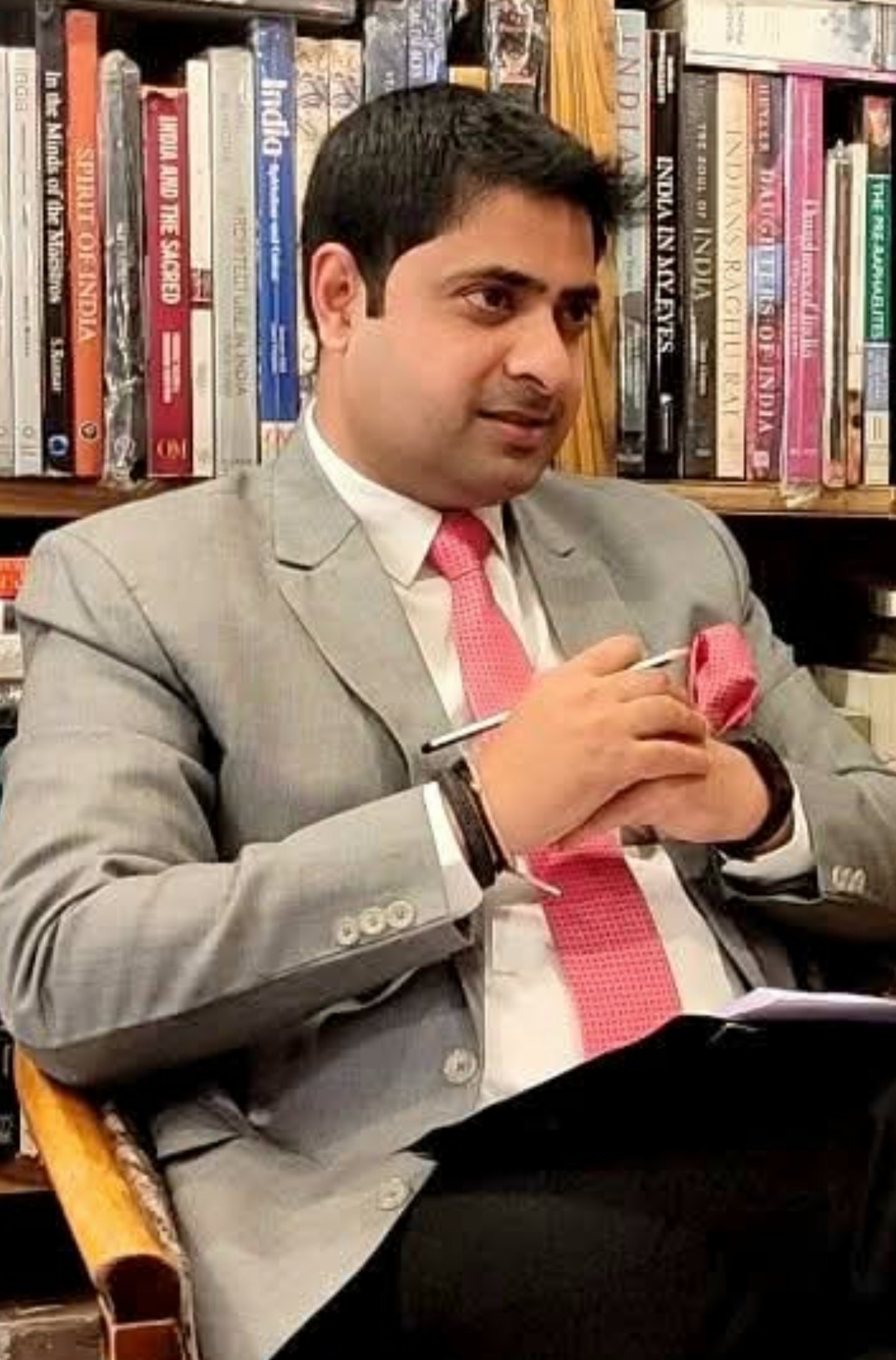
This exclusive interview is part of ROPORTAJ Podcast, where we bring you in-depth discussions with authors, historians, and thought leaders from around the world.
Aligarh is a name universally synonymous with the historic halls of the Aligarh Muslim University (AMU). Yet, beneath the layers of its iconic academic legacy lies a profound, sprawling, and largely underexplored historical tapestry stretching back across centuries—from ancient roots and medieval trade hubs to Mughal dynastic politics, Rajput resistance, French mercenaries, and the seismic tremors of 1857.
To capture this epic chronological journey, computer engineer and historian Atif Syed embarked on an extensive research odyssey, pulling together scattered Persian chronicles, British gazetteers, and academic records to write his comprehensive book on Aligarh.
In this insightful and expansive conversation for ROPORTAJ, journalist Daanish Bin Nabi sits down with Atif Syed to explore the ancient origins of “Kol,” the strategic conquests of Qutb-ud-din Aibak, the imprint of Mughal and French commanders, and what inspired a modern tech professional to dive deep into centuries of South Asian history.
Excerpts
Daanish Bin Nabi: Atif Sahib, you have spent roughly 20 years living in the US, working in the technology sector. How on earth did an IT professional decide to write such a comprehensive, monumental book on Aligarh? What sparked this idea?
Atif Syed: Professionally, my background is in computer engineering. However, my passion has always been history, spanning nearly 20 to 30 years, dating all the way back to my school days. If you look at my personal library, the vast majority of my collection consists of history books. I have a deep focus on the medieval era, Mughal history, world religions, and even pre-Columbian and post-Columbian American history.
History has always been my true passion and secondary profession. So while it might come as a surprise to some, for me, writing this book felt entirely natural.
Daanish Bin Nabi: And given that Aligarh is your ancestral place, where you grew up and hold a deep emotional attachment, that naturally influenced your focus, right?
Atif Syed: Exactly. I was born and brought up in Aligarh, and my roots there run deep. I completed my 10th standard from Our Lady of Fatima Catholic Convent School in Aligarh, and then spent a few months studying in 11th grade at AMU before receiving a scholarship with Singapore Airlines and moving abroad. The rest of my education unfolded there, but Aligarh remains close to my heart.
Daanish Bin Nabi: You mentioned the ancient name “Kol” in your book, and touched upon Qutb-ud-din Aibak. Could you share some of that early history with our viewers, how Aibak conquered the region and what impact it had?
Atif Syed: To understand it properly, we have to look at a broader historical perspective. The name “Kol” is ancient and has existed for millennia. The central part of historic Aligarh, the elevated area known today as Upper Court (Upar Kot), was the original focal point of the early town. Even today, there is a police station named “Kol,” and official government documents still refer to that historic core as Kol.
The northern areas, including the Aligarh Fort, were built much later, around 1717 during the late Mughal era under governor Sabit Khan, followed later by the Civil Lines and the AMU campus.
When Qutb-ud-din Aibak launched his campaign in 1194, it was a major turning point. Prior to that conquest, the region was heavily influenced by Dor Rajputs, a prominent clan within the Rajput community who held sway across Kol, Bulandshahr (Baran), and Meerut. About a century earlier, Mahmud of Ghazni had raided Mathura and parts of Bulandshahr, bypassing Kol. However, Aibak’s 1194 campaign permanently dismantled the Rajput hold across these interconnected centers.
This event is meticulously documented in Persian historical texts, notably Taj-ul-Ma’asir by Hasan Nizami, a historian originally from Nishapur who detailed the conquest in poetic prose, describing the exact conditions, the elevated fort, and the celestial constellations observed during the siege.
Daanish Bin Nabi: Moving forward into the Mughal era, how did Aligarh fit into the broader imperial economy and administration of the Mughals?
Atif Syed: Aligarh’s strategic importance was recognized right from the establishment of the Mughal Empire. Just a year after the Battle of Panipat in 1526, Babur planned and executed a royal visit to Kol, holding feasts and documenting his reception by local figures, including the family of Shaykh Quran, in the Baburnama.
While Humayun’s reign was too turbulent for deep administrative changes, Akbar transformed the region profoundly. Akbar reorganized the empire into structured subahs (provinces), mahals, and tehsils, systematically documenting and formalizing the administration of Kol.
Later under Shah Jahan and Aurangzeb, further administrative subdivisions were established. However, because Aligarh was geographically sandwiched between two massive imperial powerhouses, Agra and Delhi, its independent spotlight was often overshadowed, yet it remained a vital agricultural and administrative cog in the imperial wheel.
Daanish Bin Nabi: You also highlight the transition into the late Mughal and post-Mughal phase, featuring fascinating European mercenary figures such as George Perron and the French families. How did they shape Aligarh?
Atif Syed: Following the decline of central Mughal authority and the rise of Maratha power under Mahadaji Sindhia, Aligarh Fort became a key military headquarters. During this volatile period, European adventurers, particularly French mercenaries, entered the region.
Among the most prominent was George Perron (Pierre Cuiller-Perron), who served the Scindias and controlled vast territories from Aligarh Fort. Alongside him were families like the Pesh family, whose patriarch, Francis Gottlieb Pesh, served in the court of Begum Samru near Meerut, and Louis Bourquin.
These figures built sprawling garden houses, maintained elite cavalry units, and integrated into local politics before the British East India Company dismantled their power during the Second Anglo-Maratha War in 1803, notably at the storming of Aligarh Fort led by Lord Lake.
Daanish Bin Nabi: The Aligarh Movement and Sir Syed Ahmad Khan naturally form a core pillar of modern history. How did you approach researching the socio-political awakening of the 19th century leading up to 1857?
Atif Syed: The Aligarh Movement did not happen in a vacuum; it was born out of the profound socio-economic devastation experienced by the Muslim community following the 1857 War of Independence. Communities that had previously held administrative power faced severe British retribution, leading to widespread educational and economic backwardness.
Sir Syed Ahmad Khan recognized this crisis acutely. Initially, he contemplated establishing a vernacular university system, but recognizing the shifting tides under colonial rule, he pivoted towards modern Western and scientific education grounded in English, while preserving Islamic heritage. This vision culminated in the founding of the Muhammadan Anglo-Oriental (MAO) College in 1875, which eventually blossomed into Aligarh Muslim University in 1920.
Daanish Bin Nabi: Writing a comprehensive history spanning centuries with scattered sources must have been an immense challenge. What advice do you have for modern researchers tackling regional history?
Atif Syed: The biggest challenge in writing Aligarh’s history is that sources are highly scattered. You cannot rely on a single textbook that packages everything neatly. Instead, you have to piece together evidence from multiple archives, ranging from Mughal chronicles like the Baburnama and Akbarnama, British gazetteers and district records (such as those by H.R. Nevill), Persian poetry, and travelers’ accounts.
My advice to modern researchers is simple: do not confine history to a single era. History is a continuous river spanning millennia. Cross-verify your sources rigorously, ground your narrative in reliable primary documentation, and weave the facts into an engaging story that keeps readers immersed from beginning to end.
Daanish Bin Nabi: Atif Sahib, thank you so much for sharing your insights and taking us on this remarkable historical journey. Where can our viewers find your book?
Atif Syed: Thank you, Daanish, it was an absolute pleasure. The book is available widely online and through major booksellers for anyone eager to look past the modern university gates and discover the deep, rich history of Aligarh.
Disclaimer: This text was generated from the podcast audio and may slightly differ from the actual spoken conversation. To listen to the full podcast, you can access it here: https://www.youtube.com/watch?v=JnLN2IT_g4c