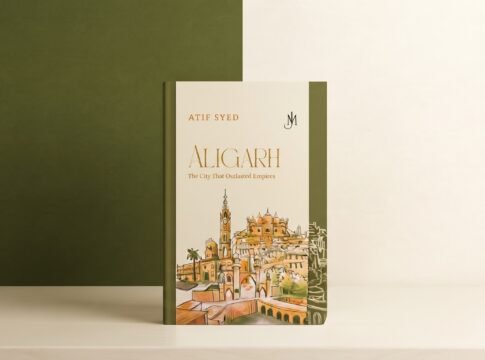
New Delhi: For most of the world, and indeed for most of India, Aligarh is a single word that means a single thing: the Aligarh Muslim University. Founded by Sir Syed Ahmad Khan after the 1857 uprising, the institution has so thoroughly dominated the city’s identity that its older, stranger, and far more layered past has been buried beneath the weight of that association.
Atif Syed’s new book, Aligarh: The City That Outlasted Empires, published by Hachette India under its John Murray India imprint, sets out to excavate what lies beneath.
Syed is an unlikely historian. He grew up in Aligarh but left early, earning a Singapore Airlines scholarship to study computer engineering before settling in Austin, Texas, where he has spent over two decades in the technology sector. That distance, perhaps, is what allowed him to see the city clearly.
His book is not the work of a professional academic burdened by the conventions of the discipline, but of a curious native son who returned to his birthplace with questions that the existing literature could not answer.
The result is a panoramic biography of a city that stretches back nearly a millennium, from its origins as Koil under the Dor Rajputs, through Qutbuddin Aibak’s conquest in 1194, the Mughal centuries, the turbulent era of European intervention, and finally to the founding of the institution that would come to define it.
What makes the book valuable is not simply its chronological sweep but its insistence on the ordinary. Syed is less interested in the grand procession of dynasties than in the citizens who adapted and rebuilt with each change of power, the merchants and nobles who linked local histories to global networks, the French soldiers who composed poetry in Urdu, and the indigo plantations that transformed the region’s economy during the colonial era.
This is a history of a place, not merely of its rulers, and that distinction gives the narrative its texture and its warmth.
The most striking sections of the book concern the eighteenth and nineteenth centuries, when Aligarh became a prize contested by Marathas, British, Afghans, and French forces. It is here that Syed’s instinct for the cosmopolitan absurdity of the region comes into its own.
The detail of French military men writing Urdu verse is the kind of fact that no textbook chronology could accommodate, and yet it captures the hybrid reality of North Indian urban life better than any abstract argument could.
Syed also pays careful attention to the built environment, examining the symbolism of the Jami Masjid and the lost Koil Minar, and reconstructing the origins of neighbourhood names that residents pass through daily without a second thought.
The book’s treatment of Sir Syed and the Aligarh movement is notably well-judged. Syed places the founding of the Muhammadan Anglo-Oriental College not as the city’s origin story but as its culmination, a later chapter in a much longer history.
He shows how Sir Syed deliberately sought a location that was connected to the cultural and political arteries of Delhi and the North-Western Provinces yet isolated enough to shelter students from urban distractions.
The university, in this telling, did not create Aligarh; it entered an existing city with its own social geography and accumulated historical landscape, and then gradually transformed that landscape in its own image.
Where the book has drawn scrutiny is on matters of analytical depth. One reviewer has noted the absence of sustained social and economic analysis, arguing that a comprehensive urban history would require systematic treatment of markets, artisans, caste structures, landholding patterns, demography, and municipal administration, subjects that Syed touches upon but does not pursue in detail.
This is a fair criticism, and it suggests a book that is stronger on narrative and heritage than on the harder edges of social history. But it would be ungenerous to hold Syed to a standard he did not set for himself.
He aimed to recover a forgotten past and to inspire readers to explore the heritage that survives, and in that he has succeeded.
For anyone who has lived in Aligarh, or who imagines they know it through its university alone, this book will be a revelation. For general readers interested in the layered histories of Indian cities, it offers a model of how to write about place without reducing it to a single institution or identity.
Aligarh, Syed reminds us, outlasted empires. It is time its history outlasted the amnesia that has surrounded it.