Daanish Bin Nabi
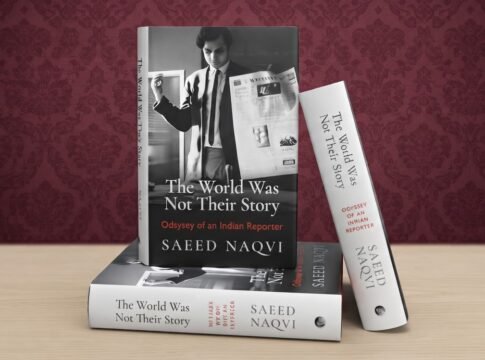
The history of the modern world is often told through the eyes of politicians, military leaders and heads of state. Journalists usually stand on the sidelines, recording events as they unfold. In The World Was Not Their Story, veteran Indian journalist Saeed Naqvi shifts that perspective. Rather than putting political figures at the centre of the narrative, he places the reporter’s experience at the heart of history.
Published by Speaking Tiger Books, this memoir arrives at a time when journalism itself is under scrutiny. Questions about media bias, foreign influence and the reliability of news have become common across the world. Against that backdrop, Naqvi’s reflections feel both timely and relevant.
What immediately stands out is that this is not a conventional autobiography. The book does not follow a predictable pattern of childhood memories, career milestones and personal achievements. Instead, it moves through decades of reporting, carrying readers from one political crisis to another. The narrative often feels like a long foreign assignment rather than a memoir. Readers travel alongside the author through wars, revolutions, diplomatic disputes and moments that changed the course of nations.
The central argument of the book is clear. For many years, Indian journalism viewed international affairs largely through Western sources and Western interpretations. Naqvi believes this limited the way global events were understood in India. Whether one agrees entirely with that position or not, it forms the intellectual backbone of the memoir.
This theme gives the book value beyond personal storytelling. It raises larger questions about who controls information and whose voice shapes public understanding. In a media environment increasingly dominated by international news agencies and global platforms, those questions remain important.
As a writer, Naqvi’s greatest strength is his ability to place readers at the scene of an event. There is an immediacy to many of his recollections. Rather than presenting history as a collection of facts, he presents it as lived experience. Political crises are shown not as distant headlines but as situations unfolding in real time, often with uncertainty and confusion.
The book also serves as a reminder of how journalism worked before the digital age. Younger readers have grown accustomed to instant communication, live broadcasts and social media updates. Naqvi belonged to a generation that relied on physical travel, personal contacts and persistence. His stories reveal the practical difficulties of reporting from distant locations long before information became available at the click of a button.
One of the reasons the memoir succeeds is its sense of authenticity. The author rarely sounds as though he is trying to impress the reader. Instead, he writes with the confidence of someone who has spent decades observing events first-hand. His reporting experiences speak for themselves. There is no need for exaggeration.
At the same time, the book provides interesting insights into the changing nature of Indian journalism. Through his career experiences, readers witness the evolution of news organisations, editorial decision-making and the relationship between journalists and political power. These sections are particularly useful for students of media studies and communication.
For academic readers, the memoir offers several layers of analysis. It can be read as a contribution to journalism studies, as a commentary on international relations, or as a reflection on post-colonial perspectives in media coverage. The book repeatedly challenges the assumption that major global events can only be interpreted through Western frameworks.
However, the memoir is not without its limitations.
The sheer scale of the author’s experiences occasionally becomes a weakness. Because so many events, countries and personalities appear throughout the book, some episodes feel rushed. Readers may find themselves wanting greater detail or deeper reflection on certain historical moments. On several occasions, an incident that could easily fill an entire chapter receives only a few pages before the narrative moves elsewhere.
Another challenge is the book’s structure. It is rich in anecdotes and observations, but not always tightly organised. The transitions between subjects can sometimes feel abrupt. Readers looking for a straightforward chronological autobiography may find the narrative uneven.
There are also moments when the book assumes a degree of familiarity with political history. Readers already interested in international affairs will have little difficulty following the discussion, but general audiences may struggle with some references. A little more contextual explanation in certain sections would have improved accessibility.
Yet these criticisms do not diminish the book’s overall achievement.
The real strength of The World Was Not Their Story lies in its perspective. Many memoirs tell readers what happened. This one encourages readers to think about how we know what happened. That distinction is important. Naqvi is not merely documenting events; he is questioning the ways in which events are reported, interpreted and remembered.
His observations are particularly valuable in an era of information overload. Today, audiences consume vast amounts of news, often without considering where it originates or whose interests shape it. The memoir quietly challenges such passive consumption. It asks readers to think critically about sources, narratives and assumptions.
The writing itself is generally clear and engaging. Naqvi avoids unnecessary academic language and focuses on storytelling. As a result, the book remains accessible despite dealing with complex political subjects. Readers do not need a background in international relations to appreciate the narrative, though such knowledge certainly enriches the experience.
From a journalistic standpoint, the memoir functions as both a personal record and a defence of old-fashioned reporting values. Curiosity, independence, persistence and eyewitness observation remain central to the author’s understanding of the profession. In an age of commentary-driven media, that commitment feels refreshing.
Ultimately, The World Was Not Their Story is less about one journalist’s career than about the struggle to develop an independent perspective on world affairs. It argues that journalism is at its strongest when reporters venture beyond accepted narratives and see events for themselves.
That message gives the book lasting significance.
For journalism students, it offers a masterclass in foreign correspondence. For historians, it provides a witness account of major international developments. For general readers, it delivers an engaging journey through decades of political change. Most importantly, it reminds us that the telling of history is never neutral. The stories that reach us depend on who is there to tell them.