
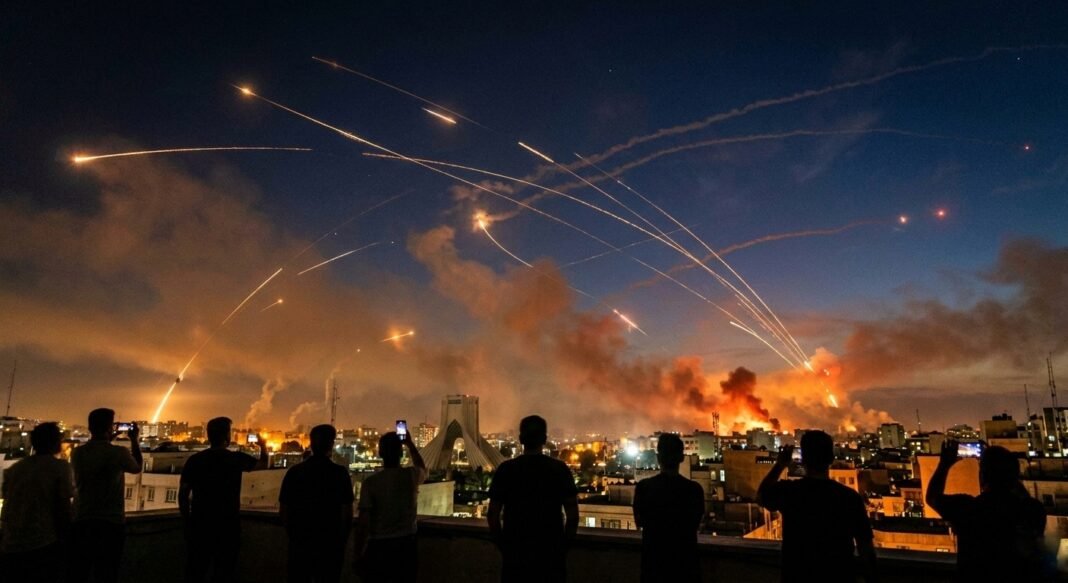

The conflict between Iran, Israel and the United States has intensified sharply in recent days, with waves of airstrikes and missile attacks spreading across several parts of the Middle East. The escalation began after large-scale U.S. and Israeli strikes targeted Iranian military sites and strategic infrastructure in cities including Tehran and Isfahan, according to multiple international news reports. Iranian authorities described the attacks as acts of aggression and said they caused damage to military facilities and surrounding civilian areas. Israeli and American officials have framed the strikes as an effort to degrade Iran’s missile capabilities and military command network, marking one of the most direct confrontations between the countries in years.
Iran has responded with a broad retaliatory campaign that extends beyond Israel itself. Iranian forces have launched ballistic missiles and drones toward Israeli territory while also targeting U.S. military installations in the Persian Gulf region, including bases located in Qatar, Bahrain and other Gulf states, according to regional and international media reports. Air-defense systems in several countries have intercepted many of the incoming projectiles, but the attacks have forced widespread airspace closures and heightened security alerts across the region. The conflict has also raised fears about disruptions to shipping lanes and energy infrastructure near the Strait of Hormuz, a vital route for global oil supplies.
Inside Iran, repeated strikes and air-defense activity have shaken major cities, with explosions reported in Tehran and other areas as Israeli aircraft continued to target military positions. Iranian officials say civilians have been killed and injured during the attacks, though precise casualty figures remain difficult to verify independently. At the same time, Israel has intensified operations against Iran-aligned groups in the region, particularly Hezbollah in Lebanon, opening another front that analysts say could further expand the scope of the conflict.
Iranian leaders have combined military retaliation with political messaging aimed at preventing the crisis from widening further. President Masoud Pezeshkian rejected demands from Washington for Iran’s “unconditional surrender,” calling such statements unrealistic, according to international news coverage of his remarks. In an unusual gesture, he also apologized to Gulf countries affected by Iranian missile launches, saying the intended targets were U.S. military facilities operating from those territories. The statement appeared to signal Tehran’s attempt to avoid pushing Gulf governments more firmly into the conflict while continuing its confrontation with Israel and the United States.
Despite these signals, there is little indication that the fighting will ease soon. Israeli strikes on Iranian territory have continued, and Iranian missile launches have persisted in response. Diplomatic efforts by European governments and other international actors have so far failed to produce a ceasefire or negotiations. With attacks occurring across several countries and armed groups joining the confrontation, what began as a series of strikes between long-standing adversaries is increasingly taking on the shape of a broader regional war, raising concerns about the stability of the Middle East and the global economic consequences that could follow.