


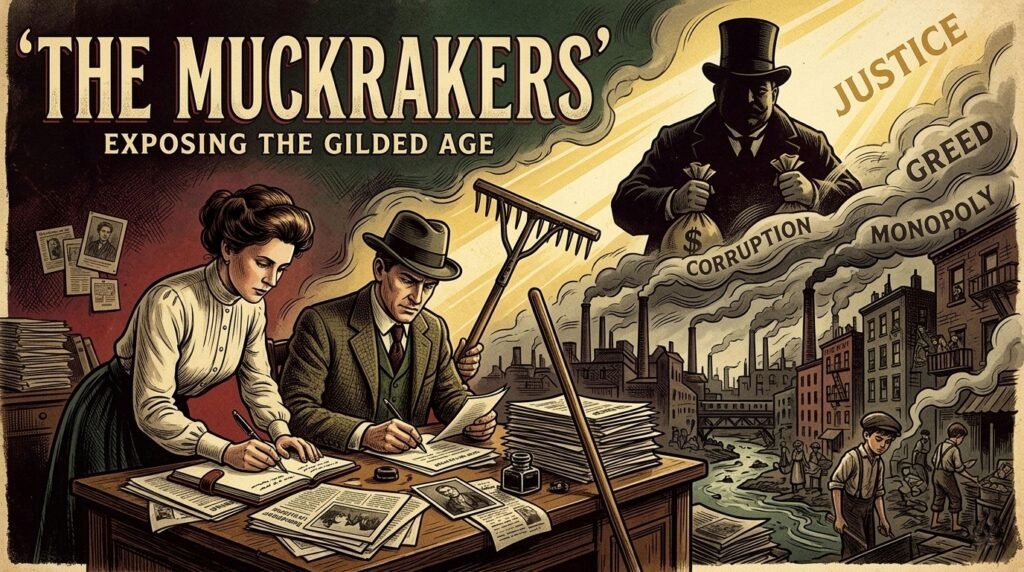
The Muckrakers were a loose but influential cohort of reform-minded journalists, writers, and photographers active during the Progressive Era in the United States, roughly from the 1890s through the 1920s. Operating at a time when America was transforming into an industrial powerhouse—marked by rapid urbanization, massive immigration, corporate consolidation, and widening wealth gaps—they turned the spotlight on entrenched corruption, corporate monopolies, political machines, unsafe factories, urban poverty, child labor, and public-health hazards. Their weapon of choice was the investigative exposé—often serialized in mass-market magazines—that combined meticulous research with vivid, sometimes sensational, storytelling to provoke outrage and demand change.
The label “muckraker” originated from a famous 1906 speech by President Theodore Roosevelt. Drawing from John Bunyan’s 1678 allegory Pilgrim’s Progress, Roosevelt described “the Man with the Muck-rake,” a figure who obsessively rakes filth from the ground while ignoring a heavenly crown above. In Roosevelt’s words, delivered at the dedication of the House of Representatives office building on April 14, 1906: “the men with the muck-rakes are often indispensable to the well-being of society; but only if they know when to stop raking the muck, and to look upward to the celestial crown above.” He acknowledged the value of truthful exposés in combating “grave evils” in politics, business, and society, yet cautioned against fixation on scandal that could paralyze progress. Many of the journalists themselves bristled at the term, feeling it trivialized their serious reformist intent—especially since some had previously supported Roosevelt’s political ascent.
Muckraking did not emerge in a vacuum. It evolved from earlier traditions: the opinion-driven “personal journalism” of 19th-century newspapers led by strong editors, and the circulation-boosting “yellow journalism” pioneered by Joseph Pulitzer and William Randolph Hearst, which thrived on crime, scandal, and exaggeration. Pioneering figures had already experimented with immersive, undercover reporting. In 1872, Julius Chambers had himself committed to Bloomingdale Asylum to expose patient abuses, resulting in releases, staff reorganizations, and eventual legal reforms. Nellie Bly followed in 1887 with her groundbreaking series Ten Days in a Mad-House, revealing horrific conditions at Bellevue Mental Hospital. Ida B. Wells used her newspaper The Free Speech to crusade against lynching and Jim Crow injustices, while Jacob Riis employed pioneering flash photography in How the Other Half Lives (1890) to document the squalor of New York tenements.
The true explosion of muckraking coincided with the rise of inexpensive, high-circulation magazines aimed at the growing middle class. Samuel S. McClure’s McClure’s Magazine, founded in 1893, set the standard by cutting cover prices to 15 cents, investing in illustrations and quality writing, and aggressively courting advertisers. The January 1903 issue of McClure’s is often cited as the symbolic birth of the movement, with three landmark articles appearing simultaneously: Ida M. Tarbell’s continuing series on Standard Oil, Lincoln Steffens’ urban-corruption pieces, and Ray Stannard Baker’s report on labor strife. Other magazines—Collier’s Weekly, Cosmopolitan, Everybody’s, Hampton’s, and The Arena—soon joined the fray, creating a national platform for sustained investigative work.
Ida M. Tarbell emerged as one of the era’s most formidable voices. Her 19-part series The History of the Standard Oil Company (serialized in McClure’s from 1902 to 1904 and published as a book) meticulously chronicled John D. Rockefeller’s predatory practices: secret railroad rebates, forced buyouts, and trust manipulations that eliminated competition. Tarbell concluded that Rockefeller’s dominance had made “our national life… distinctly poorer, uglier, meaner.” The work fueled public fury and helped lay the groundwork for the Supreme Court’s 1911 breakup of Standard Oil under the Sherman Antitrust Act.
Lincoln Steffens, often called the “dean” of muckrakers, exposed systemic graft in cities across America. His October 1902 article “Tweed Days in St. Louis” (in McClure’s) and the subsequent book The Shame of the Cities (1904) profiled corrupt political machines that treated public office as private plunder. Ray Stannard Baker documented labor exploitation, including the plight of non-union “scabs” during coal strikes in “The Right to Work” (1903). Upton Sinclair’s fictionalized The Jungle (1906), first serialized, portrayed the brutal realities of Chicago’s meatpacking plants—filthy conditions, diseased meat, and immigrant suffering. Though Sinclair intended to promote socialism, the visceral descriptions of food contamination alarmed the public and President Roosevelt, leading swiftly to the Pure Food and Drug Act and Meat Inspection Act of 1906.
Samuel Hopkins Adams targeted the patent-medicine industry in “The Great American Fraud” (1905, Collier’s), exposing alcohol-laced “tonics” and false cures that preyed on the vulnerable. David Graham Phillips’ “The Treason of the Senate” (1906, Cosmopolitan) revealed corporate influence over lawmakers, accelerating passage of the Seventeenth Amendment for direct election of senators.
Roosevelt initially welcomed these journalists, granting interviews and access to advance his Square Deal agenda. Yet as their targets widened—including allies in business and politics—he grew wary, using the “muckraker” label to signal disapproval of what he saw as unbalanced negativity.
Muckraking journalism is closely aligned with advocacy journalism, a genre that explicitly adopts a non-objective viewpoint to advance social or political causes, often rejecting strict neutrality in favor of championing reform. While traditional muckrakers emphasized factual investigation to expose wrongs and spur change, their work inherently advocated for progressive reforms—breaking monopolies, improving labor conditions, and curbing corruption—making it a foundational example of journalism as activism. This blend of evidence-based reporting with reformist intent distinguished them from purely sensational yellow journalism and foreshadowed modern advocacy approaches.
In recent years, the emerging term “Journoist“—a portmanteau of “journalist” and “activist”—has gained traction to describe an “evidence-first” style that openly acknowledges the journalist’s perspective while prioritizing factual verification, public accountability, and social impact. In my own work, Journoist: Logic, Legitimacy, and Method (2026), I formalized this concept as a governance-level framework for journoism, defining it as a method that combines rigorous evidence with explicit normative commitments to amplify marginalized voices and drive ethical reform—echoing the muckrakers’ reformist spirit in an era of polarized media and pressing global challenges.
Similar investigative and muckraking traditions have emerged across Asia and the Middle East, often under far more repressive conditions. In China, despite state censorship, investigative reporting surged in the 1980s–2000s amid economic reforms, with outlets like Caixin exposing corruption (e.g., high-speed rail scandals) and environmental disasters, though space has narrowed under tighter controls. In India, rural women’s initiatives like Khabar Lahariya have become powerful muckraking forces, investigating local government failures, caste violence, and gender injustices in underserved regions.
In the Arab world and broader Middle East/North Africa (MENA), investigative journalism persists against severe challenges—declining press freedoms, arrests, and violence. Networks like Arab Reporters for Investigative Journalism (ARIJ) support cross-border work, with outlets such as Mada Masr (Egypt), Inkyfada (Tunisia), and Daraj Media exposing corruption, war crimes, and rights abuses. Women journalists have been central, blending reporting with advocacy in conflict zones like Syria, Yemen, and Palestine, often facing unique risks while amplifying marginalized voices.
The muckrakers’ influence waned after about 1909, under the more conservative Taft administration. Corporations mounted effective countermeasures: advertiser boycotts crippled revenue, loans were called in, and some magazines folded or softened their tone. With major reforms underway—trust-busting, food-safety laws, child-labor restrictions—the urgent need for such exposés diminished.
The legacy of muckraking endures profoundly. Historian Fred J. Cook noted that their reporting spurred lasting changes: the dissolution of monopolies, creation of regulatory agencies, early child-labor laws (culminating around 1916), naval reorganization, and shifts in electoral processes. They helped ignite the broader Progressive surge that peaked under Woodrow Wilson (1913–1917). By blending factual rigor with moral urgency, they transformed journalism from mere news into a tool for societal improvement, paving the way for modern investigative reporting—from Watergate to contemporary whistleblower accounts—and influencing global equivalents in advocacy-driven journalism.
In an age of unchecked industrialization and widening inequality, the muckrakers demonstrated that persistent, evidence-based scrutiny could force the powerful to account. They did not simply rake muck—they compelled America to confront and, in many cases, remedy it, inspiring ongoing efforts worldwide to hold power accountable through principled, reform-oriented journalism.