Gujjars and Bakarwals in Jammu & Kashmir practice transhumance—a centuries-old seasonal migration between the Jammu plains and the summer dhoks in Kashmir, Ladakh, and the Pir Panjal. For them, April to June is not just summer; it is a season of movement, risk, and, too often, silent loss. As heatwaves scorch the plains and snow retreats from the passes, these pastoral nomads begin their journey. However, this journey is increasingly colliding with highways, forest closures, shrinking grazing lands, and a compensation system that rarely acknowledges them. Every year, over-speeding trucks kill hundreds of sheep and goats on highways. This is the story of India’s most visible yet invisible migration.
Gujjar-Bakarwals are the third-largest population group in Jammu and Kashmir, yet they live a very tough life. While others avoid stepping out during rising heatwaves and prefer staying in air-conditioned rooms, Gujjar-Bakarwals migrate from the plains to the upper reaches, braving extreme weather while carrying infants and managing livestock. They begin their journey with the hope of reaching their dhoks without losses, but in reality, it is filled with stress and constant concern for their safety and that of their animals. For these nomads, there is no distinction between day and night—they continue moving until they reach their destination.
During this difficult journey, they often travel on an empty stomach, surviving mainly on sabaz chai/noon chai (pink tea) and sattu (roasted corn flour). Instead of cooperation from fellow travelers, they are often harassed and abused because of their attire and livestock. Many times, their animals are crushed under speeding vehicles. In the past, hundreds of goats, sheep, and horses have been killed, yet they receive little or no compensation. They also face stoppages on highways by authorities in the name of traffic management.
Gujjar-Bakarwals play a crucial ecological role in the Himalayas and the Pir Panjal. Their livestock grazes grasslands, aids in pollination, and helps maintain ecological balance. Their goats consume pine needles, reducing the risk of forest fires. In many ways, they serve as an unpaid forest protection force, preserving forests and hills for generations. According to the 2011 Census, they are the third-largest population group in Jammu and Kashmir.
Despite their importance, there is no insurance policy for their livestock. Many lose hundreds of animals due to lightning strikes, landslides, and accidents. Their migration routes pass through difficult terrain and dense forests. They also possess valuable knowledge about medicinal plants found in the upper reaches of the Pir Panjal and beyond—knowledge that could contribute to scientific research.
In winter, they graze in the plains of Jammu, Samba, Kathua, and Rajouri. By March–April, as temperatures cross 40°C and fodder dries up, they begin ascending through established passes such as Pir Ki Gali, Mughal Road, Sinthan Top, Margan Top, and Tiggiyar Gali. By June, they reach high-altitude margs like Sonamarg, Dubjan, and Rupri. In September, the cycle reverses.
For centuries, this migration has sustained the region’s ecology—goats control pine needles, and buffalo dung fertilizes the margs. However, climate change is disrupting this cycle, with heatwaves arriving earlier and forcing premature migration. Although the Forest Rights Act, 2006 recognizes grazing rights, its implementation in Jammu and Kashmir remains patchy. Traditional pastures are shrinking due to tourism projects and eco-sensitive zones.
While there is compensation for crop loss due to hail and insurance for shops, when a Gujjar or Bakarwal loses livestock to accidents or disasters, there is often silence. There is an urgent need for livestock insurance. If these communities stop migrating, the margs will shrink, meadows will turn into scrublands, forest fires will increase, and tourism will decline. The so-called “Switzerland of India” is, in many ways, maintained by these pastoralists and their herds.
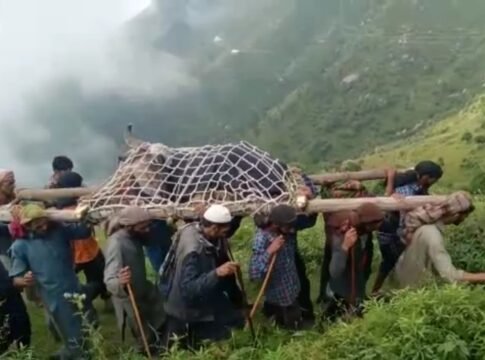
If any livestock is injured during migration, their difficulties multiply. Carrying an injured buffalo, cow, or horse through mountainous terrain becomes an enormous challenge. The story of Mohd. Azam, a Gujjar nomad from Rajouri district, illustrates this hardship. His buffalo was injured on the way to their summer dhoks.
Azam said he could not leave the animal behind to die. He requested help from friends and relatives, and around 30 to 40 people gathered to assist him. They tied the buffalo to a wooden stretcher and carried it on their shoulders across narrow mountain paths, steep trails, and rivers until they reached their destination. This is just one story—there are many others that reflect the resilience of Gujjar-Bakarwals.
Azam emphasized that livestock is everything to them, and abandoning an animal is not an option. He appealed to the government to construct shelters along main routes and develop safer, walkable tracks.
Compensation for a dead goat is not charity; it is recognition of a journey that is dangerous, ancient, and essential for the ecosystem. The Government of Jammu and Kashmir and the Ministry of Tribal Affairs should frame comprehensive policies for the welfare of Gujjar-Bakarwals, ensuring hassle-free movement on highways and in urban areas. There must be livestock insurance schemes to compensate for losses. The government should also deploy mobile medical and veterinary teams in upper reaches to minimize loss of human and animal life.
Most importantly, both the government and civil society must recognize the immense contribution and sacrifices of these communities.