


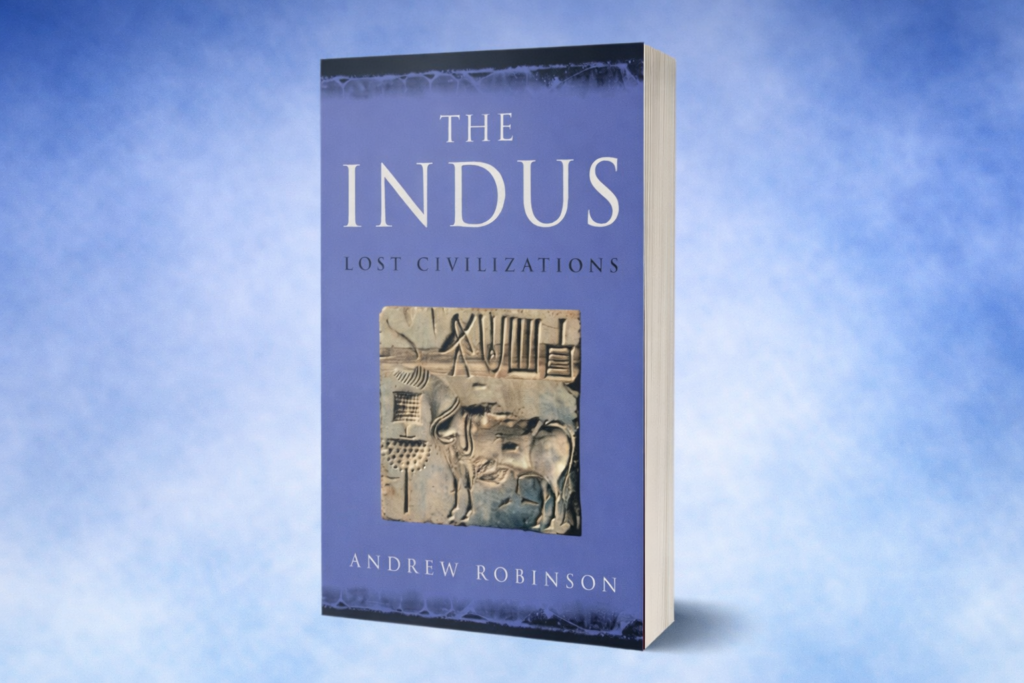
New Delhi: ‘The Indus: Lost Civilisations’, authored by Andrew Robinson and published by Macmillan Publishers India, is a captivating work of scholarship that attempts to amalgamate evidence of archaeology, linguistics, and culture of one of the oldest urban civilisations in the world.
The content unveils an easy-to-read yet scholarly piece that offers the reader a subtle insight into the accomplishments, mysteries, and eternal legacy of the Indus Valley civilisation. The book shows that Robinson is determined to present the Indus world not as an archaeological dead zone but as a dynamic and multifaceted civilisation whose impact is still felt in South Asians‘ cultural memory.
The description on the back cover outlines the book’s intellectual project. It prefigures the impressive period of the civilisation’s flourishing between 2600 and 1900 BCE and its later loss of historical visibility, only to be rediscovered in the 1920s.
The focus on the fact that the geographical scope of the civilisation is vast, the geographical area spread in excess of 800,000 square kilometres, and its advanced urban planning highlights the magnitude of its accomplishments.
The description highlights characteristics such as standardised weights and measurements, fired brickwork, and superior drainage systems, which imply a well-structured society. The lack of signs of war is especially prominent, prompting the reader to consider alternative modes of social organisation that can disrupt traditional accounts of state-building in the ancient period.
In the introductory chapter, entitled An Enigmatic World, the Indus civilisation is placed within the broader global narrative of early civilisations. Robinson utilises Kenneth Clark’s ideas about the foundations of civilisation to interpret the Indus world as part of a broader trend of human cultural advancement.
The contrast between Egypt, Mesopotamia, and early Indian philosophy, and the relative lack of knowledge of the Indus civilisation, highlights the main paradox of the Indus world: it is one of the most unknown ancient civilisations despite its enormity and technicality, since its texts were not deciphered.
Such framing encourages the reader to be both curious and cautious about the Indus world, acknowledging gaps in their knowledge while valuing the depth of the archaeological record.
The architecture pages provide a clear account of the content and structure of Indus settlements. The citadel and platform buildings, and the construction of the brick buildings, display a civilisation that is very much preoccupied with planning the city and its urban infrastructure.
The technical excellence of both mud bricks and burnt bricks, the lack of ornamentation in modelling, and the massive size of platforms at places like Mohenjodaro indicate a society with priorities towards functionality, stability, and communal labour.
The fact that no tools were used in the making of bricks, even though their use is very common, raises interesting questions about how they produced them and how they organised labour. These architectural observations can be added to the general knowledge of the Indus world as a civilisation characterised by meticulous planning and community investment.
Burial practices pages provide an insight into the social and ritual aspects of Indus life. The evidence of inhumations at Kalibangan, Lothal, and Ropar, and of very few instances of cremation, indicates a variety of mortuary methods, possibly representing social differentiation or regional variation.
There is also the lack of fancy grave gear, as was the case in Mesopotamia and Egypt, and this suggests a community that did not value material wealth in the next world. A unique insight into personal adornment and social status can be gained from the photo of the Harappan skeleton adorned with steatite beads and golden ornaments. The fact that grave wealth is gradually decreasing over time raises questions about changing religious beliefs or economic factors.
The agriculture and domestication sections broaden the reader’s understanding of the civilisation’s subsistence mechanisms. The controversy over the horse bones at Harappa, with archaeologists such as McIntosh and Kenoyer offering divergent views, reveals the ambiguities of zooarchaeology.
The mention of donkeys, onagers, and the inexplicable appearance of the Equus caballus highlight the political and cultural sensitivity of the horse in South Asian history. The elephant and dog pages offer additional information on the domestication of animals, and terracotta figurines could be considered a good piece of evidence for relations between people and animals.
When the author talks about the presence of paw prints on the drying clay, one cannot help but feel that this scene creates a very strong image of the life of normal people in Indus settlements, as it brings to mind that archaeological remains frequently leave behind the traces of the routine life together with the grandeur.
The intellectually stimulating reading is the most stimulating on the pages about the Indus script. Robinson presents the opposing scholarly arguments in an understandable manner, citing those of Steve Farmer, Richard Sproat, and Michael Witzel, who doubt that the script is a true writing system.
The fact that the characters could be non-linguistic symbols is an argument against the traditional idea of the civilisation’s literacy. Inscriptions are short, monumental texts are absent, and bilingual inscriptions are not used, which makes deciphering difficult. The fact that inscribed objects vary in number, with 5,000 as the highest and 2,906 as the lowest, as Robinson points out, indicates the methodological challenges associated with cataloguing fragmentary material.
The title of the chapter, Deciphering the Indus Script, highlights the irony that, although many have claimed to have deciphered it since 1925, none of the proposals has gained academic acceptance.
The book provides a useful time scale for placing the Indus civilisation in world history. The chronologies contrast the events of ancient Mesopotamia, Egypt, China, and India, allowing the reader to admire the interdependence of the ancient civilisations.
Events like the rule of Sargon of Akkad, the writing of the Rigveda, and the downfall of Harappa place the Indus world within a wider context of cultural interaction, movement, and technological development. These time markers enhance the book’s pedagogical quality, and it is a helpful source of information for students as well as scholars.
The biographical note about Andrew Robinson supports the author’s legitimacy. His long history of writing about both the arts and the sciences, his work in periodicals such as Nature and Science, and his prior work on undeciphered scripts all make him an experienced director of the mysteries of the Indus world. His subscription to the University of Cambridge and the Royal Asiatic Society also supports his academic qualifications.
The book is a revelation of an intellectually rigorous and approachable work. Robinson’s compilation of archaeological data, script controversy, archaeological study, and cultural explanation gives the reader a complex view of the Indus civilisation.
The uncertainty that the book focuses on, be it in the ability to read the script, the possibility of deciphering the burial practices, or determining the origins of the animal remains, is an adult scholarly stance that accepts the constraints of the present knowledge and asks future research questions.