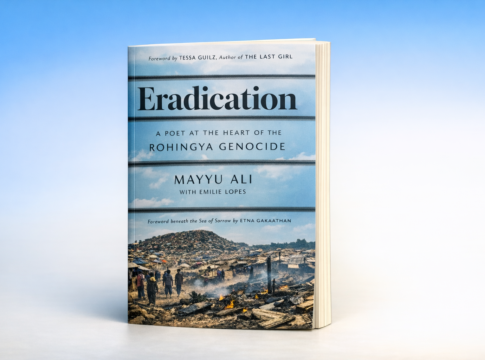
New Delhi: It is a world where the pen is usually silenced, but one man has taken advantage of it to serve the human race. Eradication: A Poet at the Heart of the Rohingya Genocide, authored by poet-activist Mayyu Ali and French journalist Emilie Lopes and translated into French by Siba Barkati, is a heart-rending first-person narrative of one of the most catastrophic humanitarian disasters of the twenty-first century.
This is a non-fiction piece published by Pan Macmillan, and it comes with a stern warning: it has graphic descriptions of genocide, sexual violence, and death.
It is recommended to leave it to the reader.
But the book’s foreword maintains that we need such discomfort. It says that the publication of his story was the need of the hour, and the only means to save the people from the darkness and despair.
Life under threat
The book almost failed to see the light of day. At the time the authors completed the writing, the publication was suspended two years ago. Mayyu Ali continued to amend his work even as his contacts went missing. Others were kidnapped by the police. The public library and the police department were shut down for six months. Ali did not surrender even though he was threatened and feared.
Ali has been an unremitting campaigner since 2017, when an estimated 740,000 Rohingya were forced to escape Myanmar in a wave of violence.
He has been living in a refugee camp on the outskirts of Banda and has documented the atrocities committed by the military of Myanmar.
General Min Aung Hlaing is the name of the mastermind of the 2017 massacre in the state of Rakhine, which was identified in the book. His cold, chilling words are quoted: ‘We have been brought to a state of oblivion.’
Poetry of resistance
Ali’s poetic voice is present in the story. There is one of his lines that has been widely shared on social media that reflects the horrors of life under persecution on a day-to-day basis: Every night, I am killed. Every precarious safety is the foundation of my life.
His poems turn personal tragedy into a shared witness, so that the crisis, which the mainstream media tends to forget, is not lost.
Some did not survive, and the book is a homage to them. Activist Mohib Ullah, a friend of Ali and his mentor, was assassinated in the Kutupalong refugee camp in the process of completing his own documentation of the crimes against the Rohingya.
Such losses do not stop Ali, who opens the Rohingya Art Garden where children and adults can learn their culture and history.
Call to the world
The foreword is by Emilie Lopes, who recounts her own visceral experience of visiting the camps. The scene, she writes, was chilling, opaque. “I felt sick.” She reports that even after writing articles and collecting money, she always felt that it was the Rohingya who had been doomed to bear the brunt.
Instead, Ali gave hope. “He was ready to do anything to save his people and never appeared disillusioned.”
Rohingya have been rendered stateless, having been stripped of citizenship in Myanmar, since 1982 by a law. The very name of the Rohingya is even banned. Their villages are ruined, women have been raped, and young girls and men have been killed.
The United Nations estimates that waves of violence have displaced hundreds of thousands of people, with an estimated 500,000 Rohingya left in Myanmar, without access to the world.
An essential document
Eradication is more than a memoir. It is a bearing-witness work. The book provides a crucial inside story to journalists, human rights advocates, and ordinary readers who may want to learn more about a genocide that even the International Criminal Court continues to probe into.
According to The Asian Review on the cover, Ali has done so with his pen in the interests of humanity. In a forgetful era, this poem by the poet does not allow the world to turn a blind eye.