


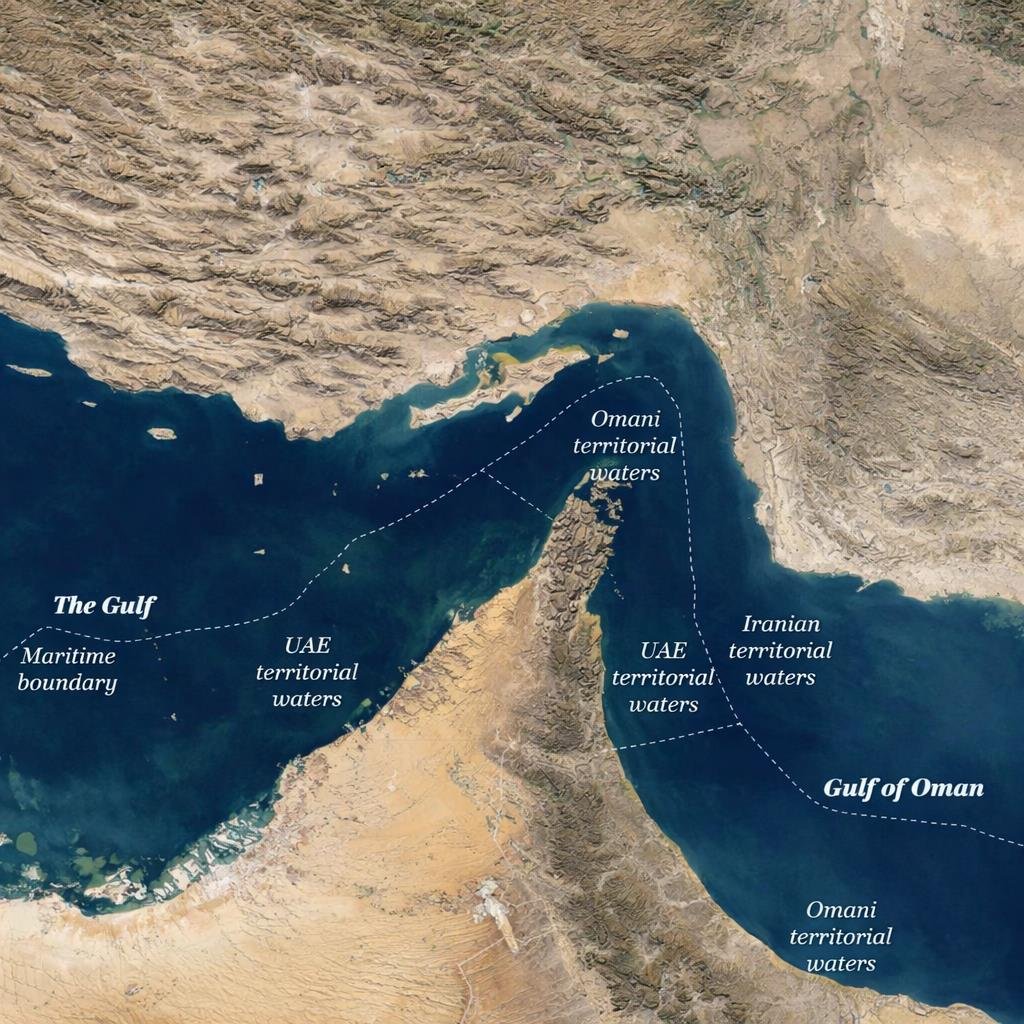
As the US-Israel war on Iran enters a critical phase in early May 2026, the Strait of Hormuz has once again become the focal point of confrontation. Conflicting claims surrounding an alleged Iranian missile strike on a US naval vessel, Iran’s release of an ambitious new maritime map, and retaliatory accusations from the UAE underscore a dangerous mix of military posturing, economic coercion, and high-stakes diplomacy. For global energy security and regional stability, the developments carry profound implications.
On May 4, Iranian state media, particularly Fars News Agency (closely tied to the Islamic Revolutionary Guard Corps), reported that two missiles struck a US frigate near Jask after the vessel ignored warnings to halt. This incident allegedly followed IRGC naval warnings and occurred against the backdrop of Washington’s newly announced “Project Freedom” — a naval mission to escort stranded commercial vessels out of the Strait.
US officials and CENTCOM swiftly rejected the claims as “fabricated.” A US official described the Iranian report as false, while CENTCOM affirmed that no American vessels had been attacked, even as it confirmed support for Project Freedom and enforcement of a naval blockade on Iranian ports.
Adding to the complexity, the UAE accused Iran of launching two suicide drones at an ADNOC-affiliated tanker in the Strait, labeling the action “acts of piracy” by the IRGC with no reported casualties. These exchanges highlight a classic fog-of-war scenario where information operations play as significant a role as kinetic actions.
Compounding the tension, Iran’s Revolutionary Guard navy released a new map redefining control lines in the Gulf. The map extends Iranian operational zones eastward from Mount Mubarak to southern Fujairah (UAE) and westward from Kashmir Island to Umm Al Quwain. Analysts note this effectively seeks to neutralize UAE bypass routes for oil exports via Fujairah and challenges aspects of UAE territorial waters.
Iranian officials frame this as necessary for defending the Strait — their primary remaining leverage in negotiations amid the broader conflict. Military analyst Alexandru Hudisteanu described the map as “excessive” and contrary to international law, yet reflective of Iran’s determination to maintain dominance over this chokepoint. Tehran views the Strait as its strongest card for forcing concessions in any peace process.
The Hormuz developments cannot be isolated from the wider war. President Trump’s Project Freedom responds to stranded shipping caused by the closure or restriction of the Strait. Iran has warned repeatedly that US interference would provoke naval confrontations. Meanwhile, Tehran has submitted a 14-point proposal to end the war, which Washington has deemed “unacceptable,” with both sides assessing responses.
Analysts like University of Tehran professor Foad Izadi argue the US-Iran ceasefire effectively collapsed earlier — citing the US blockade of Iranian ports (an act of war under international law) and the seizure of an Iranian vessel. The arrival in Iran of 15 crew members from the US-captured MV Touska adds another layer of humanitarian and diplomatic friction.
Parallel escalation continues elsewhere: Israeli operations in southern Lebanon (with reported ground clashes involving Hezbollah) and Gaza (including expansion of control via an “Orange Line” and strikes wounding medics) illustrate the multi-front nature of the crisis. Emirates airline’s restoration of near-full operations signals some resilience in regional connectivity despite disruptions since late February.
Strategic Implications
For Iran: The Strait remains its asymmetric advantage. By asserting expanded control and demonstrating willingness to harass shipping, Tehran aims to raise the costs of continued pressure and compel negotiations on favorable terms. However, overreach risks unifying Gulf states against it and inviting stronger US-Israeli responses.
For the United States and Allies: Project Freedom asserts freedom of navigation principles central to US strategy. Denying Iranian claims helps manage escalation while maintaining pressure through blockades. The challenge lies in avoiding miscalculation — as Hudisteanu warns, the risk is high when both sides operate under wartime conditions with incomplete information.
For the UAE and Gulf States: Direct targeting of commercial assets threatens economic lifelines. Abu Dhabi’s strong condemnation reflects broader concerns about Iranian coercion undermining the post-Abraham Accords security architecture.
Global Ramifications: Roughly 20-30% of global seaborne oil passes through the Strait. Sustained disruption or even credible threats can spike energy prices, strain supply chains, and complicate economic recovery worldwide. Pakistan’s opening of land trade routes with Iran offers a limited workaround but highlights shifting connectivity amid conflict.
The current impasse in the Hormuz reveals deep structural mistrust. Iran’s 14-point proposal and US reviews suggest backchannel diplomacy continues, yet military actions and maximalist territorial claims erode confidence. International law, freedom of navigation, and the balance of power in the Gulf are all under contestation.
A sustainable de-escalation would require creative diplomacy that addresses Iran’s security concerns and economic needs while upholding core maritime principles. Without it, the region risks a cycle of tit-for-tat incidents that could rapidly broaden. As day 66+ of intensified conflict unfolds, the Strait of Hormuz serves as both a barometer of tensions and a potential gateway to negotiated exit ramps — provided all parties recognize the catastrophic costs of full-spectrum confrontation.
Diplomat Digital will continue monitoring developments closely.