

For many outside observers, the United Kingdom appears to be a single country much like France, Japan, or Italy. Its passport is British, its military operates under a unified command, and its foreign policy is represented by a single government in London. Yet beneath that appearance lies a constitutional arrangement unlike almost any other in the world.
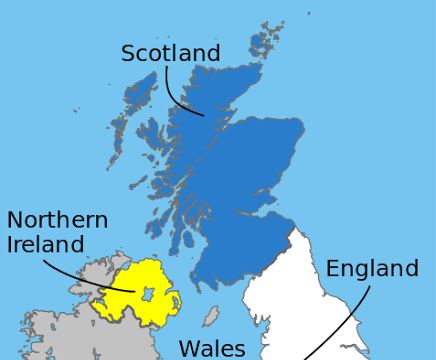
The United Kingdom is not a unitary nation-state in the conventional sense. It is a political union composed of four constituent countries—England, Scotland, Wales, and Northern Ireland—each possessing its own history, identity, and varying degrees of self-government. Understanding the United Kingdom therefore requires understanding not only its institutions but also the centuries-long process through which distinct nations were brought together, often uneasily, into a single state.
For an observer from India—a country whose own history was shaped by partition, competing national identities, and debates over federalism—the British experience offers a fascinating case study. The United Kingdom demonstrates how a state can endure despite profound differences among its constituent peoples, while also illustrating how questions of identity and sovereignty never disappear entirely.
A State Built Through Unions
Unlike many modern states that emerged through revolutions or written constitutions, the United Kingdom evolved gradually over centuries. Constitutional scholars often describe it as a “state of unions” rather than a nation formed at a single historical moment.
The process began with Wales, which became incorporated into the English legal and administrative system during the sixteenth century. Scotland followed through the Acts of Union of 1707, which merged the English and Scottish parliaments and created the Kingdom of Great Britain. Nearly a century later, the Union with Ireland in 1801 established the United Kingdom of Great Britain and Ireland. Following Ireland’s struggle for independence, most of the island left the union in the early twentieth century, while six counties in the north remained within the United Kingdom, forming what is now Northern Ireland.
The result was not the disappearance of older national identities. Scots continued to regard themselves as Scottish, Welsh people maintained their linguistic and cultural traditions, and Irish identity remained deeply rooted in Northern Ireland. Rather than erasing these identities, the British state evolved mechanisms to accommodate them.
That accommodation remains one of the defining features of the United Kingdom today.
Four Nations, One Sovereign State
The modern United Kingdom comprises four constituent countries, but their political weight and constitutional positions differ significantly.
England, home to roughly 85 percent of the UK’s population, dominates economically and politically. London houses the Westminster Parliament and the central institutions of the British state.
Scotland retains its own legal system, educational traditions, and national institutions. Its separate identity predates the union itself and remains among the strongest examples of national consciousness within Europe.
Wales, long integrated into the governance structures of England, has experienced a cultural revival in recent decades, particularly through the promotion of the Welsh language and devolved governance.
Northern Ireland occupies perhaps the most complex position. Its history is shaped by competing British and Irish identities, decades of political violence, and a peace process that fundamentally reshaped its constitutional framework.
Despite these differences, all four nations remain part of a single sovereign state represented internationally by the United Kingdom government.
Devolution: The Constitutional Compromise
The most significant constitutional change in modern Britain came not through independence movements but through devolution.
During the late 1990s, voters in Scotland, Wales, and Northern Ireland approved arrangements that transferred significant powers from Westminster to locally elected institutions. This led to the establishment of the Scottish Parliament, the Welsh legislature known as the Senedd, and the Northern Ireland Assembly.
Today, these bodies exercise authority over major domestic matters such as education, health, transport, agriculture, and aspects of taxation. Westminster retains control over defense, foreign affairs, immigration, and other reserved powers.
Devolution was intended to satisfy demands for greater self-government without dissolving the union itself. In many respects it succeeded. Citizens in Scotland, Wales, and Northern Ireland gained greater control over local affairs while remaining part of a larger state.
Yet devolution also produced an unintended consequence. By creating powerful national institutions outside London, it strengthened political identities that already existed. The Scottish Parliament, for example, became not merely an administrative body but a focal point for debates about Scottish nationhood and independence.
Brexit and the Return of Constitutional Questions
For much of the early twenty-first century, the constitutional debate appeared manageable. Then came Brexit.
The 2016 referendum exposed profound political differences within the United Kingdom. England and Wales voted to leave the European Union, while Scotland and Northern Ireland voted to remain.
The outcome generated a new constitutional dilemma. Many Scottish voters argued that their preference had been overridden by a larger English electorate. In Northern Ireland, Brexit reopened sensitive questions about borders, identity, and the region’s relationship with both Britain and the Republic of Ireland.
Brexit did not create these tensions, but it intensified them. Questions that had appeared settled suddenly returned to the center of political debate. Discussions about Scottish independence gained renewed momentum, while debates over Irish reunification became more prominent than at any time since the Good Friday Agreement.
Why the Union Endures
Despite recurring predictions of breakup, the United Kingdom has proven remarkably resilient.
One reason is economic integration. Businesses, labor markets, infrastructure networks, and public finances remain deeply interconnected across the four nations. Decades of shared institutions have created practical realities that cannot be easily separated.
Another reason is institutional flexibility. Unlike states constrained by rigid constitutional structures, the United Kingdom has often adapted incrementally to political pressures. Devolution itself was an example of such adaptation.
There is also a shared political and cultural space that transcends national boundaries. Citizens move freely throughout the country. Families often span multiple nations. National institutions such as the National Health Service, the BBC, and the armed forces continue to shape a broader British identity alongside local national loyalties.
For many people, being Scottish and British, or Welsh and British, is not viewed as contradictory. Identity in the United Kingdom is often layered rather than exclusive.
A New Debate About the Future
Recent political developments suggest that constitutional questions are once again gaining momentum.
In September 2026, leaders from Scotland, Wales, and Northern Ireland jointly called for constitutional change and greater recognition of their nations’ political aspirations. While the practical implications remain uncertain, the symbolism was significant: three of the four constituent nations publicly questioning the long-term balance of power within the union.
Yet it would be premature to interpret these developments as evidence of imminent disintegration. Constitutional change in the United Kingdom has historically been gradual rather than sudden. The country’s future is likely to be shaped by negotiation, compromise, and evolving political realities rather than dramatic rupture.
The more immediate question may not be whether the union survives, but what form it takes in the decades ahead.
Lessons Beyond Britain
For countries grappling with questions of identity, autonomy, and regional aspirations, the British experience remains instructive.
The United Kingdom demonstrates that political unity does not necessarily require cultural uniformity. It shows how multiple national identities can coexist within a single state, though not without tension. It also illustrates that constitutional arrangements must continually adapt to changing political expectations.
From an Indian perspective, these debates carry particular resonance. South Asia’s modern history has been shaped by partition, linguistic movements, federal negotiations, and competing visions of nationhood. While Britain’s circumstances differ fundamentally from those of the subcontinent, both experiences highlight a common reality: states are rarely static entities. They are ongoing political projects requiring consent, accommodation, and periodic reinvention.
More than three centuries after the Acts of Union created Great Britain, the United Kingdom remains a remarkable constitutional experiment. Its future is uncertain, but perhaps that uncertainty is itself part of the story. The British union has survived not because it resolved every question of identity and sovereignty, but because it has repeatedly found ways to manage them.
Whether it can continue doing so in the twenty-first century may become one of the most consequential constitutional questions in Europe.