


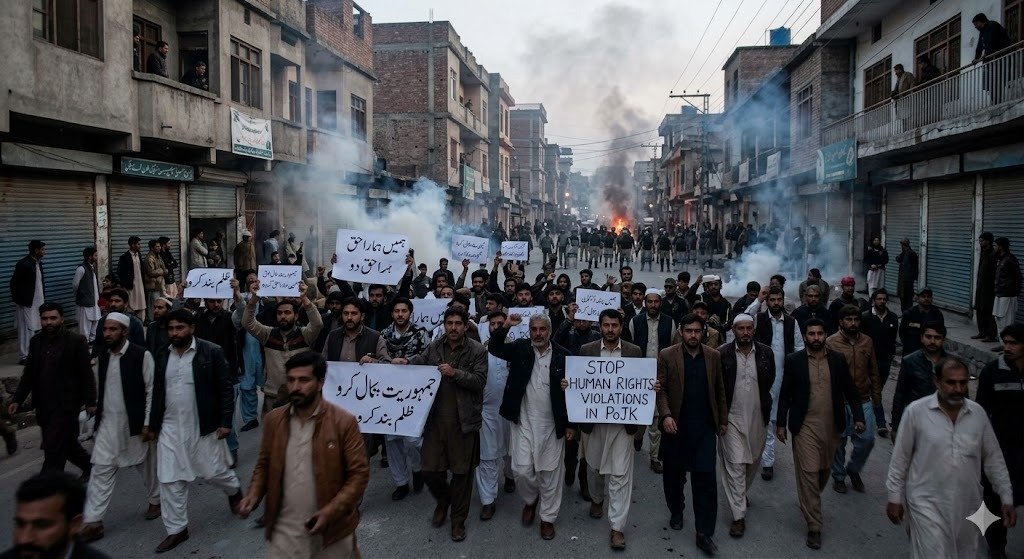
MUZAFFARABAD: Growing unrest in Pakistan-occupied Jammu and Kashmir (PoJK) has triggered international concern over allegations of human rights violations, restrictions on democratic freedoms, and the use of force against protesters, as demonstrations continue across several parts of the region.
The unrest has reignited debate over governance, political representation, economic conditions, and civil liberties in PoJK, while drawing comparisons with the democratic and developmental trajectory witnessed in Jammu and Kashmir (J&K).
Democracy Under Scrutiny
Political observers note a widening contrast between the two regions. In Jammu and Kashmir, political aspirations are largely pursued through electoral processes and democratic institutions, allowing citizens to participate in governance and public decision-making.
In PoJK, however, activists and opposition groups have alleged increasing restrictions on dissent and political mobilization. The Jammu Kashmir Joint Awami Action Committee (JK-JAAC), which has emerged as a prominent grassroots movement advocating political and economic reforms, has reportedly faced arrests, detentions and administrative crackdowns. Critics argue that while Pakistan advocates democratic rights for Kashmiris on international platforms, voices seeking reform within PoJK are increasingly subjected to pressure and restrictions.
Economic Frustration Fuels Protests
Analysts believe deteriorating economic conditions have become a major driver of public discontent in PoJK. Rising inflation, unemployment and the increasing cost of essential commodities have intensified frustration among residents.
The protests come against the backdrop of Pakistan’s prolonged economic challenges, with demonstrators demanding better governance, economic relief and greater accountability. In contrast, J&K has witnessed significant investments in infrastructure, tourism, connectivity and public welfare projects aimed at boosting economic growth and employment opportunities.
International Community Watches As Human Rights Concerns Mount
Human rights organizations and international observers have expressed concern over reports of casualties, mass detentions and communication restrictions imposed during the protests.
According to reports from local groups, dozens of protesters were killed or injured during clashes with security forces in several towns, including Kotli, Muzaffarabad, Mirpur, Rawalakot and Plandri. The demonstrations were largely centered on demands for political representation, economic reforms and administrative accountability.
The developments have drawn criticism from international rights advocates. Amnesty International and other watchdog organizations have reportedly called for restraint and respect for fundamental freedoms. More than 50 British lawmakers are also reported to have urged the United Kingdom’s government to raise concerns regarding the situation in PoJK.
How Pakistan Stops Information Restricting Press Freedom
Media freedom advocates have also raised alarms over restrictions on information flow from the region. Internet shutdowns, disruptions to mobile services, restrictions on social media access and reported intimidation of journalists have limited independent reporting from protest-hit areas.
Observers warn that communication blackouts and restrictions on press activity risk further undermining transparency at a time when international scrutiny of the situation is increasing.
Youth Caught Between Uncertainty and Unemployment
The unrest has highlighted growing concerns among PoJK’s youth, many of whom face limited employment opportunities, inadequate economic prospects and restricted access to quality education.
Experts warn that prolonged economic stagnation and lack of opportunities could deepen social alienation and fuel further instability if underlying grievances remain unaddressed.
Protests Escalation of Protests
The situation intensified between June 5 and June 9, with large-scale demonstrations reported across multiple districts. Thousands of protesters reportedly mobilized in Kotli and surrounding areas, while security forces increased deployments to contain the unrest.
Authorities imposed Section 144 in parts of Muzaffarabad and Rawalakot, sealed the central office of the Awami Action Committee, and carried out a series of arrests targeting protest leaders and activists. Reports also indicate that internet services have been suspended until further orders in several areas.
Meanwhile, allegations have surfaced regarding the circulation of misleading content on social media and the deployment of extensive surveillance measures, including drones and additional security personnel, to monitor protest activities.
Region at a Crossroads
As tensions continue, the developments in PoJK have become a focal point of international discussion on governance, human rights and democratic freedoms in the region. Analysts say the unfolding crisis reflects deeper structural challenges related to political representation, economic opportunity and public accountability.
With international attention growing and protests showing little sign of subsiding, the coming weeks are likely to prove critical in determining whether dialogue and reform can address mounting public grievances or whether the region will witness further instability.