
New Delhi: Few intellectual conflicts in recent Indian history have had as much influence on political and constitutional developments in the country as the conflict between Mahatma Gandhi and Dr B.R. Ambedkar.
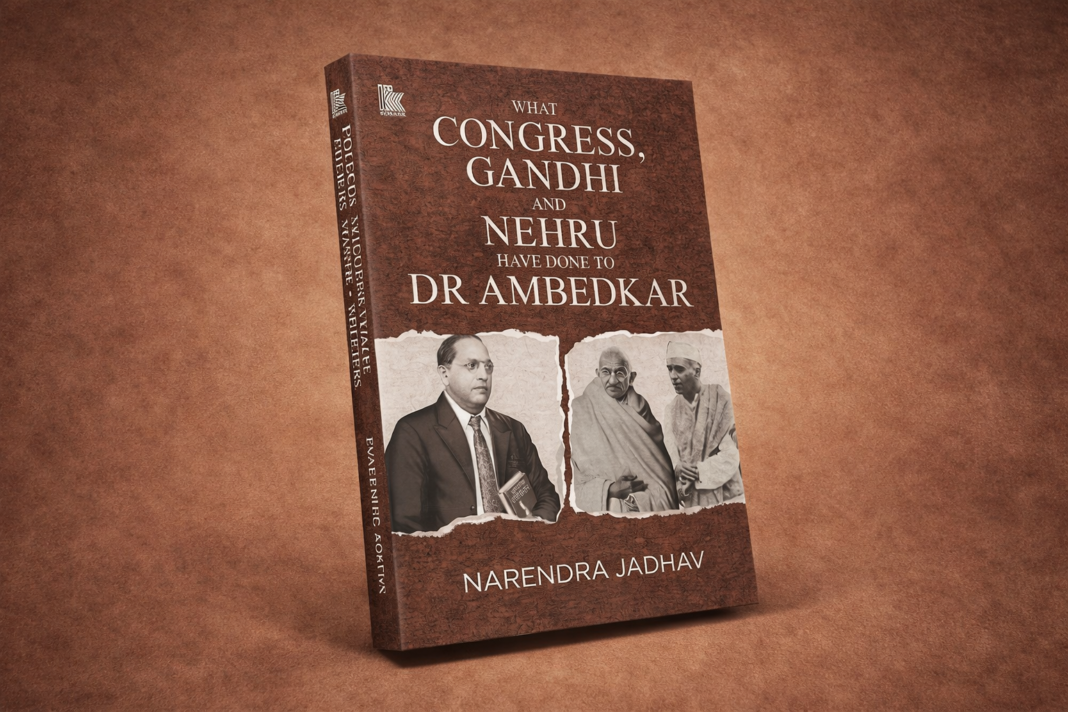
In a new book, ‘What Congress, Gandhi and Nehru Have Done to Dr Ambedkar’, the great economist, scholar, and former Member of Parliament, Dr Narendra Jadhav, has undertaken a careful excavation of this troubled association and its long-term impact on the social life of India.
Konark Publishers Pvt Ltd released the volume as a continuation of a developing body of literature re-evaluating the historical issues of the Indian freedom struggle. Dr Jadhav, the author, earned a PhD in Economics from Indiana University, worked as Chief Economist at the Reserve Bank of India, and is currently producing a web series on the Indian Constitution, combining an unusual blend of research and experience in real-world affairs.
He is a prolific author, having written 47 books in English, Marathi and Hindi, and is amongst the most diverse public thinkers of his age.
Clash of worldviews
The first meeting between two giants of Indian public life took place on 14 August 1931 at Mani Bhavan in Mumbai. Dr Jadhav sketches the difference in dramatic lines: Gandhi, the skinny, half-clad member of a well-to-do Vaishnavite family, and Ambedkar, the fat-bodied barrister born into the poverty and degradation of untouchability. Their contrasting upbringings, the author claims, were not simply the biographical curiosities but the sources of the incompatibilities of political philosophy.
Dr Jadhav takes pains to record that, despite his opposition to untouchability, Gandhi never brought the Chaturvarna system into question. Young India writes in December 1920, and the book quotes this statement by Gandhi: I feel that Caste has rescued Hinduism out of disintegration… I define the four divisions [Chaturvarna] in themselves as being fundamental, natural and essential… The Caste system is not founded on inequality; there is no issue of inferiority.
To Ambedkar, this stand was sacrilege. He considered the caste system to be a graded inequality system in which there is an ascending scale of reverence and a descending scale of contempt. In contrast to Gandhi, who idealised the village as the best unit of Indian civilisation, Dr Jadhav observes that Ambedkar described the village as cesspools where caste-based oppression thrived. Where Gandhi envisaged Ram Rajya, Ambedkar saw the spectres of Eklavya and Shambuka: Hindu mythological figures punished for violating their allotted social status.
Temple entry
Among the most enlightening parts of the book is the analysis of the Temple Entry Movement of the 1930s, a movement that, according to Dr Jadhav, revealed the cracks in the philosophy of reformism upheld by Gandhi and the structural change as demanded by Ambedkar.
After the Poona Pact of 1932, Hindu campaigners undertook vigorous campaigns to open temples to the untouchables, with weekly lists of recently opened temples, wells, and schools prominently featured in the mouthpiece of Gandhi, Harijan.
This movement was looked at with suspicion by Dr Ambedkar. In early 1933, he also issued a press statement in which he stated that he would not support the Temple Entry Bill, on the grounds that it was based on the principle of majority rule rather than the understanding that untouchability was an evil custom.
Dr Jadhav presents Ambedkar’s reasoning in his typical style: The Bill did not recognise untouchability as a sinful act, but merely as a social evil; it presupposed that the decision of a majority could make holy what was essentially immoral.
Ambedkar took the matter even further and accused Gandhi of making a somersault on the temple issue, either because he needed to destroy the untouchables’ claim to political rights, or because, as he said, he was seeking to add to his name and fame.
Theoretical Resistance
The study does not limit itself to the current political confrontations but also goes back to outline the intellectual lineage of Ambedkar’s thought as seen by Dr Jadhav. The book outlines Ambedkar’s extensive study of Western philosophy, particularly his fascination with Voltaire and Edmund Burke.
Drawing on his own works and the scholar’s writings, the author shows how the scholar-child Voltaire, in the war on Catholic orthodoxy, provided the model for challenging the authority of Brahminism. This query of Ambedkar–why had no Brahmin scholar risen to play the role of a Voltaire–is put forward as a scornful reproach at the intellectual complacency of those who were content to aid the preservation of caste.
In the book, there is also an account of Ambedkar’s strict academic life: his Master of Science diploma from Columbia University, his Doctor of Science from the London School of Economics, and his call to the Bar.
According to Dr Jadhav, Ambedkar studied as many as 21 hours a day, warning his Indian roommate in London: “No money, no food; and no time, no sleep!” According to the author, this field of intellectual study gave Ambedkar a kind of intellectual armoury, making him a singularly powerful opponent of the colonial regime and the social orthodoxy of Hinduism.
The Political Setback of 1946
The most heart-rending part of the book, perhaps, is the one concerning the provincial elections of 1945-46, a disaster for the political project of Ambedkar, as Dr Jadhav calls it, a devastating setback. Ambedkar formed an organisation called the Scheduled Castes Federation, which secured only two out of 151 reserved seats, one in Bengal and the other in the Central Provinces.
The author observes that, with this outcome, the Federation no longer had a claim to represent the Untouchables.
It was after this election debacle that Ambedkar sat down with the British Cabinet Mission in April 1946 and presented his ideas for what should be included in the constitution to protect Indians.
Dr Jadhav puts this in the context of Indian independence talks in general, and how the Congress, the Muslim League and the British were all negotiating at the same time how the future polity would be formed.
These sections of the author have a certain authority because he is a policy practitioner, able to walk the fine line of constitutional bargaining with the finesse of someone who has personally served as a Member of the Planning Commission and the National Advisory Council.
Relating struggles
An afterword has been added to the book by Professor Kevin Brown, an African-American legal scholar who was a Fulbright Scholar in India in 1996. The contribution by Professor Brown adds a transnational dimension to the analysis, tracing the historical links between the struggle for African-American civil rights and the Dalit movement in India.
He observes that abolitionists such as Frederick Douglass invoked the analogy of the caste system to criticise the American form of slavery as early as the 1830s, and that this analogy was the main theme in discussions of the equality of races in the 19th and early 20th centuries.Brown focuses on the 14th Amendment to the US Constitution, which was introduced in 1868 and prohibits any state from creating laws that violate the privileges or immunity of citizens.
He cites the well-known dissent written by Justice Harlan in Plessy v Ferguson: In the sight of the law, at least in the sight of the constitution, there is no high, ruling, master race of citizens in this country. There is no caste here.” It is this American constitutional language, which Brown contends, that provides the perception of how the dreams of the African Americans, as well as the Dalits, to become full citizens can be attained.
Enduring relevance
At the very base, the book by Dr Jadhav is an argument for seeing Ambedkar as a serious person, not only as a social reformer but also as a political philosopher whose criticisms of both Gandhi and the Congress establishment are still useful in present-day India.
The intellectual experience of the author himself, his PhD in American economics, and his long career as a servant of the Indian people give the work its unique perspective, a viewpoint that fuses Western institutional thought and Indian social reality.
The book is also a reminder that India’s constitutional democracy did not come about through agreement but through fighting. The discussions between Gandhi and Ambedkar, the Congress’s ideal of an equal nation, and the demands for social justice at the bottom of the social hierarchy remain pertinent in modern political rhetoric.
Dr Jadhav has made his contribution in recording these controversies with scholarly attention, yet never forgetting their human side, the humiliation of a nine-year-old Bhimrao at a public tap, the intellectual discipline that converted the humiliation into a lifetime struggle against indignity, and finally the architectural constitution which ultimately came to take shape out of this furnace of controversy.
Any reader who wants to revisit the ideological principles of contemporary India will find What Congress, Gandhi and Nehru Have Done to Dr Ambedkar a rich historical document and a thought-provoking challenge to the unfinished work of social justice at the core of the Indian republic.