


New Delhi: The decade between 2015 and 2025 compressed a century’s worth of disruption into ten years. Demonetisation arrived in 2016, wiping out 86 per cent of currency in circulation overnight.
The Goods and Services Tax followed in 2017, restructuring the indirect tax architecture of the world’s fifth-largest economy. Then came the pandemic, the supply chain crisis, the war in Ukraine, and eleven consecutive interest rate hikes by the US Federal Reserve.
For corporate India, this was not a period of steady growth but a succession of shocks that tested whether businesses could absorb punishment and keep moving forward.
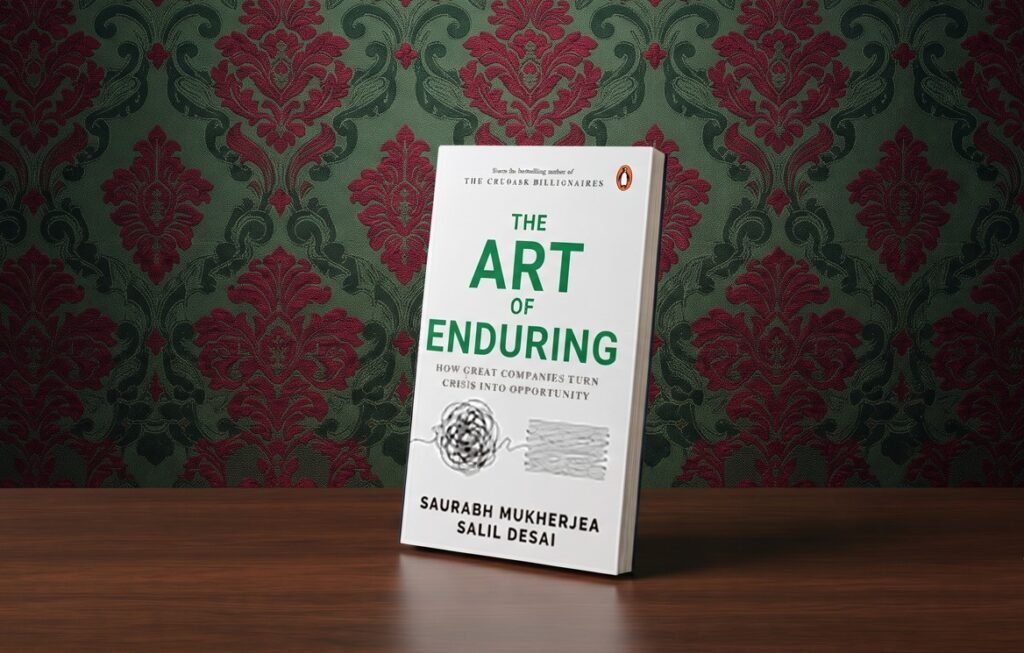
Saurabh Mukherjea and Salil Desai’s new book, The Art of Enduring: How Great Companies Turn Crisis into Opportunity, published by Penguin Random House India, asks a deceptively simple question: what do great companies do when the world goes wrong? The answer, they argue, lies in a willingness to befriend time rather than fight it.
The authors bring complementary expertise to this inquiry. Mukherjea is the founder and chief investment officer of Marcellus Investment Managers and a former CEO of Ambit Capital, with a track record of bestselling books on Indian equities including Coffee Can Investing and The Unusual Billionaires.
Desai is Marcellus’s head of research, a chartered accountant with two decades of experience covering multiple sectors at IDFC Securities and Premji Invest. Their collaboration has produced what is effectively a sequel to The Unusual Billionaires, but with a significantly harder screen.
That screen is worth understanding, because it explains why the book focuses on just five companies from India’s 500 largest. The authors began with the BSE 500 and eliminated companies younger than twenty-five years. Non-financial firms then had to clear a 15 per cent return on capital employed in every single year of the fifteen-year reference period, not on average.
Median revenue growth had to beat India’s nominal GDP growth of roughly 12 per cent. Profits had to grow faster than revenues. From 500 companies, only five made the final cut: Bajaj Finance, Titan, Dr Lal PathLabs, Divi’s Laboratories, and Tata Elxsi.
The filter is deliberately brutal, and the authors are explicit about why. Averages hide bad years, and a company that posts 15 per cent returns on average but loses money in two of fifteen years has not demonstrated endurance. It has demonstrated luck. The distinction matters, because the book’s central thesis is that endurance is not an accident. It is a capability that can be cultivated, and the five companies profiled have cultivated it in ways that are instructive.
The stories themselves are compelling. Bajaj Finance’s stock fell by 91 per cent between 2006 and 2009, yet the company went on to become one of India’s most consistent compounders.
Tata Elxsi saw its clients cancel contracts within weeks during the global financial crisis, but rather than lay off engineers, its leadership held a candid town hall and went on to win a do-or-die deal that propelled a decade of growth. Divi’s Labs faced an FDA import alert in 2017 that cut its stock by 60 per cent, but decades of trust with big pharma clients enabled a remarkably swift recovery.
The authors argue that three traits unite these companies. They identify a core set of distinctive capabilities and focus sharply on them rather than chasing every opportunity. They invest heavily in top talent, building institutional knowledge that outlasts individual leaders. And they take crises head-on, inscribing the learnings into institutional memory rather than pretending the crisis never happened.
The book also corrects the cult of the celebrity founder. In an era when business media fixates on flamboyant entrepreneurs, the five companies profiled are led by what the authors call “quiet compounders”, professionals like Dr Arvind Lal, Bhaskar Bhat, Rajeev Jain, and Om Manchanda, who built institutions rather than personal brands. This is a welcome shift in emphasis, because the mythology of the lone genius obscures the institutional architecture that actually enables long-term success.
For investors, the book’s most important lesson may be its insistence that the share price is an outcome, never a filter. Screening on stock returns selects on the result rather than the process. The companies that cleared the authors’ filters went on to beat the market handsomely, but that was a consequence of their discipline, not the criterion by which they were chosen.
The Art of Enduring is not a guaranteed blueprint for investment success, and the authors are careful to note that their firm and its clients may hold interests in the companies mentioned.
But as a study of what makes businesses durable in volatile conditions, it offers something more valuable than stock tips: a framework for thinking about resilience as a competitive advantage. For entrepreneurs, managers, and long-term investors navigating an uncertain decade, the book’s quiet compounders offer lessons worth heeding.