


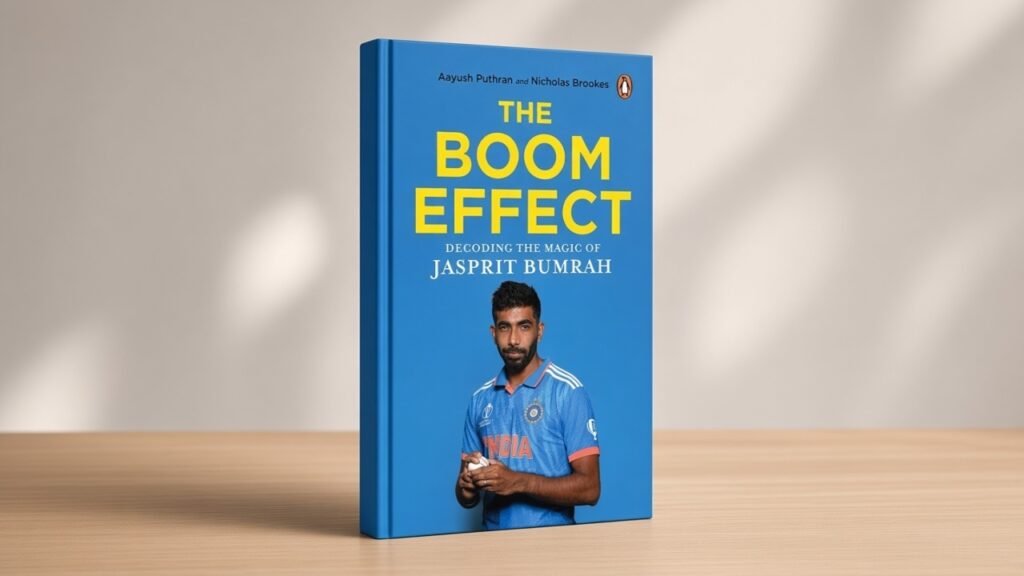
New Delhi: Jasprit Bumrah has become so familiar a presence in Indian cricket that it is easy to forget how profoundly strange his story actually is. He did not come through an elite academy or the India Under-19 system. He does not possess the physique conventionally associated with fast bowling, nor does he run in from a long, intimidating run-up.
His action is unorthodox, his short run-up almost casual, and yet he has transformed the yorker into an art form while leaving the world’s finest batters searching for answers.
A new book by Aayush Puthran and Nicholas Brookes, The Boom Effect: Decoding the Magic of Jasprit Bumrah, published by Penguin Random House India under its Penguin Play imprint, sets out to explain how this happened.
Puthran is a Bengaluru-based journalist whose debut non-fiction, Unveiling Jazbaa, was shortlisted at the Sunday Times British Sports Book Awards in 2023, and who writes for Cricbuzz. Brookes is an English writer based in Colombo since 2018, covering Sri Lankan cricket and its history for publications including ESPN’s The Cricket Monthly and Wisden’s The Nightwatchman. Their collaboration brings together an insider’s knowledge of the Indian cricket ecosystem with a historian’s instinct for context and evidence.
The book’s central question is not whether Bumrah is brilliant, but how exactly he is doing what he does.
As the publisher puts it, the book uncovers the man behind the phenomenon, tracing his struggles and resilience while asking why Bumrah feels faster than the speed gun suggests, what makes his deliveries so difficult to read, and how he developed such extraordinary control. This is not a conventional match-by-match biography.
Puthran and Brookes draw on research, published material and interviews to investigate the mechanics and thinking behind Bumrah’s success, dividing the narrative into three sections covering his Gujarat years, the physical and mental aspects of his game, and the period in which he emerged as a global cricketing force.
The Gujarat section is particularly valuable because it recovers a period of Bumrah’s career that most fans know only in outline.
He grew up in Ahmedabad, learning much of his craft by watching fast bowlers on television and playing gully cricket, and entered structured cricket relatively late.
What the book documents is how quickly he made an impact once he did. In his first full Ranji Trophy season, he took 38 wickets in eight games at an average of 21.15, and in the Vijay Hazare Trophy he claimed 13 wickets in five games at 13.76.
Gujarat’s long wait for domestic silverware ended within a month of his professional debut, and the book notes the striking coincidence that the state has not won again since his last domestic season.
The book also examines the competing accounts of who first identified Bumrah’s talent, a question that has taken on a certain mythology in Indian cricket.
More interesting is its treatment of the setbacks that might have derailed him. The most revealing episode concerns his third season at Mumbai Indians, when a freak knee injury sustained while kicking a football during Duleep Trophy preparations catalysed what the book calls “Jasprit Bumrah 1.0” becoming an updated version, leaner and meaner.
In the months that followed, his place in the Mumbai Indians side came under serious threat, with the franchise’s top brass apparently wanting to cut ties halfway through the season.
That Rohit Sharma, and possibly Sachin Tendulkar, intervened to talk them down is the kind of detail that makes the book’s behind-the-scenes reporting worthwhile.
What emerges from The Boom Effect is a portrait of a cricketer whose apparent weaknesses became the foundation of his success.
The unconventional action, the short run-up, the lack of academy pedigree, these were not obstacles he overcame so much as raw materials he transformed.
The book’s argument is that Bumrah’s genius lies not in spite of his differences but because of them, and that understanding this requires looking closely at the discipline, grind and consistent effort that shaped what the authors call the “Boom Effect.”
At 256 pages, the book is substantial enough to give the technical and biographical material room to breathe without becoming exhaustive.
For cricket fans who have watched Bumrah bowl and wondered how he does it, it promises the kind of detail that can make a familiar player suddenly fascinating again.
For readers interested in excellence more generally, it offers a case study in how an unconventional talent can turn the things that make him different into an advantage.
Penguin Play has produced a book that takes its subject seriously, and in doing so, takes its readers seriously too.