


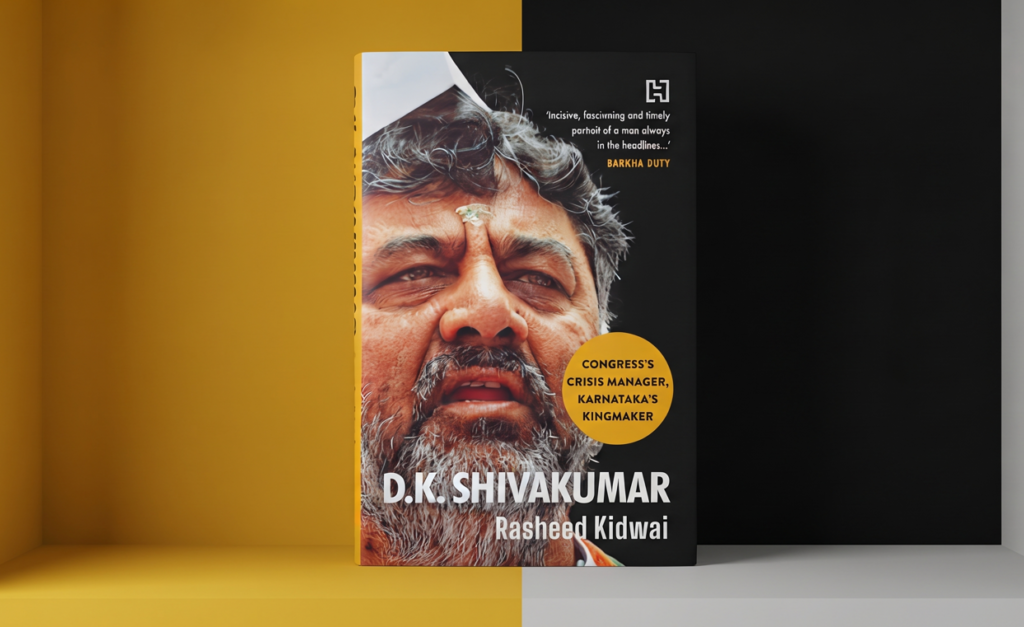
New Delhi: There is a particular kind of political biography that succeeds not by revealing secrets but by explaining patience. Rasheed Kidwai’s new book, D.K. Shivakumar: Congress’s Crisis Manager, Karnataka’s Kingmaker, published by Hachette India, belongs to that category.
The book arrives at a moment when its subject has finally moved from the wings to centre stage, having been sworn in as Karnataka’s Chief Minister in June after years of speculation, negotiation and carefully calibrated restraint.
Kidwai is a veteran Congress watcher whose access to the party’s top leadership is well established, and the book was two years in the making. That timing matters, because it means the narrative was constructed while the succession drama was still unfolding, not retrospectively smoothed into inevitability. The result is a portrait of a politician whose defining characteristic, Kidwai argues, has been his willingness to wait.
The Shivakumar that emerges from these pages is not a mass leader in the conventional sense. He does not command crowds through oratory or embody a broad social movement in the way his predecessor Siddaramaiah did.
What he possesses instead is an extraordinary facility for political management: the logistics of keeping legislative flocks together, the back-channel negotiations that avert collapses, the quiet accumulation of relationships across states and party factions that make him indispensable to the high command.
Kidwai traces this reputation back to the 2002 episode in Maharashtra, when Shivakumar supervised the sequestering of Congress MLAs at a Bengaluru resort to shield them from poaching ahead of a trust vote, and forward to the 2017 Rajya Sabha election in Gujarat, when he performed a similar service for Ahmed Patel. These episodes, the book suggests, are not incidental anecdotes but the core of his political identity.
Kidwai is candid about the limitations of the existing literature on Karnataka politics, noting that while there are many books about deceased leaders, there are far fewer about those currently in the arena.
His decision to write about Shivakumar is framed as a contribution to a more informed democratic discourse, a chance for voters to understand who they are choosing and what they stand for.
That civic justification feels genuine rather than perfunctory, and it gives the book a seriousness of purpose that distinguishes it from the quicker, more gossip-driven political biographies that crowd the market.
The book does not shy away from the more contentious dimensions of its subject. Shivakumar’s wealth, his time in Tihar Jail in 2019 on money laundering charges, and his overt religiosity all receive attention. Kidwai treats the jail period as a traumatic episode, reporting that there were feelers about a possible change in political loyalty that Shivakumar declined to entertain.
On the question of his Hindu identity and his controversial rendition of an RSS song in the Assembly, Kidwai resists the easy conclusion that this places him outside the Congress’s secular tradition, arguing instead that his pragmatism is consistent with an older Congress mould. Whether readers find that argument persuasive will depend on their politics, but it is made with care rather than defensiveness.
The most revealing sections of the book concern the relationship with Siddaramaiah. Kidwai describes the two men as temperamentally different: Siddaramaiah carries the inheritance of the Janata tradition and a socialist vocabulary, while Shivakumar is more comfortable with business, development and management.
Their coexistence was never natural, and the rotational arrangement that eventually delivered the chief ministership to Shivakumar was, as Kidwai acknowledges, an innovation without precedent in political science textbooks.
The book’s account of how that arrangement was honoured, and of the roles played by Sonia Gandhi, Rahul Gandhi and Priyanka Gandhi Vadra in the eventual decision, will be of particular interest to anyone trying to understand how the Congress high command actually functions in the post-Sonia era.
Where the book has drawn criticism is on matters of factual precision and analytical overreach. One reviewer has noted inconsistencies in the demographic figures cited for Lingayats and Vokkaligas, and has questioned the claim that Shivakumar has emerged as the tallest Vokkaliga leader after H.D. Deve Gowda, given that H.D. Kumaraswamy remains an active force with two terms as Chief Minister to his name.
The same reviewer suggests that the book overstates the centrality of Siddaramaiah’s AHINDA coalition in explaining Congress success in Karnataka, a state where the party has historically performed strongly even when losing elections. These are fair points, and they suggest a book that is stronger on political texture than on the harder edges of electoral analysis.
The portrayal of Shivakumar’s background also warrants scrutiny. The book is said to create an impression of an impoverished rural origin, whereas Shivakumar himself has acknowledged that his family was relatively well-off, and his schooling at institutions like National Public School suggests considerable means.
Similarly, his depiction as an unwavering Gandhi family loyalist sits uneasily with the fact that he contested as an Independent in 1994 after being denied a Congress ticket. These nuances do not undermine the book’s central thesis, but they suggest that the portrait is sometimes shaped by the author’s admiration for his subject.
None of this diminishes the book’s value as the first substantial account of a politician who is now central to the Congress’s fortunes.
Kidwai’s prose is clear, and his access is unmatched, and the book will be essential reading for anyone seeking to understand how Karnataka’s politics arrived at this moment.
For Shivakumar himself, as Kidwai has noted, the real test now begins. The excuses of being number two no longer exist, and the governance of Bengaluru and the delivery of the Congress’s guarantees will be judged in the elections to come.
The book explains how he got here. Whether he can convert political instinct into administrative achievement is a story that remains unwritten.