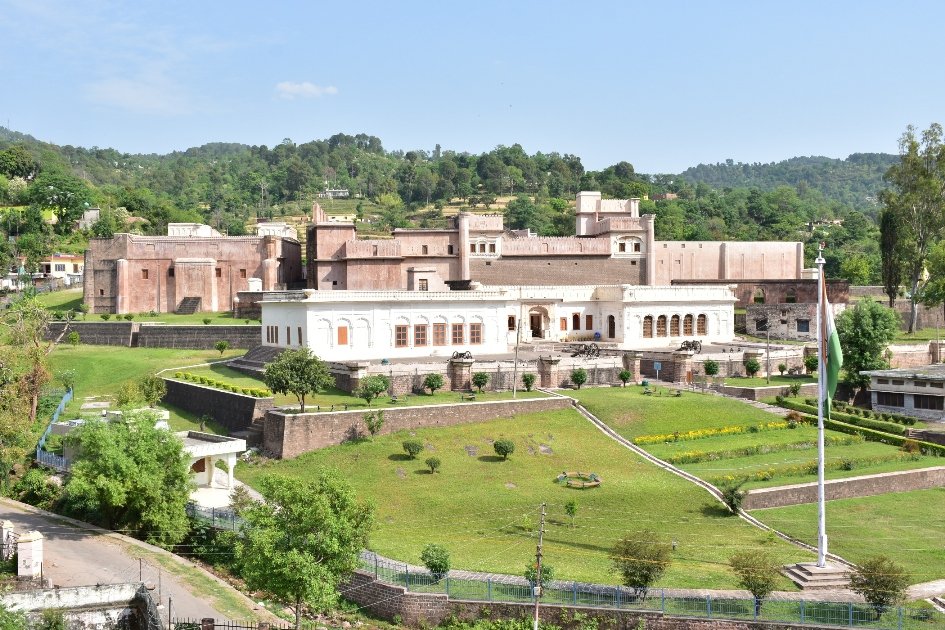

Udhampur/Ramnagar: There is a specific kind of silence that exists only in the mid-Himalayan ridges of Udhampur—a silence that doesn’t feel empty, but rather full of whispers from a thousand years ago. If you travel about 40 kilometers west of Udhampur town, leaving the highway noise behind, you will find yourself ascending toward a strategic hilltop at an elevation of 2,716 feet. Here, perched above the Mansadevi Nallah (a spirited tributary of the Tawi River), sits Ramnagar. It isn’t just a town; it is a stone-bound diary of kings, warriors, and artists.
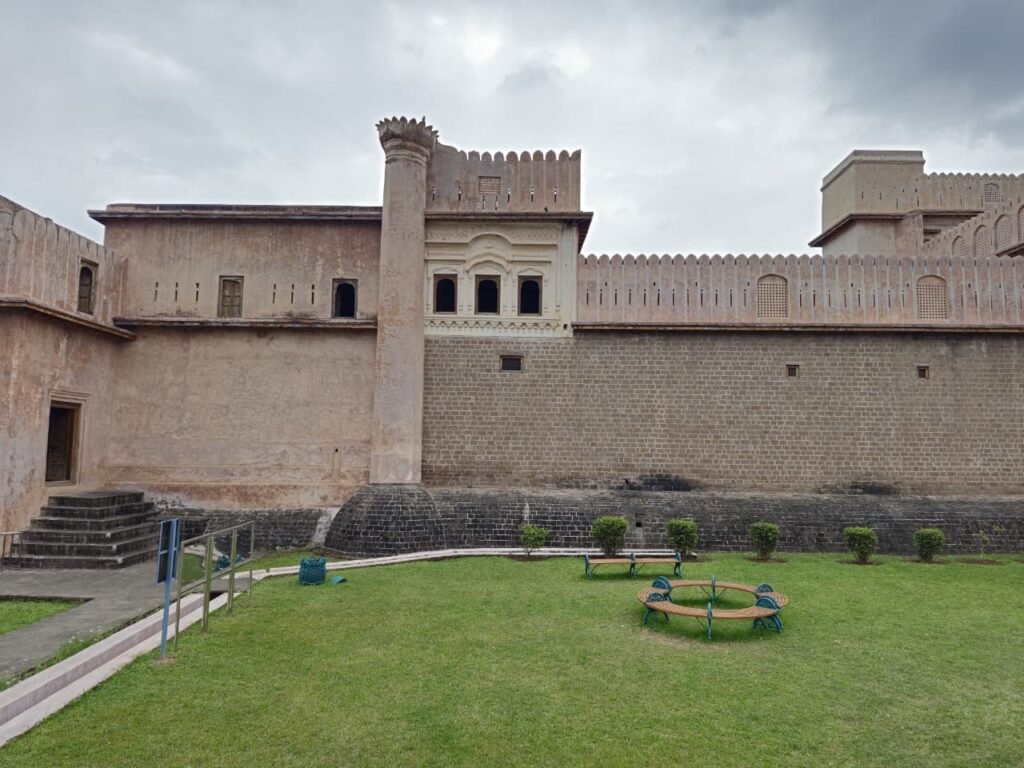
For those who think of Indian palaces only in terms of the sprawling desert forts of Rajasthan, Ramnagar offers a breathtaking correction. This hidden topographical jewel houses a triad of sovereign structures: the Purana Mahal, the Sheesh Mahal, and the Nawa Mahal. Together, they form the “Mahals of Ramnagar,” a complex that functions less like a dusty ruin and more like a living manuscript written in glass and memory. To walk these ramparts is to trace a direct line from the ancient Bandral Rajput lords to the final artistic flourish of the Dogra dynasty.
The soul of this hilltop was born long before the modern map of Jammu and Kashmir took shape. In the 10th century AD, a prince named Bahattar Dev Verman, hailing from the royal house of Chamba, looked at these emerald folds of the mountains and saw a kingdom. He established the Kingdom of Bandralta, and for eight hundred years, twenty-one successive Bandral kings ruled this land. Their sovereignty was as deep-rooted as the deodar trees surrounding them.
While much of their early structural work has been absorbed into the foundations of the current buildings, these ancient kings provided the “ancestral bones” of Ramnagar. They chose this spot for its rugged ridge-top positioning—a natural fortress that allowed them to survey the valley below while remaining shielded by the Himalayan peaks. However, the true transformation of the site from a mountain stronghold into an aesthetic marvel arrived in 1822, during the era of Sikh rule under Maharaja Ranjit Singh.
In 1822, the reign of the legendary Raja Suchet Singh began. The brother of Raja Gulab Singh (the founder of the Dogra dynasty), Suchet Singh was a man of dualities. On the battlefield, he was a valiant general—a man of iron and strategy. But inside the court, he was a profound connoisseur of the arts, a man who believed that a kingdom’s greatness was measured by the beauty it left behind.
Suchet Singh did not merely occupy the old Bandral seat; he elevated it into a symphony of symmetry. Between 1801 and 1844, he orchestrated the construction of the Purana Mahal. This was not just a residence; it was a three-story fortress-palace designed to withstand both the elements and enemies. As you look up at its high walls, you see watchtowers standing guard at regular intervals. Yet, look closer, and the “warrior” exterior gives way to the “artist” interior. The walls are decorated with delicate stuccowork, and the rooftop projections are shaped like sacred lotus flowers—a symbolic marriage of Hindu divinity and royal grandeur.
If the Purana Mahal is the muscle of the complex, the Sheesh Mahal is its soul. Known as the “Palace of Glass,” it remains Suchet Singh’s most breathtaking contribution to Indian heritage. Walking into the Sheesh Mahal is like stepping inside a diamond.
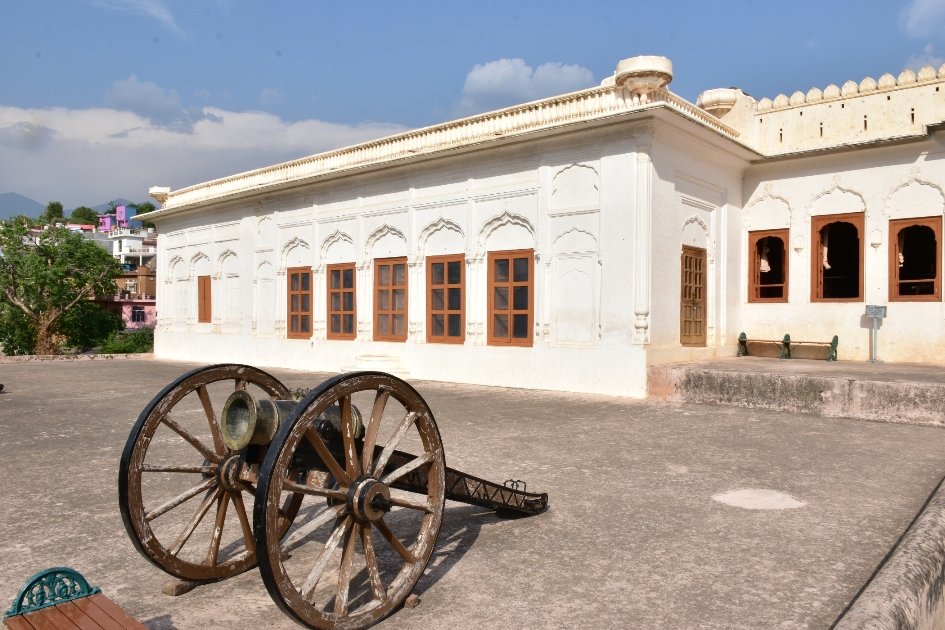
The palace comprises two forecourts with bastions at the corners, leading into a central passage. To your right lie the Darbar Hall, the Sheesh Mahal (Hall of Mirrors), and the Rang Mahal. Within these walls, a dazzling mosaic of multicolored cut glass and mirrors turns a single candle flame into a celestial spectacle. In an age before electricity, this was not just decoration; it was an engineering marvel that reflected light into every corner, defying the heavy shadows of the mountains.
The walls of the Rang Mahal (the Palace of Colors) literally breathe with history. Here, the Pahari School of art reaches its zenith. Vibrant mural paintings depict scenes from the Ramayana, the Mahabharata, and the Bhagavata Purana. You can see the romantic frolics of Lord Krishna—the “Krishna Lila”—painted with such finesse that the figures seem ready to step off the plaster. Interestingly, history is never static; even as these traditional themes dominated, European influences began to seep in. If you look closely at the corners, you may find unexpected lithographs of English ladies from later periods, showing how Ramnagar became a crossroads of cultures.
The architectural story reached its conclusion with Raja Ram Singh, who inherited the crown in 1844. It was he who officially christened the settlement Ramnagar—the “City of Ram.” He sought to add his own verse to this stone poem by building the Nawa Mahal (New Palace).
The Nawa Mahal maintained the floral elegance of its predecessor but added a sense of airy grandeur. It features a massive inner courtyard surrounded by halls with two entrances facing each other. Recognizing the bite of the Himalayan air, Ram Singh installed grand fireplaces in the rooms to provide warmth during the severe winter seasons. He also erected the Baradari, a pavilion with six doorways designed to capture the wandering mountain winds, ensuring the royal court remained comfortable even at the height of summer.
For all its structural brilliance, the heart of Ramnagar is found in its most poignant site: the Rani’s Samadhi. History tells us that Raja Suchet Singh died near Lahore in 1844. When the news reached the hills of Ramnagar, his queen, consumed by grief and duty, performed the ancient rite of Sati.
Today, a beautiful and somber structure houses her samadhi in the town. It is crowned with metallic pitchers and stands as a silent reminder that these palaces were built on more than just politics and stone; they were built on an unbreakable sense of devotion. Following the deaths of both Suchet Singh and Ram Singh—both of whom died without heirs—the kingdom eventually merged with the Jammu state, leaving these “Whispering Mahals” as the final witnesses to a vanished era.
Today, the complex is under the careful guardianship of the Archaeological Survey of India (ASI). While the 15-foot-deep moats of the Ramnagar Fort no longer hold water to ward off invaders, and the iron cannonballs sit silent, the magic of the place remains undiminished.
Ramnagar is a reminder to every traveler that India’s history is not just found in the famous monuments of the plains, but also in the rugged, high-altitude ridges where kings once tried to capture the stars in shards of glass. It is a place for the slow traveler—the one who wants to run their hands over 19th-century stucco, gaze at a lotus-shaped roof, and imagine the flicker of a thousand mirrors in the mountain night.
The Mahals of Ramnagar are waiting. They do not just tell a story of royalty; they tell a story of how humanity, even in the most rugged terrain, will always find a way to create something beautiful.