
On 28 February 2026, the United States and Israel opened a new chapter in the long-running Iran–Israel conflict with a coordinated campaign of surprise airstrikes that struck military sites, government facilities, and urban areas across Iran. The operation resulted in the assassination of Supreme Leader Ali Khamenei, several senior officials including Ali Larijani, and dozens of civilian casualties. Iran responded within hours with missile and drone barrages targeting Israel and U.S. bases in the Gulf, while closing the Strait of Hormuz—a chokepoint for roughly one-fifth of global oil trade. One month later, the war remains ongoing, with Iranian proxies engaged on multiple fronts, economic shockwaves rippling worldwide, and diplomatic efforts in tatters.
The conflict did not erupt in a vacuum. Tensions between Iran and the U.S.–Israel axis trace back decades, shaped by the 1953 U.S.- and U.K.-backed coup that ousted Prime Minister Mohammad Mosaddegh after he nationalized Iran’s oil industry, the 1979 Islamic Revolution that toppled the Shah, and the subsequent severing of diplomatic ties. During the 1980s Iran–Iraq War, Washington provided economic and intelligence support to Baghdad; a U.S. warship was mined by Iran, prompting American retaliation against the Iranian navy, followed by the mistaken downing of Iran Air Flight 655. Iran’s ballistic-missile program began as a deterrent against Iraqi Scud attacks and a hedge against sanctions that crippled its air force. By the 2000s, Tehran had built an informal “Axis of Resistance” through support for Hezbollah in Lebanon and militias fighting U.S. forces in Iraq. Direct confrontation peaked in January 2020 when President Donald Trump, in his first term, ordered the assassination of Qasem Soleimani.
The nuclear dimension has remained central. Iran suspended its AMAD Project in 2003 following a fatwa by Khamenei banning nuclear weapons. Tehran has consistently maintained that its enrichment activities are for civilian power generation. The 2015 Joint Comprehensive Plan of Action (JCPOA) sought to constrain the program, but the U.S. withdrawal in 2018 and reimposition of “maximum pressure” sanctions under both Trump administrations eroded trust. By late 2025, the second Trump administration had intensified the campaign; Treasury Secretary Scott Bessent called the collapse of the Iranian rial the strategy’s “grand culmination.” In February 2026, indirect nuclear talks resumed in Muscat and were scheduled for Geneva. On 27 February, Omani Foreign Minister Badr Al-Busaidi announced a “breakthrough”: Iran had agreed never to stockpile enriched uranium beyond the lowest level possible and to accept full IAEA verification. Peace, he said, was “within reach.”
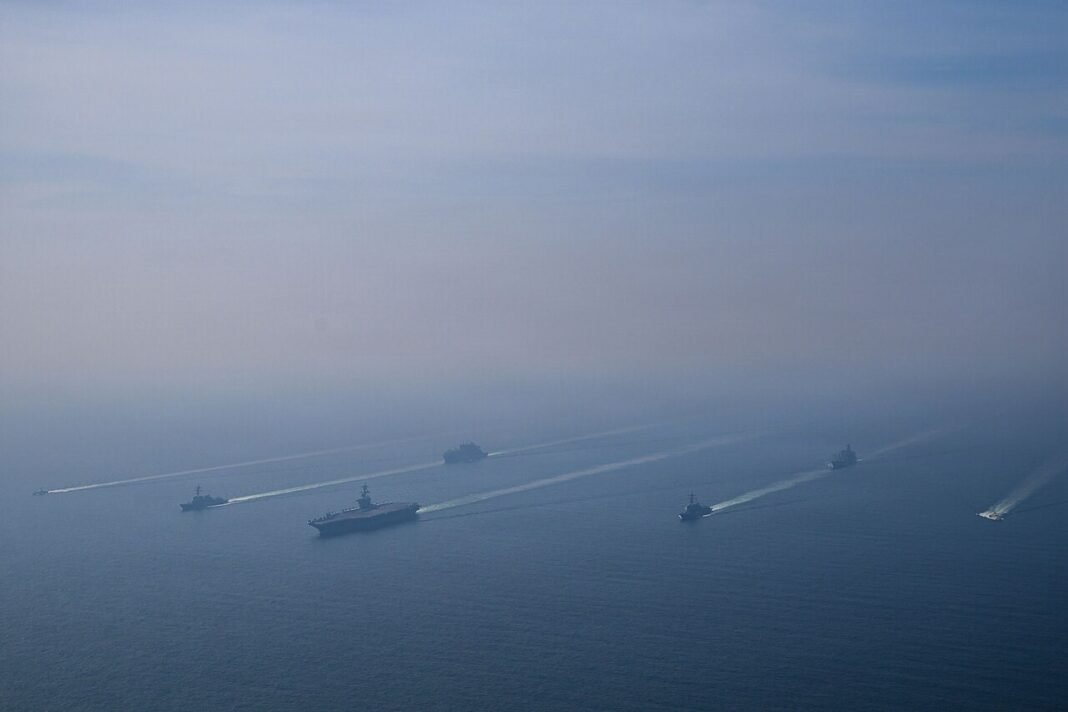
Yet hours later, the strikes began. On 27 February at 3:38 p.m. EST, Trump, aboard Air Force One, authorized Operation Epic Fury (codenamed Operation Roaring Lion by Israel). U.S. missiles, drones, and Israeli fighter jets hit targets at 9:45 a.m. Iranian time the next morning—coinciding with the start of Ramadan. Israeli officials later reported striking 500 military targets in the largest combat sortie in the IAF’s history, dropping more than 1,200 bombs in 24 hours. U.S. aircraft operated from regional bases and carriers. Cyberattacks accompanied the barrage, triggering a near-total internet blackout in Iran lasting over 60 hours and broadcasting messages urging Iranians to rise against their government.
Iranian retaliation—codenamed Operation True Promise IV and dubbed the “Ramadan War” by state media—was swift. Hundreds of drones and ballistic missiles struck Israeli cities including Tel Aviv and Haifa, as well as U.S. bases in Bahrain, Jordan, Kuwait, Qatar, Saudi Arabia, and the UAE. Iranian officials reported hitting Al Udeid Air Base in Qatar, the U.S. Fifth Fleet headquarters in Bahrain, and other installations. Strikes also reached civilian infrastructure in Azerbaijan, Oman, and elsewhere; Tehran denied responsibility for some, labeling them false-flag operations. Two ballistic missiles were reportedly aimed at Diego Garcia, which Iran likewise denied. Hezbollah escalated its conflict with Israel into what has become the 2026 Lebanon war, killing more than 1,000 militants and civilians by late March. The Houthis and Popular Mobilization Forces joined the fray.
Casualty figures remain fluid and contested. Iranian health authorities reported more than 2,000 dead and 26,500 injured in the initial waves. U.S. and Israeli losses include at least 26 American soldiers killed and hundreds wounded, plus 11 Israeli soldiers and 23 civilians dead. Hezbollah acknowledged over 400 fighters killed; the PMF reported 84 dead and 138 injured. Civilian tolls in Gulf states and Lebanon have climbed into the thousands.
The economic toll has been immediate and severe. Iran’s closure of the Strait of Hormuz—later accompanied by toll collection in Chinese yuan—has stalled hundreds of oil tankers and triggered the largest global supply disruption since the 1970s energy crisis. Oil prices surged more than 40 percent in the first weeks. The Pentagon estimated the cost to U.S. forces at $18 billion by 19 March, requesting an additional $200 billion. Aviation, tourism, and financial markets have suffered widespread volatility.
Trump administration explanations for the strikes have shifted. Officials initially framed the operation as pre-emptive, aimed at neutralizing an imminent Iranian threat, destroying missile capabilities, preventing nuclear breakout, securing oil resources, or achieving regime change. Iranian and some U.S. sources rejected claims of an impending Iranian attack. The International Atomic Energy Agency stated that, while Iran maintained an “ambitious” program and had barred inspectors from damaged sites since the 2025 Twelve-Day War, there was “no evidence of a structured nuclear weapons program” when the 2026 conflict began. UN Secretary-General António Guterres and several nations condemned the initial U.S.–Israeli strikes; the Security Council later passed a resolution denouncing Iran’s retaliatory attacks on Gulf states. Legal scholars have described the opening assault as a violation of Iranian sovereignty and, under some interpretations, U.S. law.
Inside Iran, the power vacuum was filled rapidly. Mojtaba Khamenei, the late supreme leader’s second son, was designated successor on 8 March. An Interim Leadership Council under Ali Larijani (later killed in strikes) accused Washington and Jerusalem of seeking to dismantle the Islamic Republic. Protests that had raged since late December 2025—described by the U.S.-based Human Rights Activists News Agency as the largest since 1979—were brutally suppressed in January, with death toll estimates ranging from 3,117 (Iranian government) to over 32,000 (independent health officials).
The war has spilled beyond Iran. Israel launched ground operations in southern Lebanon. European nations, including the UK, France, Germany, Italy, the Netherlands, and Spain, deployed assets to defend Cyprus after Iranian drones struck Britain’s Akrotiri base. Turkey intercepted multiple Iranian missiles over its airspace. The U.S. has sunk at least one Iranian frigate in the Indian Ocean and conducted large-scale strikes on naval and oil-related targets, including Kharg Island.
As of early April 2026, the conflict shows no signs of abating. U.S. Central Command reports more than 11,000 Iranian military targets struck. Iran continues to control the Strait of Hormuz, launch missiles and drones, and coordinate with proxies. Trump has warned of escalated strikes—including potential targeting of power plants, oil wells, and desalination facilities—if the strait is not reopened. Iranian President Masoud Pezeshkian has rejected U.S. peace proposals and published an open letter to American citizens framing the war as manufactured aggression. Netanyahu has spoken of “ten plagues” inflicted on the “axis of evil” and hinted at the necessity of ground operations.
Historians will debate whether the 2026 war was inevitable or the product of miscalculation during active nuclear negotiations. What is already clear is its human and strategic cost: assassinated leaders, shattered infrastructure, a region on the brink of wider conflagration, and a global economy reeling from disrupted energy flows. One month in, the 2026 Iran war stands as a stark reminder that the Middle East’s interlocking crises—nuclear ambitions, proxy networks, great-power rivalry, and unresolved grievances dating to 1953—can still ignite with devastating speed.