


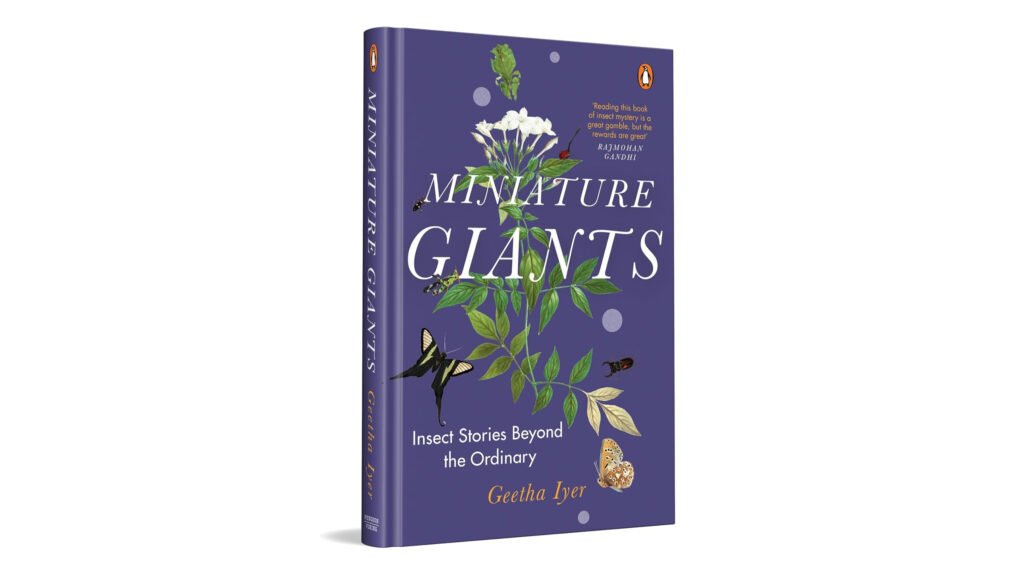
New Delhi, Feb 24: Published by Penguin House, Geetha Iyer’s Miniature Giants: Insect Stories Beyond the Ordinary is an important addition to the body of Indian natural history literature, a kind of writing that fills a special niche between the discourse of rigid science and that of easy nature writing.
The paratextual aids to the assessment, consisting of the front cover, back cover, prologue, acknowledgements, and a final author note, provide a clear indication that the piece does far more than merely document the morphological peculiarities of the hexapod fauna of the subcontinent.
Iyer, a naturalist and teacher living in Suchindram, has made what seems to be a call upon the world to wake up and take a fresh look at creatures who, as she aptly remarks, run the world, yet are, as far as many are concerned, nothing but a curse.
The book opens with endorsements from a group of renowned scholars, which sets the stage for the book’s scholarly merits. The description of the volume as a wake-up call and an indispensable primer places it in the tradition of environmental writing that aims to wake a sleeping population to the sublimities of the natural world and, by implication, to the forms of vulnerability the world offers them.
The term “veritable tour de force” by Rohini Balakrishnan also references the book’s grand scope, while Adrienne Mayor’s recommendation shows that the book is intended to attract a readership interested in exploring the historical and scientific intersections of the human and non-human world.
The presence of these accolades from ecologists, historians, and classicists indicates that Iyer has transcended the specifics of a particular discipline and that his work would be attractive to a variety of epistemic perspectives.
The prologue defines the author’s purpose and voice in an adorable way. The rhetorical approach of Iyer, which is to refute the omnipresent why insects? With the response, “Why not insects? is falsely naive and actually disruptive of the anthropocentrism that underlies our apathy toward arthropods.
Her insistence that insects are nature’s work of art is not aesthetic frivolity, but is based on a materialist understanding of the physiological innovations, the geometry of wing venation, and the mathematics of flight, among others.
Iyer aligns her project with current evolutionary thought by placing it in the context of theoretical biologist Mary Jane West-Eberhard, who identifies insects as silent storytellers whose tale of adaptation, survival, and coexistence can be read by those who are not merely tolerant or attentive enough to do so.
The prologue also alludes to the utilitarian importance of entomological knowledge, citing the booming industry of biomimicry and its use in prosthetics, robotics, and even the vaguely envisioned technology of invisible cloaks.
However, Iyer does not reduce insect life to a reservoir of man-centric solutions; the implication is that their intrinsic and instrumental values are not mutually exclusive.
One of the most interesting features of the previewed material is Iyer’s metacognitive awareness of her narrative methodology. She admits, as ever with endearing candor, the perplexity which any writer must face when trying to reconcile the demands of scientific accuracy and the needs of the popular reader: how far to go, how far to forbear. Her suggestion, to arrange some chapters in the form of detective stories, not to explicate them directly but to stimulate the reader and encourage his or her curiosity, is pedagogically correct.
It does not underrate the intelligence of the reader, but recognizes that scientific discovery is a process that is iterative, tentative, and, in most cases, dependent on the gradual accretion of observational evidence.
This terse note is further narrowed by the author, who addresses the reader directly: readers seeking a more scientific treatise are referred to the bibliography at the end of each chapter, and those who prefer the narrative alone are permitted to skip the science. This loose style of entomology democratises without watering down.
The recognition that Iyer has received shows how rich her academic contacts were and how indebted she was to professional entomology. The fact that Emeritus Professor Dr Chandrashekara Viraktamath, Dr Prathapan Divakaran, and a host of other researchers from Indian agricultural universities and the ICAR system give it the weight of empirical study, making it not merely amateur natural history.
These are debts, not chance debts of gratitude, but recognition of knowledge production in collaboration, of field identifications validated, of behavioural phenomena elucidated by reference to taxonomic knowledge. This collegiality addresses the well-being of Indian entomology as a profession, although Iyer complains that it is in its infancy compared to the world’s research.
The book’s thematic preoccupations, as sketched in the preview, are numerous but consistent. Iyer shows a special interest in nomenclatural injustice: the earwig, which has been unfairly labelled an ear invader, and the lanternfly, which has been unnecessarily given the glow-in-the-dark name. All these linguistic criticisms are more than pedantic: they are politics of perception.
Renaming is re-framing, and Iyer would never fail to offer her larger conservationist ethos in the cause of a more correct nomenclature. Equally, her joy in the anatomic and behavioural aberrations of insects, ears on tongues, eyes on penises, metameres that predict the engineering of humans, are ways to defamiliarise the familiar, compelling the reader to deal with the extreme otherness of insect embodiment.
There is also an impending conservationist subtext that is paratextually framed in Miniature Giants. The fact that the blurb notes only that insects are rapidly becoming extinct on Earth places the book in the wider context of the Anthropocene extinction event. The project that Iyer makes, then, is not descriptive and celebratory, but rather elegiac and prescriptive.
In making insects visible, in telling their tales with passion and scholarship, she aims to stimulate the emotional attachment that, in turn, could inspire their defense. The promotional text, the question, “Will they be there when we most need them to keep us alive,” is not rhetorical; rather, it is a challenge to the complacency of the reader.
To sum up, Geetha Iyer’s Miniature Giants preview is indicative of a work of great intellectual and literary worth. It is simultaneously both a science communication work, a cultural criticism work, and a conservation advocacy work.
Iyer is an experienced observer and a fervent entomophile, and the experience and the zeal of an unashamed entomophile come to her writing, and, as you see, it is not inaccurate and suggestive.
Unless the rest of the book can justify the hints of the first pages, Miniature Giants will rightly take its place among the best books in the field of Indian natural history writing, a perennial monument of the miniature giants with whom we inhabit this world.