New Delhi: The fact that Akhtarul Iman was translating his autobiography into English almost thirty years after his death is an important phenomenon in the history of the reception of modern Urdu literature in the Anglophone world.
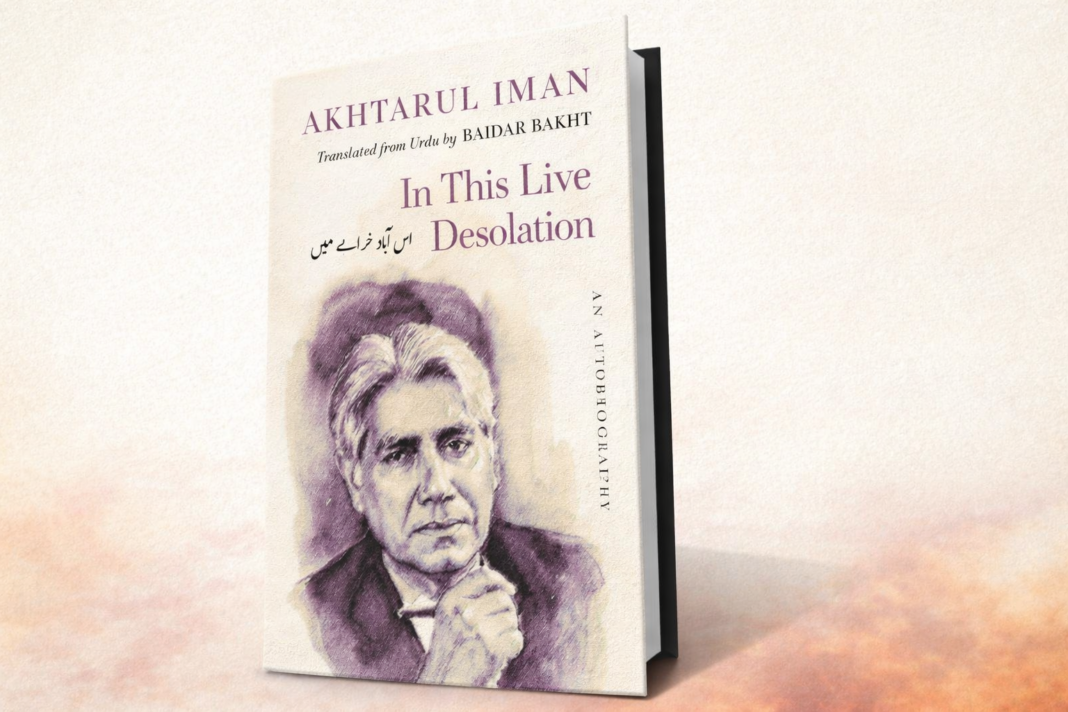
Adapted from the Urdu original, Is Aabaad Kharabaen Mein, by poet and translator, Baidar Bakht, sheds light on the life and era of what has long been recognised by connoisseurs, but is strangely little known to the general culture of post-independent India.
The Speaking Tiger Books that have already positioned itself as an essential voice of the northeastern and the marginalised South Asian turns its focus to an entirely different form of marginality, that of the Urdu intellectual manoeuvring his way through the perilous clichés of the film industry in Bombay and capitalising on the whole in the process without losing any of its artisanal spirit.
The outcome is a volume which works on several registers at once, as memoir, as literary history, as speculation upon artistic integrity, as a heart-rending account of a sensibility made in the crucible of displacement.
The title of the autobiography itself preaches the paradox that controls it. A state between being alive and being desolate, aabaad and kharaba, is to be in the condition of the modern artist as Akhtarul Iman perceived it: fertile in creative possibility and sterile of the securities, material, emotional, and social, of the ordinary life.
It is the driving force behind each page of the story, whether it is the recollections of a childhood lived between mosques and makeshift homes in the villages of Uttar Pradesh and Haryana, it is the hardship of the years in a Daryaganj reformatory, or the prolonged, grinding struggle to survive in the dream factories of Bombay.
Iman, being the son of a promiscuous imam, learned early in life that stability was an indulgence he could not afford, and this was imprinted on him and his art. The reserve which dominates his style, the absence of a certain self-dramatisation even in the relating of scenes of real distress, is no symptom of emotional poverty, but rather a philosophically acquired position: the perception that the self would be best expressed by what is not said than by what is said.
The translation of Baidar Bakht’s manoeuvres around these subtle details is quite good. The English prose has the rhythm of the Urdu of Iman without the literalism upon which so many translations of poetry more frequently end.
What one feels all through the translation of the translator is his consciousness of rendering not words only, but a special vision, what the foreword describes well, as a subtle intellectual poise of the art of Iman.
It is particularly useful to have the choice of having the translations of the poems that are mentioned in the text, and then the reader can follow the continuities between the life described and the verse itself that came out of it.
When Iman speaks of Zikr-e maghfoor or Zamistaan sard mehri ka, we get to know not only the circumstances under which those poems were composed, but the poems themselves, and thus we understand even better how lived experience is turned into the aesthetics.
The form of the autobiography reminds us of the relationship between its author and memory. As Sultana Iman reminds us in her preface to the Urdu edition, which appears here reprinted, her husband had a habit of forgetting the minor details of life, and never spoke much of his past, but could recall very ancient events with extraordinary sharpness.
This selective yet recollective paradox creates a narrative that does not read over time but rather, associatively, through storytelling connected to specific characters and event occurrences, overlooking others without mention.
The reader who was hoping the book would have a traditional storyline, with its chronological sequence starting with the birth, progressing to maturity, and culminating in decline, will be disappointed; in fact, what Iman provides is more of a poetic reflection on the moments that transformed his life.
His death on 9 March 1996 prevents him from finishing the autobiography, which is why it breaks off so suddenly, and this break-off is somehow correct, an aesthetic equivalent of the fragmentariness of all self-knowledge.
The sphere in which Iman travels is filled with literary and cinematic stars, and his memories of them are among the book’s biggest joys.
His story of the long silence in the relationship between him and Faiz Ahmed Faiz represents something fundamental about the feel of intellectual friendship in India during the middle of the century: a certain comprehension went between poets, and it was as expressive as speech.
His portraits of Meeraji, Shahryar, Krishan Chander, Jigar Muradabadi, and Josh Malihabadi are executed with the same tact he brings to his own work, with a fondness that is free of sentimentality, and with an eye that is never gossipy.
The same happens to the film world: W.Z. Ahmed, B.R. Chopra, Protima Dasgupta, Raaj Kumar, and Amjad Khan are not presented as stars but as co-workers in the strenuous art of narration.
The years of his career as a dialogue writer in Hindi cinema, as in Waqt, 1965, where Iman wrote the now-famous line: Chinnoy Seth, jinke apne ghar sheeshe ke hote hain, woh doosron par patthar nahin phenka karte, are disposed of with that discretion with which he handles his literary friendships, neither sentimentalised nor condemned as hackwork.
But even the gallery of famous contemporaries is not the most serious pre-occupation of the autobiography. The blood in the story is the unbending devotion Iman has to craft, and his belief that poetry is not irrelevant to the world but, in fact, because of it.
The financial wisdom of those seasons, the lengthy periods of being apparently forever denied recognition, the need to earn money by doing something that, however, could not possibly nourish his artistic cravings, all this is documented without a sense of self-pity but not false heroism.
Iman realises that the life of the artist is not a romance, but a discipline, a question of turning up for work day after work day at the heavy task of moulding language into meaning.
His narrative of the many rewrites and the rewrites each poem needed, the slow, meticulous revision, which sometimes spanned years, is an effective refutation of the myth of spontaneous inspiration that continues to play upon popular knowledge of the creative.
The book, in its quiet way, also sheds light on the social world in which Urdu literary culture continued to survive in the decades following Partition. Even the magazines, Shabkhoon, Aiwan-e Urdu, and Saughat, in which Iman first published her poems and autobiography, were not periodicals but essential institutions, points in an interlocking system that tied together a scattered people.
The constant urging of Iman by Mahmood Ayaz, that he should carry on with his autobiographical work, the action of the Delhi Urdu Academy to prepare the manuscript in book form, the groups of friends and fellow poets who crowded to celebrate his eightieth birthday only a few months before his death, these facts draw the lines of a literary culture that had been glued together with loyalty and mutual respect, and that might so easily have been drawn off to the centrifugal force of geography and politics.
The physical deterioration that Iman experienced in his last years, forcing him to undergo dialysis twice a week since October 1993 up to his death, is noted with the same demeanour with which Iman treated previous misfortunes.
The treatment made him exhausted, and the productive hours were only two or three days a week, but he was there until the end. The three poems issued in Shabkhoon and Aiwan-e Urdu immediately preceding his death, titled Zikr-e maghfoor, Zamistaan sard mehri ka, and Nijaat, led some of his readers to conclude that he had become pessimistic or had lost faith in life.
The fact that they were arranged in meticulous order, either by Sultana Iman or by their dates of composition, indicating that they had been started long before his dialysis was inaugurated, is, though it makes life more difficult, not an instance of rejection of this interpretation.
The poems can be addressing the subjects of death and indifference, but they are addressing it with the experience of a lifetime of dealing with these subjects, not with the immediate hopelessness of a dying man. The indifference towards mortality which Iman had shown in the face of death, as is symbolised by the faint smile which his widow saw on his face after death, was not out of place with the philosophical calm with which he had conducted his life.
The release of Speaking Tiger’s translation raises some interesting questions about how Urdu literature is being received in modern India. The list of houses has been biased towards north-eastern writers and other marginalised areas, and has provided Anglophone readers with a platform for voices previously marginalised by the national discourse.
Iman, on the other hand, finds himself at the heart of one of the most important literary traditions, but here again, he has been marginalised, the forgottenness which has overtaken those artists whose art has been tantamount to a crossing over into the so-called high and popular culture, between the naivety of the lyric and the corrupt world of commercial film.
Speaking Tiger renders a favour by bringing his autobiography into English, bringing a complex figure back into sight, and challenging the reader to grapple with the multidimensional aspects of his accomplishment.
The book’s limits are the limitations inherent in the mode chosen by Iman. Though artistically admissible, the episodic format will annoy readers accustomed to a more conventionally narrative account of his life. The reserve which regulates his prose, a virtue in the absence of self-dramatisation, approaches at one point the border of reticence, and causes the reader to wish there were more emotional forthcoming of the writer.
But these are not exactly flaws so much as elements of a sensibility that put a premium on indirection, on innuendo, over assertion. Iman wrote poetry that merited time to appreciate, and his autobiography challenges its readers in the same way.
Ultimately, [In This Live Desolation] is a tribute to a life lived with integrity in a situation where integrity was not a largely promoting factor. Akhtarul Iman was not a poet who wrote about films, or a film-writer who now and then wrote verses; he was an artist whose two callings were the same, and in whom there was no change of heart or resolution to do the merely expedient things.
Even his partial and selective autobiography retains that surface of that commitment, that daily labour of attention which is the real life of the artist, in his under- and over-relationships to the outward successes and failures which so much preoccupy the biographer.
To the reader prepared to take it on its own terms, it offers not only the history of an extraordinary life but also an education in how to read such lives, how to perceive, in their apparent incompleteness, the outline of a complete whole.
Daanish Bin Nabi can be reached at daanishoffice@gmail.com