


Prof Ravij Seth
India’s transport sector—particularly railways and civil aviation—has long operated under conditions of structural strain, where capacity constraints and operational inefficiencies shape the everyday experience of mobility. The railway system, despite its expansive reach and affordability, remains chronically overburdened, often functioning beyond its optimal carrying capacity. Conversely, the airline industry positions itself around speed and efficiency, yet remains highly vulnerable to external variables such as weather disruptions, air traffic congestion, and infrastructural bottlenecks at major airports.
Within this duality, Indian passengers are consistently compelled to navigate a trade-off between affordability, time efficiency, and convenience. It is in this context that a re-evaluation of airline operational models particularly the potential of direct flight services—becomes both relevant and necessary.
A useful conceptual distinction may be drawn from railway operations. While non-stop trains such as the Prayagraj Express or select high-speed intercity services operate without intermediate halts, the majority of Indian trains are “direct” rather than non-stop. These direct trains stop at multiple stations but maintain continuity of carriage for passengers traveling from origin to destination. This model prioritizes accessibility and inclusivity over speed alone.
In contrast, the airline industry in India has largely emphasized a binary structure: either non-stop
flights or connecting flights that require passengers to change aircraft. However, an.intermediate and underutilized category exists—direct flights with stops, where passengers remain onboard during brief halts.
Direct airline services, though less visible in public discourse, offer a hybrid operational model..In such flights, passengers are not required to disembark during intermediate stops; instead, the aircraft halts temporarily to allow additional passengers to board or alight, after which it proceeds to its final destination. For instance, certain routes originating from Jammu operate via Srinagar en route to metropolitan destinations such as Delhi or Mumbai, with through- passengers remaining seated during the stopover. This model, though operationally modest in current scale, holds significant transformative potential.
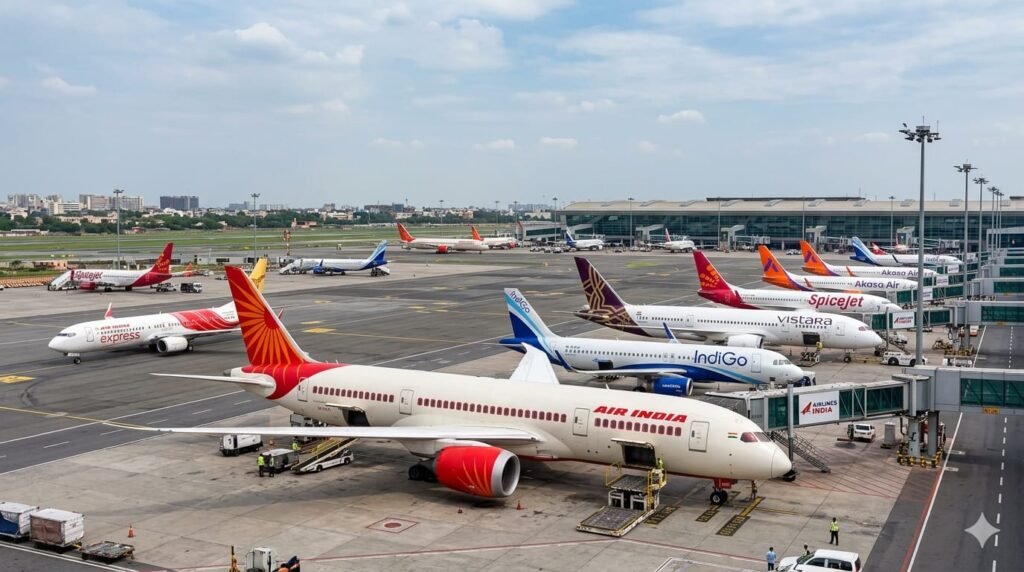
The advantages of direct airline services are both practical and systemic. First, they substantially reduce passenger inconvenience by eliminating the need for repeated boarding and deboarding procedures. Second, they bypass the often time-consuming and unpredictable security checks at transit airports—an issue particularly acute at high-density hubs such as Delhi’s Indira Gandhi International Airport. Recent instances of congestion and security delays at such airports highlight the fragility of existing transit infrastructures. By minimizing passenger movement within airports, direct services can alleviate pressure on security systems
and terminal facilities.
More importantly, the expansion of direct services can contribute to a broader reconfiguration
of India’s aviation network. At present, the system is heavily hub-centric, with metro airports—
especially Delhi and Mumbai—functioning as primary nodes. This concentration results in
systemic congestion, increased turnaround times, and passenger fatigue, particularly when
terminal transfers are required. The lack of seamless intra-terminal connectivity—for example,
between Terminals 1, 2, and 3 at Delhi—exacerbates the problem, often forcing passengers to exit secure zones and re-enter as new entrants. Such inefficiencies not only increase travel time
but also impose physical and cognitive burdens on passengers.
A strategic shift toward direct services could decentralize air traffic flows by enabling airlines
to design routes that bypass congested metro hubs. This would not only enhance passenger
experience but also optimize aircraft utilization and reduce operational costs associated with delays and ground handling. Furthermore, from a policy perspective, such a shift aligns with the objectives of regional connectivity schemes like UDAN, which aim to integrate tier-2 and tier-3 cities into the national aviation grid without over-reliance on metropolitan hubs.
From an economic standpoint, direct services can also improve load factor management. By allowing airlines to aggregate passengers across multiple segments within a single flight, they can achieve higher seat occupancy without the need for separate connecting flights. This model, if effectively scaled, could enhance route viability, particularly on semi-dense corridors where
demand does not justify high-frequency non-stop services.
However, the adoption of direct services requires a paradigmatic shift in both operational strategy and regulatory facilitation. Airlines must recalibrate scheduling, crew management, and turnaround protocols to accommodate short halt operations. Simultaneously, airport authorities and regulatory bodies must streamline ground handling and security procedures to support such models efficiently. The recent expansion of airline licenses following the operational disruptions of major carriers like IndiGo in late 2025 underscores the urgency of rethinking service design alongside capacity expansion.
In conclusion, the argument for expanding direct airline services in India is not merely about
convenience; it is about systemic efficiency, infrastructural decongestion, and passenger-
centric innovation. By drawing lessons from the railway model and adapting them to aviation,
India can move toward a more balanced and resilient transport ecosystem. Such a shift would
represent not just an operational adjustment, but a conceptual reorientation—from a hub- dominated, transit-heavy system to a more distributed, seamless, and humane model of air travel.