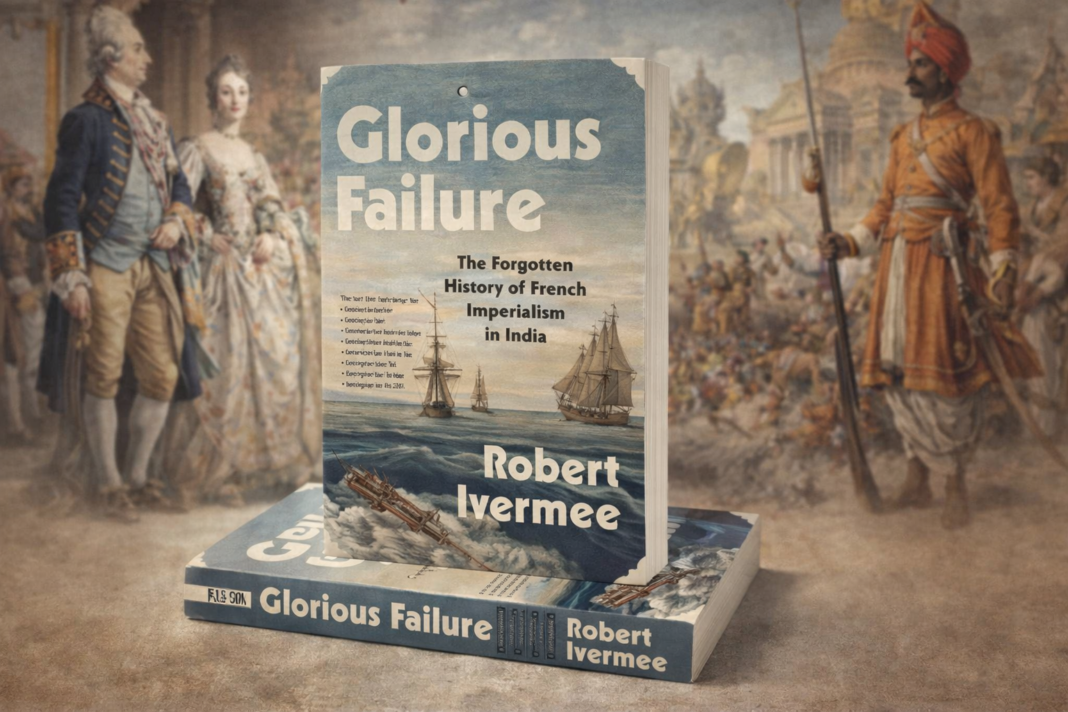

New Delhi: Over 150 years, from the reign of Louis XIV to the fall of Napoleon Bonaparte, France was a violent imperialist in South Asia, driven by the quest for greatness and wealth. In a new book, Glorious Failure: History of French Imperialism in India, by Robert Ivermee, the long-running myth of a soothing French presence in the subcontinent is shattered: an empire of war-making, conquest, expedient alliances, regime change, and slavery.
The volume has already won the acclaim of historian Rosie Llewellyn-Jones, who describes it as an innovative and highly commended book, published by Context India, an imprint of Westland Books bringing essential, hard-hitting history to Indian readers.
Shashi Tharoor, in his cover article, tells us that it is a peek into the immensity of the world, readable and an indispensable addition to historical writing that reveals the appalling human cost of imperial dreams.
A forgotten chapter
The imperial project of the French in South Asia manifested through their East India Company, and the state established a widespread empire in India. However, this hegemony was increasingly lost to war with Indian rulers, high competition with other European powers, especially Britain, and a sequence of lethal strategic miscalculations. The wide-ranging study by Ivermee, conducted in France, India, and the United Kingdom, relies on archives to create a piece of history that is essential to know yet is frequently neglected.
The author is not afraid of the mechanisms of the French colonial rule, which were brutal. He unveils that the Indian empire of France was based on war-making, conquering, alliances as situations arose, regime change, and slavery to achieve its goals.
The book considers the responses of influential French individuals to the failure of their imperial project, and their cynical use of new Enlightenment concepts, such as freedom and the rights of man, to legitimise new projects of domination.
More importantly, Ivermee reports that the colonial rulers never recognised the equality of the various indigenous groups in French India, before or after the French Revolution of 1789.
The empire of the dead
Although France found herself in diminished conditions on the subcontinent after its ultimate defeat by Britain, India remained a large and powerful figure in the French imagination as the nineteenth century began.
In popular culture, novels, travelogues, poems, plays, operas, and artworks were produced in a continuous stream for mass consumption, creating stereotypical images of India as an exotic, spiritual, and eternal home of oppressive sultans, fakirs, snake charmers, and seductive women.
Alongside these popular images, the serious scholarship of India thrived in France. Starting with the establishment of a professorship of Indology at the Collège de France in Paris in 1815, Paris was to be the centre of Indological studies in Europe over the next few decades – the place where Sanskrit students thronged.
According to Ivermee, recent scholarship indicates that once France could not subjugate India politically, it was insistent on ensuring that it spearheaded the European intellectual conquest of the subcontinent by studying manuscripts dispatched back to Pondicherry and other places.
Former slavery to indentured labour
Based on the analysis of the shift between slavery and indentured labour in the French colonial system, this is one of the greatest contributions to the book.
Ivermee records that it was in fact the abolishment of the slavery institution, not the previous ban on the slave trade, that eventually ended slave trafficking in the Indian Ocean by the French. In British colonies, slavery was abolished in 1833; in French colonies, in 1848.
Even this, however, constituted only qualified progress. A slave trade was denied in favour of an indentured labour, on which the poor Indians agreed to serve as slaves for a minimum of five years in British and French colonies, in which the slave trade was abolished, in exchange for receiving a free passage and a mediocre wage.
Key recruitment centres of indentured labourers shipped to British Mauritius, the Isle Bourbon, Martinique, Guadeloupe, and Guiana during the decades that followed were Pondicherry and Karikal.
By the time the government of British India, flexing its muscles over Pondicherry, yielded to the pressure of humanitarian campaigners and banned the export of labourers to French colonies in 1888, nearly 194,000 indentured Indians had been shipped to its colonies. But as Ivermee observes, indentured Indians were still being shipped to Mauritius as late as the end of indenture in 1920, and nearly half a million Indians had been shipped to the island.
A necessary corrective
From great power rivalry to informal empire and deep-rooted inequalities, Glorious Failure addresses issues that remain relevant and pressing in the modern world.
The book ends by looking at the decolonising of French India, which occurred in the context of Indian independence in 1947 and the overall disintegration of the European colonial empires in Asia and Africa.
To all students of colonial history, all students of international relations, and all, in general, interested in the ultimate understanding of a forgotten, thwarted chapter of Franco-Indian relations, the work of Ivermee is a weighty and much-needed correction.
It does not justify the French imperial ambitions, but it clarifies them, and, in clarifying them, serves a major purpose: helping us understand how the European powers both developed and were developed by their interactions with the Indian subcontinent.