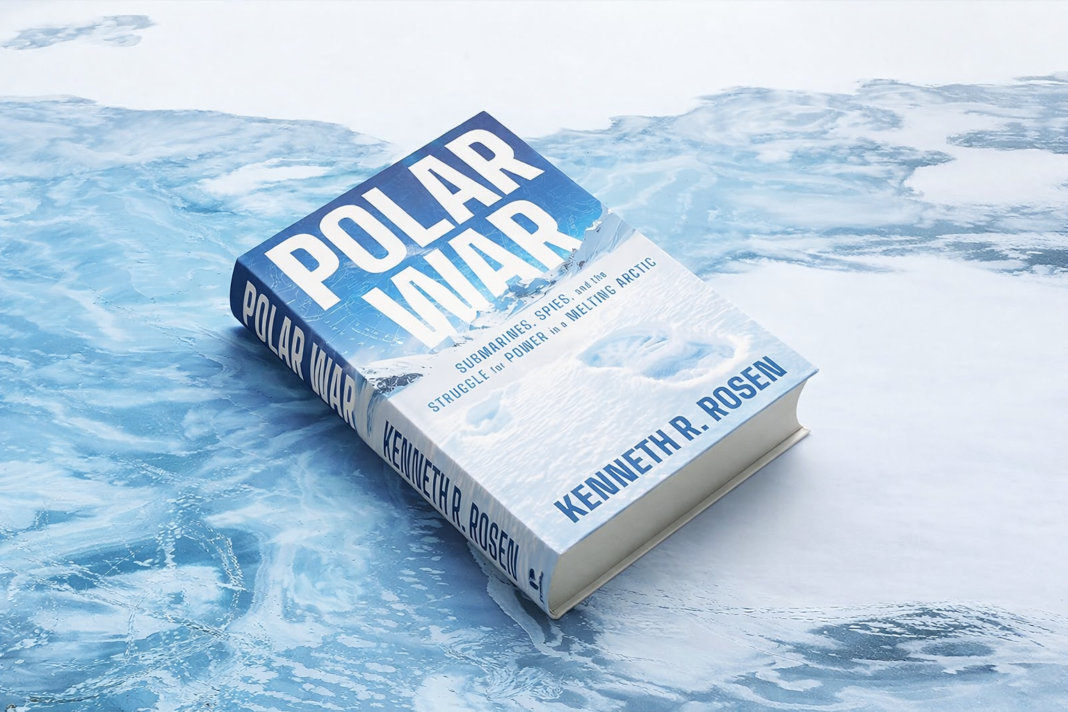

New Delhi: The Arctic was visualised as a distant, frozen, unreachable frontier, a destination where geopolitical ambitions have gone to die, encrypted in old ice. That era is over. One of the most captivating new investigations of journalism and strategic thought, Polar War by Kenneth R. Rosen, is an account of how the sudden warming of the circumpolar North has turned the region into one of the most disputed arenas of twenty-first-century great-power politics.
The book comes at a time when the Arctic issue has ceased to be merely on the margins of international relations and is now at the heart of the sphere. It is the merging of on-the-ground knowledge and prescient insight that has rarely been applied to the topic that Rosen approaches with a distinct feeling of camaraderie, being an experienced journalist who has reported from war zones around the world and has also spent months living in Juneau, Alaska.
Zone of peace to theatre of war
Rosen remembers that Soviet leader Mikhail Gorbachev once described the Arctic as a place of peace, which he labelled as the zone of peace, an idea of cooperation that temporarily prospered after the Cold War.
According to Rosen, North American and European officials no longer view the Arctic as a place of peace but as a place of war.
It offers a very evocative entry point into the author’s experience in Juneau, Alaska’s capital, in 2013. The first thing anybody in the Arctic gave me at the time was a strong drink, he writes. “The second was a gun.” This is the duality between warm hospitality and an acute sense of existential threat, and this is what life on the new northern frontier was all about.
Rosen follows the region’s path of increasing militarisation, presenting thoroughly reported facts. Russian spies, nuclear submarines, cut undersea communications cables, and sabotaged gas pipelines; these are no longer hypothetical but daily realities.
This melting of ice caps, which would have led to a new period of scientific cooperation, has instead sparked competition over new trade routes. A new Arctic shipping route, Rosen observes, would take a month or two off the time between the great seas–a business fortune to fight over.
Arctic strife
On the basis of expert testimony, Rosen singles out three mega drivers that are changing the Arctic. During the Strategic Forum of the Defence Threat Reduction Agency in 2021, Dr Brandenberger of the Pacific Northwest National Laboratory informed defence and security practitioners that the region was being remoulded due to climate change through increased access, foreign direct investment, and innovative technology. These three mega threads, she cautioned, meant the beginning of an era of a storm of strategic jostling.
As the book divulges, Russia is on the frontline. The Arctic is home to more military bases, is more competent in cold-weather operations, and boasts a larger fleet of icebreakers than the maritime Arctic fleets of all other nations.
Since 2007, after the symbolic flag-planting antic by the Russians at the bottom of the North Pole, the circumstances surrounding Arctic unity have continued to worsen. Russia has updated its military installations of the Cold War era and accelerated the testing of hypersonic weapons on the same islands in the north where the Soviet Union used to carry out nuclear tests.
Rosen opines that America and its allies are catching up. The American army took its time retrieving an enemy vessel due to a lack of experience in the dark ages of the high north and the frigid cold winds that accompanied an exercise they had recently conducted.
Since then, Washington has shifted gears and developed a consistent Arctic Strategy as recently as May 2024. But the author observes that budgetary constraints and the lack of completion of major programmes, such as the Polar Security Cutter fleets for the Coast Guard, represent a trend that can only slow American ambitions.
China’s quiet advance
The most worrisome aspect of Polar War is possibly having documented the rise of China into a self-proclaimed near-Arctic state. Rosen states that India claimed to be a near-Arctic country in 2021 through its Arctic Policy, having been an observer at the Arctic Council since 2013. But China is the one that demands the book’s continued attention.
The aspirations of Beijing in the region, Rosen writes, are dressed in the terms of climate science and benevolent co-operation. Scandinavian and American officials believe that the Chinese quest to increase scientific presence in the Arctic is not just about spying, but also about physical presence in a global context.
The author draws an analogy to China’s activities in Africa, where Arctic countries will be left with unpayable junk loans.
The book gives particular examples of Chinese outreach: the attempt at funding the construction of the airports in Greenland, infrastructure projects in Scandinavia and a loan which was more successful than a Chinese government proposal to fund an airport in Greenland- an endeavour which was described as part of the Chinese ambition to be a polar great power.
Rosen cites Communist Party officials who delivered thimble-veiled threats against countries that do not seem to acquiesce to Chinese influence, such as Sweden (youth their lack), Norway (must pay the price for their arrogance), and Iceland (weak).
Whisky War
Some of the most memorable passages in the book are the description of the so-called Whisky War over Hans Island, the uninhabited half-mile-long rock between Greenland and Canada. Rosen dates the conflict to 1871, when an American explorer, Charles Francis Hall, named the island after his Greenlandic guide, Hans Hendrik.
Over 50 years of absurdist sovereignty-assertion a la Danish flag hoisting and aquavit drop-placement; at the same time, the Canadians swapping the Maple Leaf flag and whisky, Canadian Club. According to Rosen, the fusilade lasted almost 40 years, bottle against bottle, flag against flag.
He reports that the territory of either of the countries was not that strong, there was never a permanent inhabitant of the island, and it was never used by the Indigenous people.
However, the rock represented more than just national pride and sovereignty of the Arctic: Rosen moves on to the idea of polar madness, the extreme absurdity evoked in countries by cool calculation by the north, the far north. The conflict was eventually settled in June 2022, marking one last time the two exchanged bottles of liquor.
The name of the island, given by the Inuit as Tartupaluk, or kidney, on account of its form rather than its diplomatic baggage, serves as a silent protest against the attitudes of ignorance regularly overlooked by nation-states.
Awakening of military education
Among the more subtle yet major points Rosen raises is the change in military education. Among the five military academies in the country, West Point, the Naval Academy, the Air Force Academy, the Coast Guard Academy, and the Merchant Marine Academy, and out of the few US service academies such as the University of the Marine Corps, none are devoid of a course on the Arctic. Such classes would have appeared like freebies a decade ago.
This institutional change is indicative of a deeper realisation: the Arctic is no longer a marginal outlier of interest, but a major stage of future conflict. The heading of the region, by which Rosen writes, is once more being put into place by the directional compass.
Portrait of vulnerability
Polar War is not just a book on military strategy. Rosen is also equally concerned with the human and environmental aspects of Arctic change. He describes apartment buildings, hospitals, and houses as falling apart day to day or being washed away by surging waters.
He records the existence of cruise liners and nuclear submarines, commercial shipping routes and espionage. In his narration, the Arctic has become the land of unreal contrasts, where the sublime beauty of nature is juxtaposed with the rough machinery of great-power rivalry.
The author also observes the quiet failures of Western governance. A report released by an inspector general on the state of American military installations in the Arctic and subarctic- Alaska and Greenland- showed that the buildings were in poor condition and the infrastructure was inadequate.
According to Rosen, the US and Canada faltered as China, Russia and other so-called near-Arctic states progressed.
A call to attention
Polar War is a successful work of journalism and a strategy call. Rosen does not want to offer easy solutions to the complex geopolitical puzzle he outlines. Yet he does not fail to make a case that cannot be disputed that the Arctic can no longer be given the blind eye.
The formerly clearly delimited territory of ice is now clearly delimited by uncertainty-and the re-evaluation of purpose, visions and calculations formerly frozen in place by ice.
Polar War provides a vital, timely, and very human history for policymakers, military strategists, and general readers interested in understanding one of the defining geopolitical dramas of the next decades. The north compass has now gone crazy. The Rosen book is a must-have reference for where it could be going next.