New Delhi: Indian political biographies have frequently struggled to strike the right register between hagiography and hatchet job, between, on the one hand, naive admiration of the rulers and, on the other, naive destruction of their reputations. The authorised biographies, especially, also stand in a dangerously precarious position within this terrain, with the promise of exclusive access to personal papers and family memories on the one hand, and suspicion about the extent of the subject’s editorial discretion granted to the writer on the other.
Likewise, Harbans Singh’s A Statesman and a Seeker: The Extraordinary Life and Legacy of Karan Singh (Speaking Tiger) is an interesting peek preview of a book that will add to the rather disputed genre. This review examines the biographical project as it emerges from those pieces, focusing both on the life being recorded and the way it is recorded.
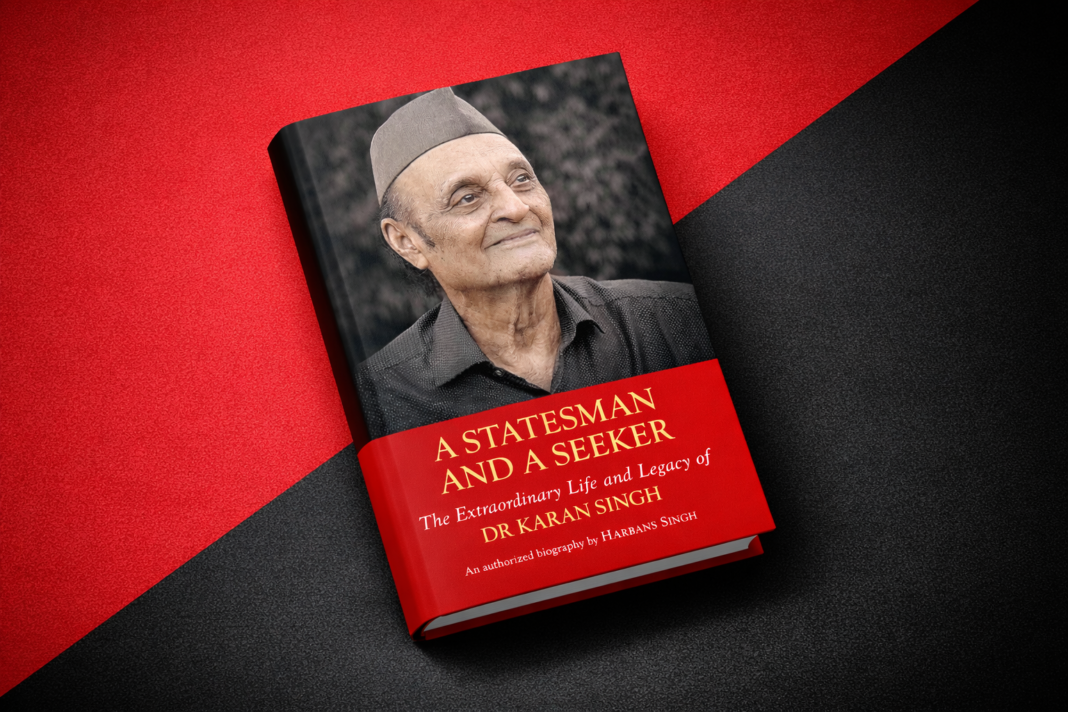
The book is conceptualised with an attention to its presentation of the physical and the scholarly paraphernalia. The title, A Statesman and a Seeker, creates, at a glance, the two-level structure within which the author wants us to interpret his subject.
The subtitle, The Extraordinary Life and Legacy of Karan Singh, does not humbly promise much for its subject, and the project is authorised, as the front flap announces, indicating something official in the work, which will necessarily influence readers’ expectations.
Even the cover design by Devashish Verma, which features a front cover photograph by Abhishek Sharma and a back cover photograph by courtesy of the subject’s personal collection, indicates a volume created with the help of the family and with assistance from their visual collections.
The front flap copy gives a brief contextualisation of the relevance of the subject, and he is described as one of the most familiar and popular public figures in India, whose life story is inseparably connected not only to the story of Kashmir, but to the story of India as a country and society since Independence. It is a large claim, and the biographical project should support it by amassing evidence of what seems to be a very large mass.
The author describes Karan Singh’s childhood in the palaces of Kashmir. The description is very atmospheric and evokes the walled-off world of princely India at the sunset of the British Raj. In our reading, we find that when he was still four years old, the subject was given the nickname of Tiger by one of the Muslim guests staying in the house. Tiger’s nickname was given to him by a Muslim guest who sat before Maharaja Hari Singh and his friend, Maharaj Ummaid Singh of Jodhpur.
The name persisted, and the book tells us that during his adult years, Nehru was still called by that name by many of his friends, and that even Jawaharlal Nehru called him that name, which of course establishes the familiarity between Nehru and the young prince and how the childhood identity continued to exist in the adult world.
The story of the early years is built around the three boys, Tiger, Digby, and Bilti, who had to live with a series of British guardians, first the Colonel and Mrs Wyndham, and then the Ritchie brothers. Its description of their life at the Taley Manzil on the Shankaracharya Hill, with its commanding view of the mountain range of Zabarwan and its breathtaking panoramic view of the Dal Lake and the Srinagar city, creates the aesthetic sensibility that would further be incorporated in the writings of Karan Singh on the topic of art and culture.
At Jammu, they lived in Karan Niwas, which was originally a staff house in the larger palaces of the estate, and in which they had a full complement of servants who doubled as playmates, particularly for organising football and cricket matches.
Maharaja Hari Singh’s regimen stands out as one of the major factors shaping personality. The boys were under a rigid academic, dietary, and recreational program in which deviation of any kind was not permitted. Interestingly, the food regulations made it clear that no Indian food or bakery items were to be taken, so the boys had to be satisfied with English food, which is an indication of the Maharajas’ desire to become Anglicised and modern.
The biographer adds, though, that the finest food of the day was at tea-time, when they were served on silver dishes buttered scones, sponge fingers, a kind of shortbread prepared by Huntley and Palmers, and sandwiches.
The school system involved an Indian teacher, Amar Nath Khosla, who taught English, Mathematics, and other subjects, writing monthly reports to the guardian in neat handwriting and submitting them to the Maharaja.
This tutor was the one who brought the boys covertly into the world of the freedom movement, introducing them to a black marble statue of Mahatma Gandhi, a dhoti-clad, weak-looking man. The conflict between their institutional status and their youthful sympathies is described in the text: as most youth, they were instantly pro-revolutionary, but they knew that the establishment around them, which they had to live under, was not going to be any better about it. They followed Gandhi’s instruction to keep quiet to their English master, yet the figure of India rising against British rule still appealed to them.
Next, the chapter ‘The Years of Anxiety’ follows the path of the emotional disturbance brought about by Karan Singh being taken away to boarding school. After having very gradually adjusted himself to Taley Manzil, in which the school and its activities had already made themselves palatable, and the separation with his mother less agonising, the little boy was confronted with what seemed to his mind to be another sudden and arbitrary choice — to take him away to a boarding school. Even the institution matters: instead of sending his son to Mayo College in Ajmer, where he himself had attended school and where all princes were supposed to go, Maharaja Hari Singh chose the Doon School in Dehradun.
The excerpt stresses the democratic nature of this institution. It was founded in 1935 as a public school and did not grant any special privileges to the wards of Maharajas or Nawabs. At Doon School, the boarder was required to make his bed, clean his shoes, and tidy his room. The eleven-year-old Tiger was forced to lead a retinue-free life and carry out all his daily duties himself, an experience that would later inform his sense of democratic citizenship and his ability to traverse the worlds of privilege/public service.
The story also shows what was threatening the movements of the young prince in Kashmir. It tells how, to get to their school at Raj Bagh, the boys were driven in a car to a point on the riverbank, then took a boat across, and how the car met them on the other side. This tedious process, as we learn, was by the directions of the Maharaja, who desired to avoid any chance of jeopardy to the person of his son.
The context of these precautions was the fact that political mobilisation had been increasing in Kashmir, with Sheikh Abdullah and his All Jammu and Kashmir Muslim Conference, which he co-established in 1932 and then renamed the National Conference, becoming belligerent, with no fear to openly oppose the Maharaja and demand the termination of Dogra rule.
The sources show that a large part of the biography is devoted to Karan Singh’s political life in Kashmir between his appointment as Regent in 1949 at the age of eighteen and his resignation in 1967 as Sadr-e-Riyasat and Governor.
The beginning of the book puts the reader in dramatic mode: “Karan Singh was only eighteen years old and barely out of bed after an inexplicable illness that had kept him bedridden more than a year, when he was thrust into the world of politics in the year 1949. He was made Regent by his father, the late Maharaja of Kashmir, who had just signed the Instrument of Accession to India and abandoned the State, never to see it again.
The book also describes the political crises that characterised this time. In 1952-53, the Praja Parishad agitation, which ran on the slogan Ek Vidhan, Ek Nishan, Ek Pradhan – One Constitution, One Flag, One Head of State, was launched on 13 November 1952, which demanded a complete integration of the State with India.
The passage shows that Karan Singh had been shocked by the extent of the agitation and by the strength of the passion the Dogras had displayed, both in their active interest in women’s rights and in their support for bloodshed.
His conclusions, which he had reported to Prime Minister Nehru, were that an overwhelming majority of the Jammu Province appeared to be in support of the agitation as a whole, and that it was based on very deep-rooted and sincere economic and psychological causes, and not just the invention of a reactionary clique.
The story shows how Karan Singh was ready to take principled positions, even though that put him at odds with stronger individuals. In his letter to Nehru, he says that, with the hoisting of the new State Flag upon the Jammu Secretariat on 1 December, his suggestion about hoisting the Indian Flag has evidently been neglected. The passage goes on to say that Sheikh Abdullah had rudely declined the proposal, leaving the opportunity to appease the Dogras. Even Karan Singh refused to raise the State Flag unless the National Flag was raised first, a clear indication that he would not be the rubber stamp Sheikh Abdullah desired him to be.
The author has also provided a detailed explanation of the political crisis that led to the dismissal of Sheikh Abdullah in August 1953. The story indicates that a section of the National Conference government had reservations about Sheikh Abdullah’s dictatorial tendencies and his loyalty to the development of the State into India.
Karan Singh had culled out something to this effect during his contacts with Bakshi Ghulam Mohammad, D.P. Dhar, and Girdhari Lal Dogra, and this perception was corroborated in the letters that Nehru wrote later.
What triggered this was the ultimatum issued by Sheikh Abdullah, which called on Sham Lal Saraf to step down from the ministry on 7 August 1953. The senior-most member of the National Conference, being “the second only to Sheikh Abdullah in the Party,” and named Saraf, in response did not resign, but wrote a letter accusing the Prime Minister of having placed the country in a dangerous position by delivering so inflammatory speeches before the people, together with your authoritarian attitude in the Cabinet.
The book observes that by forcing Saraf to resign, Sheikh Abdullah not only created a crisis but also left a position ready to be occupied by Sadr-e-Riyasat Karan Singh, Bakshi, Dhar, and others, who were well equipped to fill.
Mechanics of crisis outlined in the constitution are well laid out. The Sadr-e-Riyasat could replace and appoint ministers on the recommendation of the Prime Minister, but to ensure the recommendation was carried out, the Prime Minister had to go to the Sadr-e-Riyasat, who would then do as he advised.
The book, however, indicates that Sheikh Abdullah had become a prisoner of his own image as a powerful leader and believed he could flick his fingers and that everyone, including the Sadr-e-Riyasat, would do as he ordered. The opposing party, which had made preparations for this contingency, had drawn up a memorandum to Sheikh Abdullah, a copy of which, signed by Bakshi, Dogra, and Saraf, was sent to the Sadr-e-Riyasat.
An important aspect of the biography, as indicated in the title and explored in the inner pages, is Karan Singh’s spiritual journey. It presents Sri Krishnaprem, or, as his followers and students refer to him, as Gogalda, as the second Guru of Karan Singh, after his previous association with Swami Shivananda. Most importantly, the text highlights that he formed a relationship that had a long-term impact on him.
The counsel of Sri Krishnaprem is given in extenso, and it is worth reproducing, on account of its value to the scheme of biography: do not lose the light which is within thee. You possess it, and it is worth more than your intelligence, fame, and wealth. Nothing will last but it, and lose it not. Adhere to what you consider the best. You will never regret it.” It is this advice, the passage implies, that informed the way Karan Singh dealt with the incompatibility between the demands of publicity and his conviction in his own privacy.
Besides Sri Krishnaprem, there is the image of Madhav Ashish – “Ashishda”- that manifests itself as a powerful agent. They would sit together long into the night, talking about all things, politics, relationships, dreams, and books, connecting all topics to the outside world and internal desires. It has been accredited to both having reached inner peace, which also spread to others, and having intellectual perception and profound emotional empathy, such that they could analyse life situations in ways no one had ever considered before, doing so on behalf of Karan Singh.
The story touches on the breakdown of intelligence: although all the intelligence agencies, the State, and the Centre were sophisticated, no one had even dreamed of the wicked scheme Pakistan had initiated in Kashmir.
The magnitude of this failure is gauged by the fact that on 5 August, when Karan Singh issued a large reception at Oberoi Palace Hotel (now Lalit Palace), Srinagar, on the occasion of the first birthday of his son Vikramaditya, some guests had already been talking of rumours that Pakistani infiltrators had penetrated the borders of Srinagar. But there, too, the gravity of the position had not yet been properly comprehended.
The narrative has an emotional autobiographical note. Karan Singh departed on 6 August for Delhi and went to Mirrola to see Gopalka, who had not been doing so well. He came in, as usual, to be welcomed, but it was quite clear that he was not the same strong and energetic man that he had been.
The next day, when Karan Singh had stooped to greet his feet and bid him farewell, he was welcomed by Gopalka, who embraced and hugged him. At those times when they gaze into each other’s eyes, they understand that they will not see each other again.
When Karan Singh entered Delhi, he had heard that a Pakistani invasion was in progress. He flew back at once to Srinagar, where the Chief Minister, Sadiq, and his colleagues were supposed to look rattled, and D.P. Dhar, to whom the intelligence agencies were answerable, had lost his head.
The operation was known as Operation Gibraltar, and the operation used a huge number of Pakistani undercover agents who had entered the Valley with the hope that they would emerge on the ground at a certain time, after which the masses would revolt against India.
The invasion was preceded by violent and staged propaganda, such as posters that proclaimed “Proclamation of War of Liberation” that was issued in the name of the Revolutionary Council of Kashmir.
The book also offers a retrospective on the later years of Karan Singh, the widow of Karan Singh, and on how he maintained his scholarship and involvement in politics. The section starting with and so, like the River Ganga, Karan Singh flows on, accumulating experience and giving something of himself to the things that surround him, making his particular way to the ultimate ocean that we will all reach at the end, contains a metaphor that would otherwise sound as an unreasonably overdone expression.
The story of Yasho Rajya Lakshmi, or, as she was fondly called, Asha, the name given to her by her father-in-law, is especially touching. The text refers to her as being involved in all his decision-making, and Karan Singh admitted he had gotten into trouble several times when he made decisions independently. Her judgment of individuals and circumstances, he has been quoted as saying, was still better than his. “It was not just me; all the family members tried to consult her and seek their comfort. And then one day she was gone.”
Her final days are depicted in a modest, respectable manner. When treatment in the hospital seemed not to work, she had requested to be released from the hospital, so that she might meet her demise without the artificial life support. This was in line with a ruling that she and Karan Singh had made way back in the days in their living wills that when the moment comes near death, they would not be put on ventilator machines.
She went back to her house, went into a coma, and died on 24 May 2009, at the age of seventy-four. The reading focuses on the gap left by her death: she was the cement that had held not only the nuclear family together but the extended family and a considerable number of friends scattered around the world.
The story of her character contains eye-opening information about her interpersonal affairs at social boundaries. One of her most confided servants was somebody of an oppressed caste, of whom many would have kept aloof in the ritualistic world in which she was born and grew up.
She earned his respect and loyalty, and he, who was so trusting, was depended upon by her, and she trusted him with the keys to the house. The reaction to her daughter’s divorce, when she stood by her wholeheartedly, providing her with all the support she could have possibly needed, shows that it was the woman who chose love over social conformity.
Tailpiece
The book will constitute a significant contribution to the biographical literature on modern Indian public figures. The author has been granted access to his subject’s papers and family recollections, and he brings to the task both scholarly credentials and deep familiarity with the Kashmir context.