


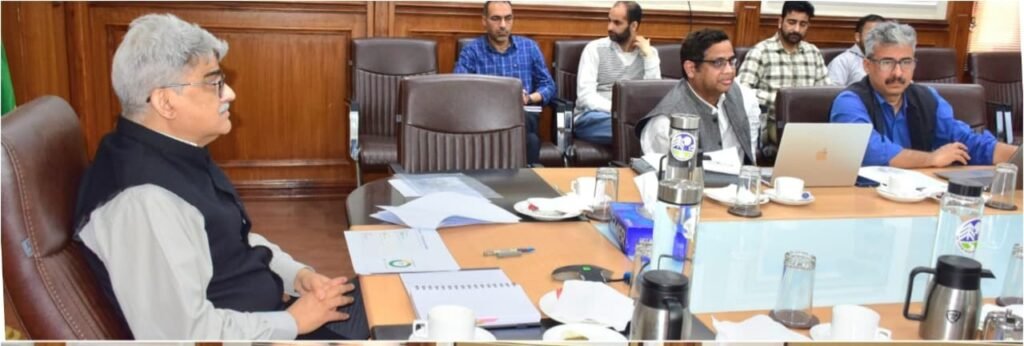
Jammu: Chief Secretary Atal Dulloo has observed that establishing a robust and responsive mechanism under the MSME Health Clinic to provide “the right advice at the right time” to local enterprises would be one of the most significant developmental interventions for the MSME sector in Jammu and Kashmir.
He made these remarks while chairing a comprehensive review meeting on the performance of the MSME Health Clinic, an initiative of the Industries and Commerce Department Jammu and Kashmir in collaboration with Indian Institute of Management Jammu under the Raising and Accelerating MSME Performance Scheme (RAMP).
The meeting was attended by the Director of IIM Jammu; Commissioner Secretary, Industries and Commerce; Director Industries, Jammu and Kashmir; faculty members from IIM Jammu; representatives from Bhaskaracharya National Institute for Space Applications and Geo-informatics (BISAG-N); and other senior officers.
Emphasising the way forward, the Chief Secretary called for reaching out to all MSMEs across the Union Territory to digitally assess their operational and financial health through a comprehensive analytical tool to be developed with BISAG-N.
He outlined a structured approach that enterprises would first undergo preliminary digital screening, followed by an advanced assessment of identified units. Stressed or sick units would initially be provided tele-consultation, followed by personal interaction with experts and, wherever necessary, customised on-ground interventions through field visits by subject specialists.
He directed the Industries and Commerce Department to ensure seamless sharing of the required enterprise data with experts from IIM Jammu to facilitate evidence-based diagnosis and recommend both financial and non-financial interventions tailored to the specific needs of each unit.
Stressing institutional strengthening, he advised the creation of dedicated cells within both the Industries Department and IIM Jammu to oversee and streamline this specialised service for MSMEs.
Observing that MSMEs form the backbone of the UT’s industrial ecosystem, the Chief Secretary underscored the need for strong intent, coordinated action, and sustained commitment to ensure the sector’s growth and resilience.
He stated that no greater support could be extended to MSMEs than a timely and well-structured intervention mechanism such as this, assuring that the availability of funds would not be a constraint in achieving the mission. He also encouraged securing adequate human resources to scale up the initiative effectively.
Director IIM Jammu, B. S. Sahay, described the initiative as a mission-driven effort aimed at ensuring measurable impact within a time-bound framework.
He suggested launching a focused outreach campaign, building upon the work already undertaken as a sample survey. Highlighting the scale of opportunity, he stated that reaching nearly 5.5 lakh enterprises across J&K is achievable with a well-designed strategy.
He further proposed leveraging the academic strength of IIM Jammu, including the involvement of its 800 students through structured project work, to contribute meaningfully to the initiative.
Commissioner Secretary, Industries and Commerce, Vikramjit Singh informed the meeting that after establishing the necessary digital framework by integrating GST, Udyam registrations, electricity consumption data, and other utility metrics, around 2,050 units have been registered on the MSME Health Clinic portal. He added that approximately 12,000 units are targeted to be assessed by April this year, with expert-backed interventions to be recommended by IIM Jammu.
Director Industries, Jammu, Arun Manhas, through a presentation, apprised the meeting that the MSME Health Clinic portal has been technologically strengthened with stabilised architecture, enhanced dashboard analytics, and a user-friendly interface for field officers and enterprises.
He added that key API integrations have been completed with Jammu and Kashmir Bank for financial pattern analysis, the Power Development Department Jammu and Kashmir for electricity consumption trends, and the Udyam portal for enterprise registration data. Integrations with GST filings and Employees’ Provident Fund Organisation (EPFO) data are currently underway to enable comprehensive multi-parameter digital assessments.
Phase-1: 14 Units Flagged for Rehabilitation Across 11 Districts
The meeting was also informed that over 5.85 lakh MSME Udyam data records have been received from the Ministry of Micro, Small and Medium Enterprises.
During Phase-1 (pilot execution), 75 enterprises were identified, 62 clinic sessions were conducted, and 14 units were flagged for rehabilitation across 11 districts.
Under Phase-2, 406 enterprises were digitally assessed, of which 318 were found stable, 87 categorised as stressed, and three identified as sick, extending coverage to 12 districts. The combined outreach now spans 20 districts across the Union Territory.
The review highlighted that preliminary findings suggest enterprises require financial and credit restructuring support, assistance in raw material sourcing and supply chain stabilisation, marketing and branding interventions, technology upgradation, skilled manpower retention, and, in complex cases, physical site visits for detailed diagnostics.
Moreover, it was stated that under the upcoming Phase-3, targeted interventions will be undertaken for stressed units through in-depth interviews, stakeholder workshops, structured field visits, and preparation of comprehensive diagnostic and revival reports.
The meeting was informed that this will be a continuous and evolving process aimed at building a sustainable early-warning and enterprise support system for MSMEs in Jammu and Kashmir in the years to come.