


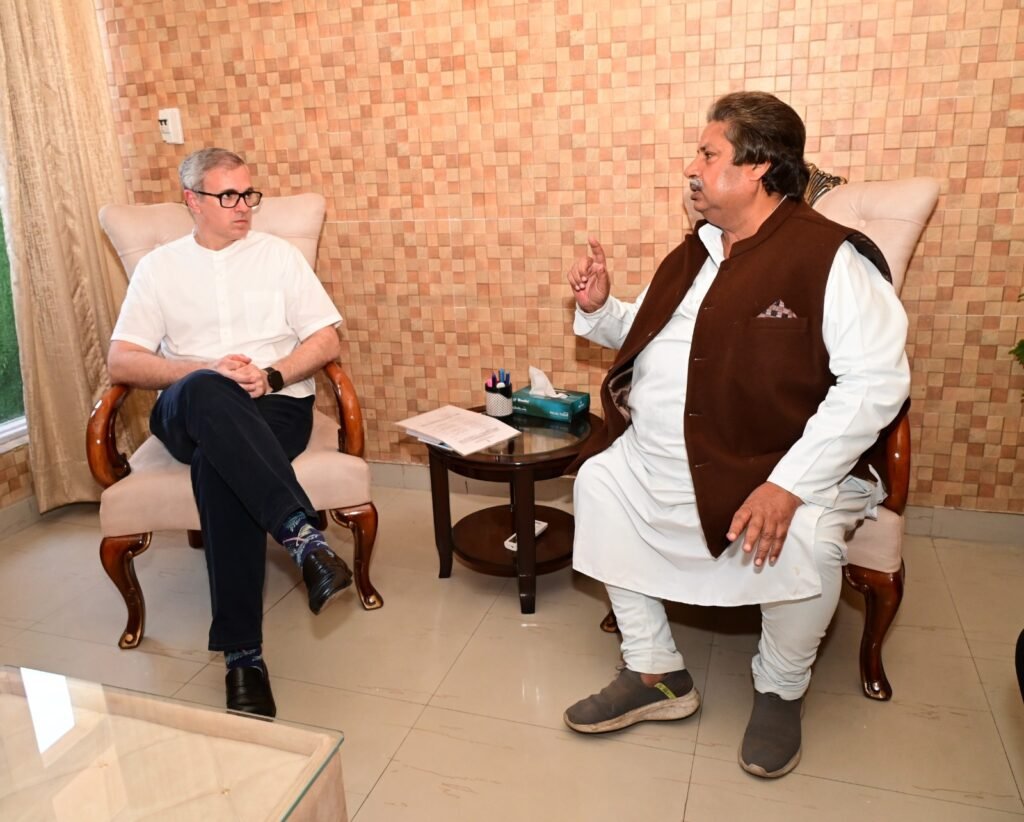
Jammu: In a significant political development concerning displaced families in Jammu and Kashmir, JKPCC Working President Raman Bhalla led a delegation to Chief Minister Omar Abdullah, seeking urgent intervention over the alleged denial of Scheduled Tribe (ST2) certificates to members of the displaced Pahari community from Pakistan-occupied Jammu and Kashmir (PoJK).
Describing the issue as one of constitutional justice and equal treatment under the law, Bhalla urged the Chief Minister to direct all district administrations across the Union Territory to ensure uniform implementation of the Scheduled Tribe notification for the Pahari Ethnic Group (PEG), without discrimination based on present place of residence.
Bhalla also raised the long-pending demand for the implementation of the Parliamentary Committee’s recommendation of a ₹30 lakh rehabilitation package for PoJK displaced persons (DPs). He said thousands of families uprooted during the 1947 conflict continue to face economic hardship and deserve comprehensive financial relief for dignified rehabilitation.
“This is not merely a question of certificates or financial aid. It is about correcting the historical injustice faced by families who sacrificed their homes and livelihoods during one of the most turbulent chapters in our history,” Bhalla said.
The delegation submitted a memorandum dated March 3, 2026, highlighting the grievances of displaced persons belonging to the Pahari Ethnic Group who are residing in various districts of the Jammu Division, particularly Jammu district, but outside Rajouri and Poonch.
According to the memorandum, eligible applicants fulfilling all criteria under SO 176 dated March 15, 2024, are allegedly facing rejection or non-processing of their ST2 applications in districts other than Rajouri and Poonch.
The delegation included Amrit Bali (Ex-Sarpanch), Retd Col Ravinder Sharma, S. Rajinder Singh (Ex-Sarpanch), S. Gurmeet Singh, S. Inder Pal Singh, Ankush Raina, Madan Lal Sharma, Romesh Raina, Koushal Kumar Shastri, Babu Ram Sharma, Tushar Sharma, Rohit Khujria, and Retd SP Vijay Sharma, among other representatives.
They sought immediate directions to competent authorities to process and issue ST2 certificates to eligible members of the displaced PoJK Pahari community without discrimination based on geographical location.
Bhalla pointed out that under Rule 21 of SO 176, a person seeking benefits under the Pahari Ethnic Group category must belong to the Pahari clan, community, or tribe with a distinct cultural, ethnic, and linguistic identity; produce valid identification documents such as an Aadhaar Card, Voter Identity Card, or Domicile Certificate; and obtain certification from the concerned Tehsildar. He asserted that displaced PoJK Pahari families fulfil these requirements but are allegedly being denied ST2 certification because they reside in districts such as Jammu or Samba.
Terming the interpretation restrictive and discriminatory, Bhalla emphasized that ethnicity, culture, lineage, and language—not district boundaries—form the constitutional basis for Scheduled Tribe recognition.
The delegation also referred to an earlier official clarification issued in response to a former legislator from Kishtwar, which stated that ST status granted to the Pahari Ethnic Group is based on distinct ethnicity and not geographical location. They said it was contradictory to exclude displaced PoJK Paharis living outside Rajouri and Poonch.
Citing specific cases, the memorandum mentioned instances where two brothers from the same displaced family were treated differently—one settled in Rajouri or Poonch granted ST2 status, while the other residing in Jammu or Samba was denied the same and placed in the general category. The delegation termed such instances inconsistent and a violation of the constitutional principle of equality.
They further recalled that the earlier Pahari Speaking People (PSP) certificate approved in 2020 was implemented only in six districts, creating what they described as an artificial geographical limitation on a community sharing identical ancestry and cultural identity across the Union Territory.
Reiterating the demand for the ₹30 lakh rehabilitation package, Bhalla stressed that identity recognition and economic rehabilitation must go hand in hand. While ST recognition would provide reservation benefits in education and employment, financial assistance is equally essential for families that lost land, property, and livelihood during displacement.
“For nearly eight decades, these families have struggled to rebuild their lives. The ₹30 lakh package is not a favour but justified compensation based on a Parliamentary recommendation,” Bhalla said.
Chief Minister Omar Abdullah gave a patient hearing to the delegation and assured them that their concerns would be examined thoroughly. He stated that appropriate steps would be taken in accordance with the law after reviewing the matter.
The delegation expressed hope that timely administrative intervention would ensure equal implementation of constitutional provisions across all districts of Jammu and Kashmir and restore faith among displaced Pahari families.