
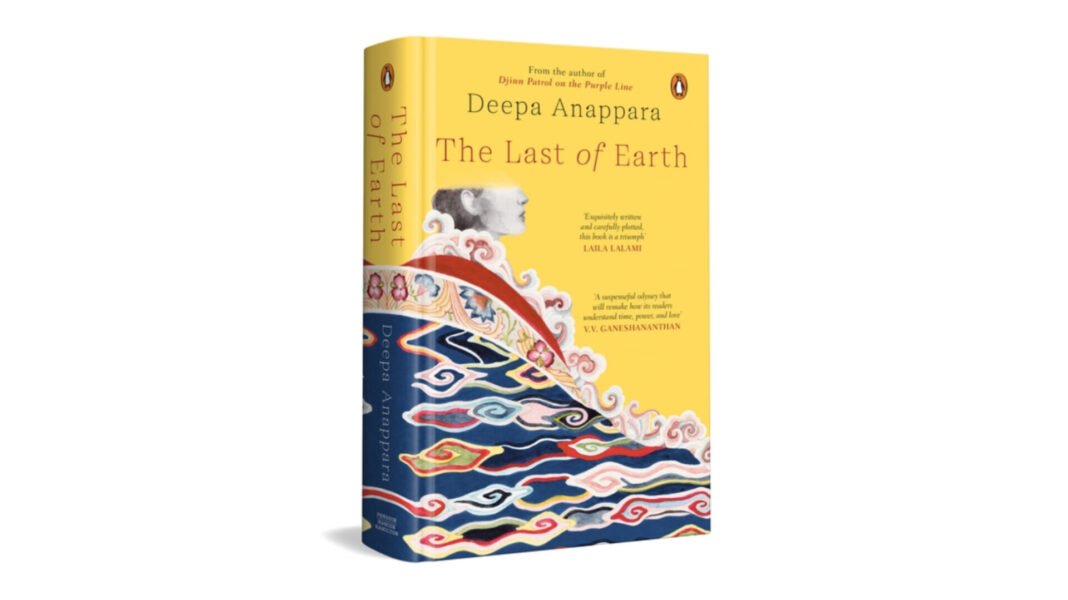

The second work of fiction by Deepa Anappara, The Last of Earth, published by Penguin Random House India, is an important step in the author’s literary career.
After the more than ample accolade which followed her debut, Djinn Patrol on the Purple Line, which earned her numerous awards at home and abroad as well as translations into more than twenty languages, Anappara has now made a bold venture into the zone of historical fiction, specifically the sub-genre dealing with the machinery of colonial exploration, mapping, and the active process of deleting the agency of the native population of the colonial empire.
The supplied paratextual materials, including the front and back covers, an author note, acknowledgments, large reproductions of passages in the narrative of the novel, and the quote used as an epigram in the report to the Royal Geographical Society by Captain T.G. Montgomerie in 1868, present ample evidence of a work that tries to both challenge the myths of exploration that lie behind the history of colonialism, and at the same time give voice to those who were needed to be silenced through a carefully constructed history of colonialism.
The novel is set in the geopolitical context of the Great Game, the extended nineteenth-century conflict between the Russian and British Empires over which was the chief power in Central Asia. Tibet at this time, as the author explains in her note, was an especially vexing element in British imperial ambition: its borders were essentially shut to European invasion and, at the same time, open to Indian pilgrims and businessmen.
The British reply, which is repeated in the first pages of the book, was of a practical order: Indian surveyors, or, as they were called, Pundits, were recruited and trained to make a secret reconnaissance of the Tibetan plateau, and to use their own bodies as measuring and observing instruments.
In reporting on the Government of his time, Montgomerie has made a characteristic disclosure when he says, with startling candour, that a European, though disguised, will be noticed when in the Asiatic world, and that his arrival, when he is discovered, is nearly certain to produce a temptation.
The remedy to this was to avail himself of the comparative freedom of movement enjoyed by the Asiatics, who were the subjects of the British Government, and who were known to move freely without any harassment in nations much farther to the eastward of the British frontier. These men, whose names were not recorded in the authoritative literature because of such reasons as obvious ones, walked through the territory that was strictly forbidden to their masters in Europe, but their works were systematically erased out of the chronicles of the exploration history, and their work was made invisible by the very mechanisms of the colonial knowledge production that those men were supposed to be servants of.
Out of this historical blank, Anappara recreates her hero, Balram, an Indian schoolteacher called on to serve as a surveyor-spy for the British. The plot driving force is based on a twofold motive, the ostensible commission of Balram to mentor an English captain, disguised, with poorly comic incompetence, as a Buddhist monk, on a journey to map the route of the Tsangpo River, as well as on a secret personal mission to find the beloved friend Gyan, who is reported to be in prison somewhere in Tibet after his own unfortunate surveying expedition.
This mixture of imperial ambition and close friendship is one of the novel’s most powerful structural elements, as it makes personal loyalty one of its opposing forces to the abstractions of colonial cartography. This is achieved with commendable economy, as the opening epigraph in Montgomerie of the novel, with its clinical aloofness toward the expendable nature of Indian surveyors, sets the ethical stakes.
The expedition of the captain, which the promotional material terms a foolhardy venture, is a result of the typical imperial belief that there can be no corner of the earth left unmapped, no river left unexplored, no people left unconquered.
The captain, who has been delegating the actual labour of exploration to the Indian subordinates over the years, now wants his own glory; his goal is to chart the river’s route to the sea, first among the Europeans. His disguise, which is made laughable due to his lack of control over his habitual posture of authority, is a metonym of the greater inanities of colonial pomp.
The storytelling approach to this character, though never reduced to caricature, reveals the inherent violence, both epistemological and physical, that underlies the imperial project. When at last, the captain is captured by Tibetan soldiers, one of the first things that the captor sees is that he is a man who had lost everything, even hope, the Tibetans having seized not only his Herodotus and sketches, but even the effects of the men on whose bodies they have taken, and who are now obliged to send them home to their families without even the ashes or bones of their men to pour into the Ganga.
But the captain, as Balram observes bitterly, had his life, and his narrative of this voyage, even without a route map or measurements, would probably have secured him the Founder’s Medal of the Royal Geographical Society.
Running parallel to Balram’s path is that of Katherine, a fifty-year-old mixed-race woman of Indian and English descent who has set herself a secret goal: to make European history of her own by becoming the first European-born woman to reach Lhasa. This drive in Katherine is given a very psychological subtlety: since she is denied the fellowship of a society exclusively of men, the Royal Geographical Society of London, she wants to make her mark in the annals of history by an exploratory piece of derring-do that the metropolitan society can not overlook.
Nevertheless, Anappara declines the temptation to make Katherine a simple sympathetic character; because she is marginalised by the metropolitan patriarchy, it does not mean that she is not a complicit agent of imperial ideologies. The privilege of being mixed-race at once makes Katherine feel privileged and, at the same time, threatened, a privilege she confronts when she informs Chetak, the enigmatic bandit who traverses the novel’s narrative strands, that the English are honourable and just people.
Chetak’s reply, ‘The Koh-i-noor is quite expensive,’ makes the unsuspecting reader realize, with grovelling economy, the material violence which the English claim of honour and justice. The next line of Katherine, that she had always thought that at some uncertain moment in the future she would be the person she was meant to be, but fifty years on earth had not given her anything certain, only brought her confusion, expresses a state of existential suspension in line with the general issue of the novel in the problem of the instability of identity under colonial circumstances.
The character of Chetak represents a rather advanced contemplation of the potentialities of opposition in unequal power relations. Their inability to be legible, his denial of his real name, his non-disclosure of his Muslim identity, and his evasiveness in dealing with his motives are ways of self-preservation in the context of colonial domination. When Katherine pushes him to give his name, he finally tells her it is Sulaiman, but the act is burdened by a secret so closely guarded.
Balram praises the reserve of the bandit, and it is an indication that he did not want his tongue to be so eager to declare his every word and fact. It was, as it were, liberty, to have a self which the world—and the masters of the English—had never been able to understand. This figuration of resistance as epistemological withdrawal, as the intentional cultivation of obscureness in the wake of colonial calls to transparency and legibility, is an important addition to postcolonial literary discourse, shifting beyond the dichotomy of cooperation and insurrection to think about other opaque ways of self-preservation.
The relationship of the novel with cartography as an erasing technology is perhaps the most enduring thematic obsession of the novel. Balram writes on the inappropriateness of maps to reflect the experienced reality of Tibetan life, which is a searching critique of imperial description: Which map had the nomads weaving their colourful wool into their earholes, the pilgrim who knelt and lowered his forehead to the ground with footstep as he wound round high mountains to pray of the well-being of all sentient beings, or the snow leopards, who wore their tails as scarves when it was cold outside?
Balram desired maps that would show these lives, or he desired no maps at all, and now that he was probably bound to the gallows, he thought that he had squandered too many years in untrue things. This text summarizes the novel’s main message: that cartographic representation is never neutral, that maps are always instruments of power, making invisible exactly those forms of life that cannot be fitted into imperial grids of intelligibility. This criticism is further emphasized by the fact that the river was not a blue spiral on a map but a life, which demands the impossibility of reducing phenomenological experience to abstracts.
The excerpts unveil a complex structure of narration, with a multi-perspective alternating between Balram and Katherine, and a third-person narration that is close to each of them but allows some breadth for the omniscient. Such polyphonic form allows Anappara to create a multiplicity of thematic contrasts: between the rationality of science and the cosmology of the spirit, between imperial mapping and the sacrality of the natives, between the aspiration to immortalisation and the realisation of impermanence.
Even the landscape of Tibet becomes a sort of third actor, whose ontological condition is higher than that of a setting. The novel’s descriptive scenes strive to make the Tibetan plateau available not as a blank slate to be inscribed by European surveyors but as a landscape full of meaning, in which its mountains and lakes are already consecrated by indigenous occupants as sacred.
The fact that Balram remarks that he hunches his back in the manner Gyan did, illogically afraid that, should he straighten his spine, his head would brush against the contour of the sky without clouds and shatter it, is an expression of cosmological orientation which is essentially different from the equally economic instrumental rationality of the captain.
The Buddhist treatment of the novel, especially through the character of Mani, who guides Katherine, brings in philosophical issues that go beyond the historical context of the novel. It is also possible to note a contrast between the frenzied effort that drives both Katherine and the captain, and the equanimity of Mani when suffering strikes him, and he repeats to him that suffering is not only a part of our lives, but also not new or groundbreaking. The sarcasm of what Katherine has answered, as I could do without it, on the whole, can not utterly obscure the impression of calm his serenity has produced upon her. The use of the invocation to the mandala in the epilogue, even unrendered in the given extracts, is expected in Katherine’s.
and consideration of how quickly her journal would fade away: given the personal property of a man, who was to open up the cover of her journal, rubbed by the dust of the earth, by the soot and precipitation, he would not know (as she did) that the form of these letters had been determined by the temperature, by the speed of the wind, and by the benumbedness of her fingers. They would not be aware of the lies she had decided to bring to life, the animals and outsiders she had created to serve only to entertain.
The sentences she had scribbled in the open eyes of the sun and the moon meant everything to her, and she would not live without her corrections and alterations. This philosophizing about the frailty of inscription, about the reliance of meanings on circumstances and on the memory, makes the journal of Katherine parallel to the Buddhist mandala, that complicated cosmogram so carefully built up by monks, and so carefully destroyed by them, as a demonstration of the impermanence of life.
The acknowledgement and the note made by the author show how far the research went to reconstruct the historical background of the novel. Anappara admits that she owes her work to the work of Peter Hopkirk on the Great Game, to the writings of women travellers such as Annie R. Taylor and Alexandra David-Neel, to the travel writing of Vikram Seth, and to Karl E. Ryavec’s A Historical Atlas of Tibet.
The fact that the edition of the diary of Annie Taylor is included by William Carey, and that the reference to A. Henry Savage Landor, In the Forbidden Land, with its photograph of the two faithful servants of Mansing and Chanden Sing, is made, shows the archival basis of the imaginative reconstruction of the novel. The fact that Anappara credits the beginnings of the novel to the dramaturgy lessons offered by Professor Steve Waters, which helped open a new perspective on the concept of space in a story, and the invaluable advice, support, and encouragement of Professor Vesna Goldsworthy over a number of years, testifies to the fact that the novel was born into a highly academic environment that has obviously contributed to its thematic obsessions and formal ambitions.
Should reservations be made on the basis of the extracts given, it is the pacing of the novel, which may not be sufficiently natural to some of the readers, and the sometimes flawed development of minor characters whose story interest is not yet fully fulfilled.
The character of Gyan, who supplies the emotional propulsion to Balram, is only annoyingly spectral, seen through the nervous ministrations of Balram and the threatening figure of him shoving a blindfold over Balram’s eyes, as though the stuff were not cotton but silk. The interiority of the captain is markedly less subtle than either Katherine’s or Balram’s, but this imbalance might be explained by the novel’s focus on restoring subaltern consciousness rather than recreating imperial subjectivity. These, though, are comparatively small cavils against the new novel having so much to be proud of.
The Last of Earth underscores Deepa Anappara’s position as one of the most ambitious and successful storytellers in the Anglophone Indian literary tradition today. The rigorous historical writing, the openness to take philosophical problems and yet not lose narrative drive, and its involvement in the task of restoring the voices that had been systematically deleted from imperial archives, are all signs of a writer at the peak of her own abilities.
The novel is worthy of a large readership, not just for those who want to read it because of the historical era it recreates, but for all readers who want to comprehend the ethical and political aspects of the storytelling as such.
By insisting on the illegitimacy of a map that destroys lives as a map that does not deserve the name, and by insisting that the story of people who have crossed the boundaries of history must be told, Anappara has created a morally and aesthetically powerful work.