


New Delhi: When crowds at a Tehran Friday sermon in June 2009 chanted “Death to Russia” instead of the state-sanctioned “Death to America,” it was a rare public display of the deep-seated mistrust that had long defined Iranian attitudes towards their northern neighbour.
The chants emerged as a direct consequence of Russia’s swift endorsement of President Mahmoud Ahmadinejad’s contested election, which had triggered nationwide protests known as the Green Movement. Yet, within just a few years, this animosity would be subsumed by a strategic alignment so profound that Russia and Iran would fight side by side in Syria, coordinate military operations, and eventually see Tehran supply drones for Moscow’s war in Ukraine.
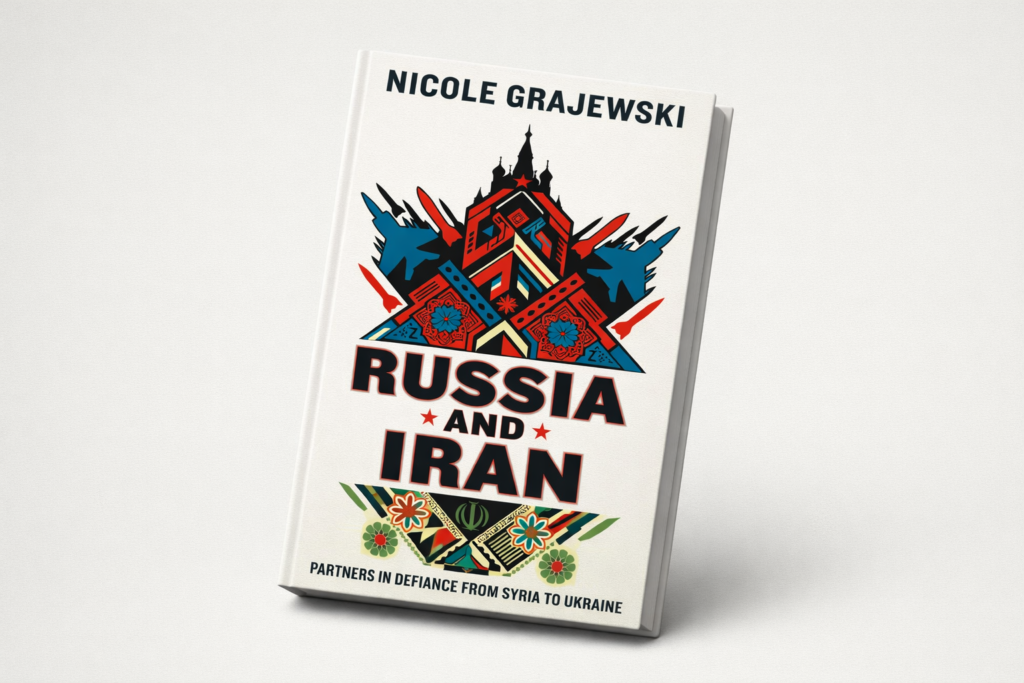
How this transformation occurred is the subject of a compelling new book, ‘Russia and Iran: Partners in Defiance from Syria to Ukraine,’ by Nicole Grajewski, published by Hurst Publishers.
Grajewski, an assistant professor at Sciences Po in Paris and a nonresident scholar with the Carnegie Endowment for International Peace, has produced what is being described as a definitive account of this modern alignment.
Drawing on extensive primary sources in Russian and Persian, as well as interviews with elites from both countries conducted over several years, the book provides an unprecedented look inside a partnership that is reshaping the global balance of power.
It deliberately eschews simple theoretical models to reveal “the textured reality” of how Russia and Iran’s cooperation unfolded through cycles of engagement and distrust, ultimately producing, as Grajewski terms it, a “partnership of defiance.”
The historical backdrop to this partnership is one of profound mistrust and betrayal, and the book opens by tracing these deep roots. Iran’s fraught relationship with Russia dates back to the eighteenth-century wars of territorial expansion, during which Iran ceded significant territory to imperial Russia.
Throughout the nineteenth and twentieth centuries, Tsarist Russia repeatedly meddled in Iran’s internal affairs, obstructing political reform while eyeing further territorial gains.
In the early twentieth century, Russia and Britain divided Iran into spheres of influence, with Russia controlling the north and Britain the south, undermining Iran’s sovereignty.
Later, the Soviet Union fostered further Iranian enmity by supporting separatist movements and providing arms to Iraq during the devastating Iran-Iraq War of the 1980s. For many Iranians, Russia’s actions in 2009 were not an isolated incident but rather the latest chapter in a long history marked by mistrust and betrayal.
The book argues that the shared experience of being marginalised by the Western-led liberal international order provided the crucial foundation for overcoming this history. Both nations harbored a profound sense of alienation, perceiving a system that disproportionately favored the interests of the United States and its allies.
For Russia, the Soviet collapse and the perceived weakness of the state under Boris Yeltsin were seen as profound deviations from its identity as a great power. The consensus around Russian self-perception as an independent “great power” (Velikaya Derzhava) emerged as a reaction to the perceived failure of Yeltsin’s pro-Western foreign policy, which many Russian elites believed had led to the country’s marginalisation.
This sentiment intensified during the Putin era, as Russia’s international position strengthened, bolstered by rising oil prices and a more assertive foreign policy that rejected what it saw as Western encroachment.
Iran’s experience with unipolarity was different but equally formative. Tehran’s revolutionary slogan of “neither East nor West” (Na Sharghi, Na Gharbi) was conceived in a bipolar world where aligning with either superpower was seen as forsaking national sovereignty.
The emergence of a unipolar world order threatened this ideological equilibrium, and the U.S. policy of “dual containment” in the 1990s, which sought to isolate both Iran and Iraq, hardened Tehran’s determination to defy what it saw as American hegemony.
Instead of compelling Iran to align with the Western-led order, dual containment drove Iran to look for partners beyond the West who shared its quest to counterbalance U.S. preeminence.
Over time, Iran’s worldview began to gravitate closer to the Russian perspective on multipolarity, leading Tehran to increasingly emphasise strengthening ties with Eastern powers as a means to counterbalance U.S. influence and build alternative centres of power.
However, Grajewski argues that these shared grievances alone were insufficient to create a comprehensive partnership. The practical institutionalisation of their relationship required a specific catalyst, which arrived with the outbreak of the Syrian Civil War in 2011. From 2011 to 2014, shared anxieties over potential regime change in Syria prompted both Moscow and Tehran to emerge as principal supporters of the Assad regime.
Initially, while both supported Assad, they pursued largely independent policies with minimal coordination. Russia’s early involvement focused primarily on diplomatic efforts to prevent Western intervention, leveraging its veto power in the UN Security Council, while Iran offered more substantial material assistance, including military advisors, financial aid, and weapons shipments.
The rise of the Islamic State in 2014 created urgent new imperatives for collaboration, as the group’s advances threatened Assad’s control over Syrian territory and both countries found themselves confronting a common enemy.
The decisive shift in Russian policy came in early 2015, when a series of military setbacks threatened the Assad regime’s survival. Although Moscow initially rebuffed Iranian requests for military support, the rapid erosion of Assad’s control, marked by rebel advances in northwest and southern Syria and an Islamic State offensive in the northeast, forced a recalculation. These mounting pressures ultimately led to Russia’s direct military intervention in September 2015, transforming Moscow overnight into a partner with Tehran on the Syrian battlefield.
The book provides an in-depth examination of how these two militaries, with no prior experience in joint operations and significant differences in equipment, tactics, and command structures, managed to forge a battlefield partnership.
The absence of prior military-to-military cooperation inevitably led to significant challenges, including communication barriers, difficulties in synchronising missions, and occasional confusion over the chain of command.
Yet over time, these obstacles were mitigated through the expansion of liaison mechanisms and high-level coordination bodies that institutionalised wartime cooperation.
The mechanisms developed in Syria, joint operations centres, intelligence cells, and logistical networks, outlasted their initial wartime rationale. They evolved into enduring instruments of collaboration, extending into domains such as cyber defense, internal security, and space cooperation.
Syria also became an experimental laboratory for new technologies and tactics, fostering cross-pollination in electronic warfare and unmanned systems. Russia’s provision of GPS jamming and electronic warfare expertise, for example, directly informed Iran’s subsequent advances in these fields, establishing a technical foundation for future joint operations.
By the time of Russia’s invasion of Ukraine in 2022, these wartime habits of coordination had hardened into institutional routines. The bureaucratic scaffolding built in Syria facilitated rapid adaptation: joint command structures and logistical routes were repurposed for the Ukrainian theatre, where Iranian drones became integral to Moscow’s war effort.
The war in Ukraine fundamentally transformed the Russia-Iran relationship, cementing it into one of necessity and mutual dependence. The invasion plunged Moscow into a steep downturn in relations with the West, triggering unprecedented sanctions and diplomatic isolation.
Under these circumstances, Iran’s long-cultivated expertise in evading international sanctions proved indispensable to Russia, offering valuable insights into alternative financial channels, illicit trade networks, and economic resiliency strategies.
At the same time, Russia’s protracted military campaign in Ukraine severely strained its defence capabilities, creating a dire need for new sources of armaments and ammunition. Iran emerged as one of the few actors not only willing but also equipped to meet this demand, supplying drones and ammunition that played a key role in bolstering Moscow’s war effort.
In turn, Iran benefited by securing advanced Russian technology and deepening its access to vital military know-how. Rather than simply deepening existing ties, the Ukraine war entrenched Russia and Iran’s cooperation to a degree neither could easily abandon.
The book details how Russia’s full-scale invasion of Ukraine ushered in a maelstrom that would fundamentally transform relations. Iran emerged as a crucial military supplier to Moscow within months of the invasion, leveraging the networks and procurement channels established during their joint campaign in Syria to begin supplying much-needed drones. This eventually expanded into joint production facilities on Russian territory.
Simultaneously, Russia gravitated closer to Iran politically, symbolised by Putin’s June 2022 visit to Tehran, where Russia finally embraced the “strategic” nature of ties with Iran, a designation it had deliberately avoided for decades despite Iran’s eagerness to elevate ties.
The deepening of this partnership manifested not only in military cooperation but also in internal security matters, as Iran’s widespread protests following Mahsa Amini’s death in September 2022 spurred further cooperation, with both countries signing agreements to share expertise between their domestic security agencies.
Despite this deepening cooperation, the book is careful to distinguish this relationship from a formal military alliance. Grajewski deliberately avoids describing it as an alliance because that would imply a binding agreement to provide military support and assistance in the event of an attack, such as Article V of NATO.
Instead, she characterises it as a partnership or alignment, both of which imply informal cooperation to pursue common interests. The relationship, while now deeply institutionalised, remains defined as much by its constraints as by its convergence. Divergent geopolitical interests, power asymmetries, and lingering mistrust continue to shape its contours.
The book argues that even the sudden collapse of the Assad regime in late 2024 failed to fracture the Moscow-Tehran axis, as the shared experience of Syria, the deepening military integration, and the imperative to challenge Western influence had created a durable bond that now transcends any single theatre of conflict.
The partnership originally forged in Syria, then strengthened by the war in Ukraine, endured well beyond the end of the very regime they had once fought to save.
Grajewski’s ‘Russia and Iran’’ is a major contribution to our understanding of contemporary international relations, offering crucial insight into a relationship that is often the subject of intrigue but seldom fully understood.
For scholars, policymakers, and general readers seeking to comprehend the forces reshaping the global order, this book provides an indispensable account of how two historically mistrustful nations became partners in defiance, united not by affection but by a shared determination to resist Western dominance and preserve their regimes in an increasingly volatile world.