
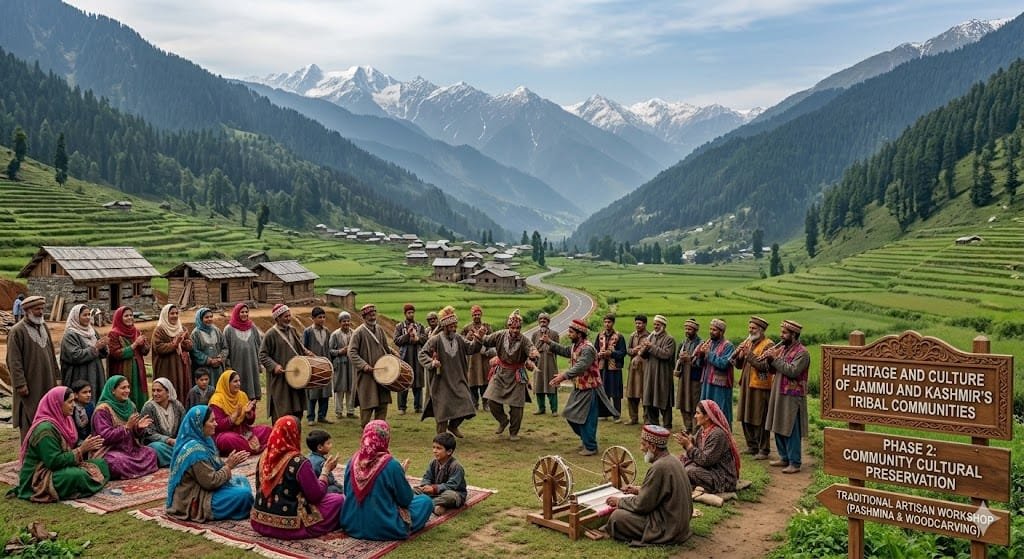

Jammu, Jammu and Kashmir (India): A detailed analysis of official data for the financial year 2024–25 has revealed a disturbing trend in the implementation of tribal development schemes in Jammu and Kashmir. Despite substantial allocations and fund releases, a significant number of projects remain either unstarted or incomplete, exposing systemic delays, administrative inefficiencies, and a glaring lack of accountability.
As per official figures under Demand No. 30 (Tribal Affairs), a total of 1,007 projects were approved during the financial year, with an allocation of ₹7,554.40 lakh. Out of this, ₹6,680.59 lakh was released, but actual expenditure stood at only ₹4,852.21 lakh, leaving more than ₹1,800 lakh (approximately ₹18 crore) unutilized and lapsed at the end of the financial year.
This translates to nearly 27% of released funds remaining unspent—a figure that underscores the magnitude of inefficiency within the system.
Even more alarming is the scale of zero-expenditure projects. A significant number of works—particularly in roads, irrigation, playgrounds, community infrastructure, and basic amenities—recorded no spending at all despite funds being released. For instance, road construction projects in Poonch, irrigation works in Kupwara, and multiple retaining wall and drainage works in Rajouri show ₹0 expenditure, clearly indicating that work never commenced.
In several other cases, spending is disproportionately low compared to the funds released. A striking example includes electricity infrastructure support for a hostel in Rajouri, where only ₹8,663 was spent out of ₹1.97 lakh. Similarly, road construction works saw only ₹96,500 spent out of a ₹24 lakh allocation—barely 4% utilization—while community infrastructure projects recorded just ₹48,000 spent out of ₹5 lakh.
At the same time, a few projects show full or near-full utilization, such as hostel facilities, smart libraries, and certain electrification works—highlighting inconsistent execution across sectors rather than a uniform lack of funds.
The data also reflects a sectoral imbalance. While institutional infrastructure such as hostels and classrooms has seen relatively better progress, grassroots infrastructure—roads, water supply, drainage, and rural connectivity—remains severely neglected, directly affecting tribal habitations.
A key reason behind this poor performance lies in bureaucratic bottlenecks in approvals and execution. Project files reportedly remain stuck for months across multiple administrative layers—from ministerial offices to the Tribal Affairs Department and the Secretariat. By the time approvals are finalized and files reach district-level authorities, the financial year is often nearing closure. This leaves negligible time for tendering, execution, and monitoring, ultimately resulting in non-utilization of funds.
The absence of real-time monitoring and accountability mechanisms further worsens the situation. There appears to be no effective system to flag delays, fix responsibility, or ensure time-bound execution. Inter-departmental coordination remains weak, and field-level supervision is largely ineffective.
The consequences of this systemic failure are most visible among the tribal population, who continue to struggle with poor infrastructure, lack of basic services, and limited access to development opportunities. Roads remain incomplete, water supply projects are stalled, and community facilities remain non-functional—despite funds being available on paper.
This gap between policy announcements and ground reality raises serious questions about governance. While both the Government of India and the Jammu & Kashmir administration continue to highlight tribal welfare initiatives in official forums, the failure to translate allocations into outcomes undermines these claims and dents public trust.
The crisis also reflects a broader issue of weak transparency, poor financial discipline, and a lack of ownership among implementing agencies. Additionally, limited engagement from political representatives and local stakeholders in ensuring execution further compounds the problem.
Experts argue that unless structural reforms are introduced—such as streamlined approval processes, strict timelines, digital monitoring dashboards, and enforceable accountability—the situation is unlikely to improve. There is also a need for district-level empowerment and decentralization to ensure faster decision-making and execution.
In its current form, the system risks reducing development to a mere accounting exercise—where funds are allocated and released, but real impact remains absent. Without urgent corrective measures, tribal communities will continue to bear the burden of delayed governance and missed opportunities, while crores of public money lapse year after year.