
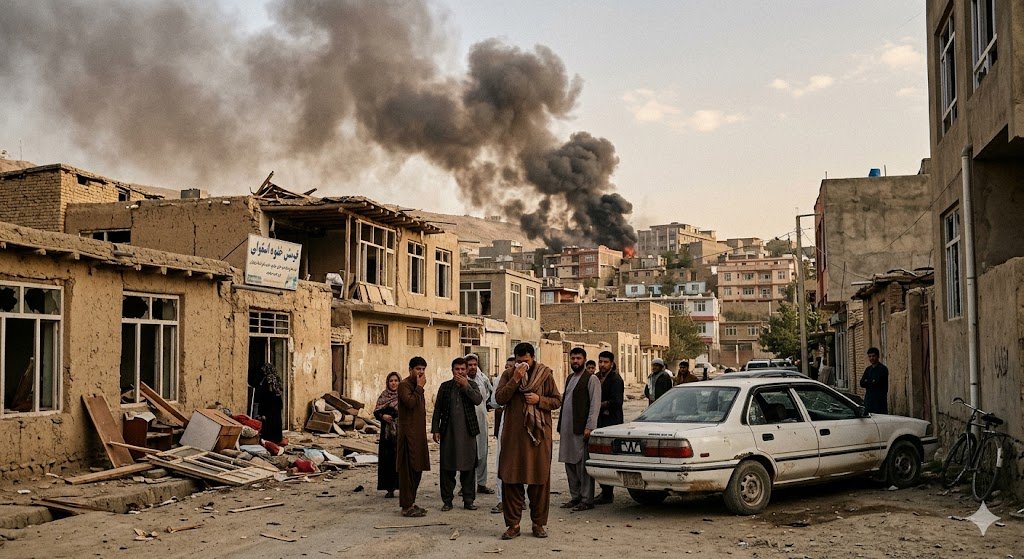

Pakistan’s recent cross-border strikes targeting locations around Kabul and Kandahar mark a decisive turning point in its long-standing Afghanistan policy. These are not merely military actions; they are signals of deeper strategic compulsions.
These moves appear unusually brash, raising critical questions about intent. Are they meant to justify Pakistan’s reluctance to militarily support Saudi Arabia in a wider regional conflict? Are they a response to mounting pressure from the United States to act against militant safe havens inside Afghanistan? Or do they reflect a miscalculated strategy driven by internal security anxieties and eroding control over the Tehrik-i-Taliban Pakistan (TTP)? Most likely, they are a combination of all three. Notwithstanding the intent, the outcome is unmistakably clear: what was once considered a carefully cultivated sphere of influence—often described as Pakistan’s “strategic depth”—now stands transformed into a zone of hostility. By striking both Kabul and Kandahar, Pakistan has triggered the collective wrath of the movement.
To understand the gravity of this shift, one must first appreciate the internal structure of the Taliban regime. Broadly, the edifice of power within Afghanistan rests on two pillars—the Kandahar-based leadership, headed by Supreme Leader Hibatullah Akhundzada, and the Kabul-based network led by Interior Minister Sirajuddin Haqqani. While these factions have their own styles, priorities, and external linkages, they have long maintained a delicate balance.
For years, Pakistan leveraged these internal dynamics to maintain influence. The Haqqani network has traditionally maintained strong linkages with Pakistan’s security establishment, particularly the ISI, and was considered a reliable interlocutor. Kandahar, on the other hand, represents ideological authority and religious legitimacy. Islamabad’s strategy rested on ensuring that both remained within Rawalpindi’s orbit. However, recent military actions have caused a significant fissure, disrupting this equilibrium.
Strikes in Kabul directly challenge the authority of the Haqqani network, which is responsible for internal security. Such attacks expose vulnerabilities in their control over the capital and undermine their credibility. For a faction that prides itself on operational capability and governance, this is a serious blow to its legitimacy. The most likely outcome is resentment replacing compliance, giving the Taliban ample reason to distance themselves from Pakistani influence.
More consequential, however, are strikes linked to Kandahar. Unlike Kabul, Kandahar is not merely an administrative hub; it is the ideological heart of the Taliban movement. Pakistan’s actions—particularly those associated with civilian casualties—resonate deeply within this leadership circle as an infringement of Afghan sovereignty. For Kandahar, the issue is not just security but legitimacy. If the Taliban are seen as unable to protect Afghan territory from external aggression, their claim to authority is weakened. This creates a powerful incentive for unity.
Historically, divisions within the Taliban have been real, but they have rarely translated into open fragmentation. External pressure tends to produce the opposite effect—consolidation driven by national pride. Pakistan’s actions risk triggering precisely such a response. By targeting both Kabul and Kandahar, Islamabad has eliminated any perception that one faction might be spared or favored. Instead, it has created a shared sense of grievance.
The implications are significant. A more unified Taliban, bound by a common external adversary, will be far less susceptible to external manipulation. This makes Pakistan’s traditional approach—balancing factions, leveraging relationships, and exerting selective pressure—increasingly untenable.
Compounding this challenge is the issue of the Tehrik-i-Taliban Pakistan (TTP). Islamabad justifies its strikes as an operational necessity to counter the TTP, allegedly based on Afghan soil. However, this approach amounts to multiple self-goals. First, in the global narrative, it reinforces India’s justification for Operation Sindoor, which was primarily aimed at raising costs for Pakistan’s proxy war in Kashmir. Second, Pakistan’s actions do not resolve the dilemma the TTP poses for the Taliban. The TTP is ideologically aligned with the Taliban and often linked through tribal networks; it cannot be easily disowned. At the same time, overt support risks international backlash. Pakistan’s military actions intensify this dilemma, pushing the Taliban leadership into a defensive posture.
Third, instead of securing its western flank, Pakistan now faces the prospect of sustained instability along the Durand Line. Cross-border tensions, the risk of retaliatory actions, escalation into a wider conflict, and potential coordination between the TTP and the Baloch insurgency are all increasing. This comes at a time when Pakistan’s military is overstretched—managing tensions with India, securing Chinese CPEC assets, countering insurgencies in Khyber Pakhtunkhwa and Balochistan, and facing pressure from Saudi Arabia to support a potential conflict with Iran. Compounding this security calculus are economic stress and shifting global alignments.
Equally important is the erosion of narrative advantage. For years, Pakistan framed its Afghanistan policy as a defensive necessity aimed at ensuring stability and countering hostile influences. Today, that narrative is increasingly difficult to sustain. Civilian casualties, international criticism, and visible tensions with the Taliban undermine Islamabad’s position and complicate its diplomatic engagement.
None of this suggests that Pakistan has irreversibly lost all influence in Afghanistan. Geography, history, and economic interdependence ensure that ties will endure. However, the nature of that influence is changing—from one of leverage to one of negotiation, and from implicit control to contested engagement. Afghanistan is no longer a vassal state at the mercy of Pakistan’s deep state.
The central question, therefore, is not whether Pakistan has antagonized both Taliban factions, but whether it has also undermined the very strategy that sustained its regional posture for decades.
If strategic depth has indeed turned into strategic blowback, Pakistan may find that the costs of recalibration are far higher than anticipated. The all-powerful Field Marshal Asim Munir, who once spoke of offering “masterclasses” in navigating the competing interests of the U.S. and China, may now be confronted with more basic lessons in managing relationships with immediate neighbors.