


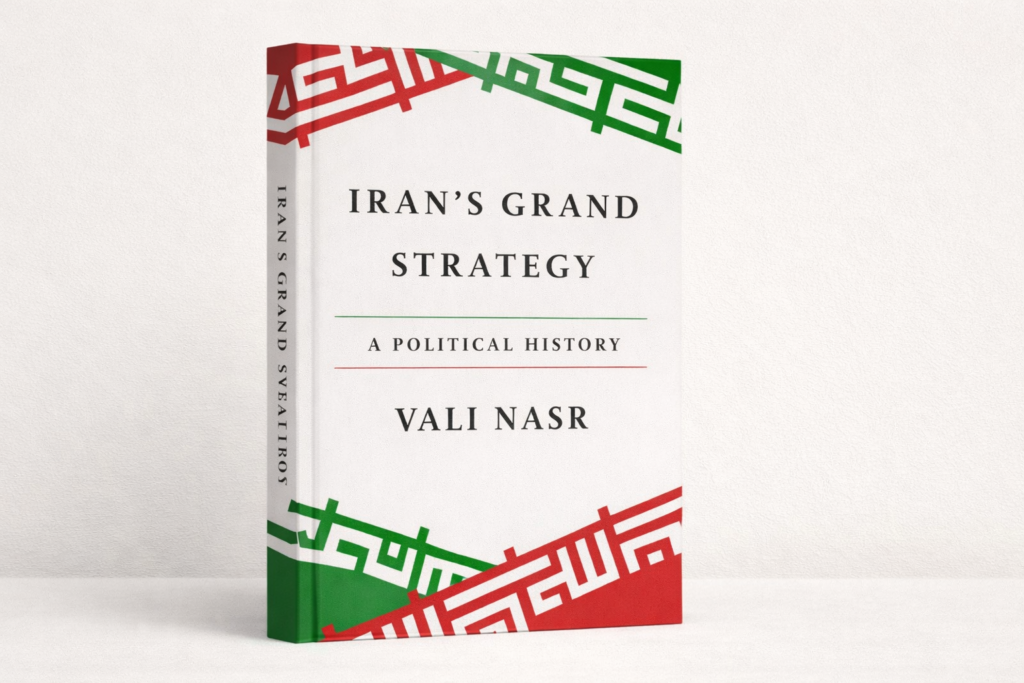
New Delhi: A new scholarly publication on the strategic development of Iran provides a broad historical analysis of the formation of a so-called grand strategy of resistance by the Islamic Republic’s leadership.
The book by Vali Nasr titled Iranian Grand Strategy: A Political History is a peep into the history of political and security paradigm of Iran since the era of the Safavid period through the reign of the Qajar dynasty to the era of the revolution and holds the view that the foreign policy adopted by Iran is best explained as a long-term reaction to foreign pressure, humiliation and encircling.
Based on the long-term research of the author, the book shows Iran not as a crazy player mind only by revolutionary messianism but as a state that has developed its strategic culture in centuries of losing its lands, being occupied by foreigners, and having the will to demonstrate its independent foreign policy in the conditions of Western domination.
Khamenei 2005 Prediction
The book cites Ayatollah Ali Khamenei, the Supreme Leader of Iran, in 2005, when he discussed 2025 as a strategic point in Iran’s ambitions. Nasr, however, proposes that the foreign sanctions imposed by the United States and its allies have limited Tehran’s capacity to achieve these objectives.
Importantly, the book also highlights the fact that the Iranian nation has fought the West regardless of the economic cost of such sanctions- something which, in the case of Nasr, Western policy-makers have never given enough consideration.
The Kissinger encounter
One of the most exposing incidents recorded by Nasr was when an Iranian diplomat sat down with the old American statesman Henry Kissinger in 2015. In this confrontation, Kissinger employed the Immanuel Kantian theory of peaceful settlement of conflict – the belief that democracies or rational states have the capacity to resolve conflict by dialogue and institutional structures as opposed to the use of warfare.
The Iranian diplomat’s reaction was very rebellious. Nasr states that the diplomat informed Kissinger that Iran was about to do the opposite of what Kantian theory would recommend. Instead of that theory, the diplomat explained that the United States is tired, not the Iranians. What Nasr conveys is that Iran’s attritional, asymmetric warfare approach has worn down American patience and resources in West Asia.
The crucial decade
According to Nasr, the most critical period in Iran’s grand strategy falls between 2001 and 2011. At this period, the United States was militarily active in Iraq and Afghanistan. Instead of engaging American forces in open conflicts, Iran took this chance to increase its influence within the region, consolidate ties with allies and proxies, as America was busy engaging in counterinsurgency and stabilisation operations. According to Nasr, this was a decade during which the execution of the grand strategy of resistance was most successful.
Safavid and Qajar
The book gives ample focus to pre-revolutionary Iranian history, contending that modern-day strategic behaviour cannot be comprehended without reference to the formative years.
The chapter of Nasr titled ‘Loom of History’ focuses on the period of the Safavid, during which the Safavid dynasty radically changed the religious demography of the region and converted Iran into a Shia state, a process that is the result of sectarian effects that persist in West Asian geopolitics to this day.
The Qajar dynasty, which reigned between 1789 and 1925, is introduced as a period of national humiliation. Nasr reports that the Russian Empire pressured the Qajars into giving up land under the Golestan and Turkmanchay treaties, losses that have marked the memory of the Iranian people. One of the major political developments of the time was Iran’s constitutional change in 1906, becoming the first state in West Asia to adopt a constitution.
The Occupation of 1941 and the Fall of Mossadegh
The book follows the rise of Reza Khan, who led a coup against the Qajar dynasty in 1921. First, as Nasr observes, the Shia clergy supported Reza Khan. Ayatollah Khomeini, however, emerged as a strong critic of his regime.
During the Second World War, the British and American forces overthrew Reza Khan in 1941. Nasr documents that these occupying powers were extremely oppressive to the local populations. When the war was over, the United States and the United Kingdom pulled out, and the Soviet Union remained; this, according to Nasr’s analysis, enabled socialist ideas to expand in Iran.
Shah Mohammad Reza Pahlavi, son of Reza Khan, was installed after his overthrow. The Shah did not take long to be at loggerheads with the popular Prime Minister Mohammad Mossadegh. Mossadegh lost Washington’s support when he refused to compromise on the Americans’ demands. This was followed by a coup orchestrated by the Central Intelligence Agency, and the Shah remained entrenched in power.
Nasr also gives a twist to the usual narratives, writing, Ayatollah Mohammad Hossein Boroujerdi, a prominent Shia cleric at the time, served as an active lobbyist to weaken Mossadegh and strengthen the Shah. The Shah, on his part, always tried to be close to Washington while at the same time maintaining opposition to the Soviet Union.
The book further notes that in 1958, the Eisenhower administration attempted to stage a coup against the Shah, a move that complicates the narrative of the uninterrupted American-Iranian partnership during this era.
Khomeini challenges the Shah
In the 1960s, Ayatollah Khomeini opposed the Shah and directed his criticism at the monarch’s reform agenda, especially the White Revolution. Despite political turmoil, Nasr observes that Iran in the 1970s was among the world’s rapidly growing economies, with annual growth rates up to 10.5 per cent. Another issue that the Shah was strongly interested in was the strategic significance of the Strait of Hormuz, through which a large share of the world’s oil passes.
Following the death of the Shah, according to Nasr, President Anwar Sadat of Egypt gave him a state funeral in Egypt, a demonstration of the convoluted regional interests that have remained difficult to categorise by cool sectarian or ideological notions.
The Revolution of 1979
Nasr describes Khomeini and Karim Sanjabi as the leaders of the revolt against the Shah. Khomeini, in an interview with a Pakistani journalist called Mushaid Hussain, said that post-revolution Iran would possess an independent foreign policy-a statement that Nasr introduces as the cornerstone of the foreign relations of the Islamic Republic ever since.
Nasr records the fact that Iraq was the first to invade Iran and Iran was the first to lose territory. Then, Iranian troops were rallied and entered Iraq, and in the last attack, contrary to the suggestion of virtually all the members of the inner circle of Khomeini, they were crushed by the Iraqi troops.
The book is also devoted to the Iran-Iraq War (1980-88) and to the hotspot of the Islamic Republic’s strategic identity, as depicted by Nasr. According to the book, Khomeini wanted the war to be extended as he felt the need to save the revolution itself.
During the war, the regime of Saddam Hussein was employing chemical weaponry against Kurdish civilians who had gone into insurrection against Baghdad. Nasr also points out that all the senior advisors to Khomeini encouraged him to end the war after 1982, when Iranian troops had already regained the ground they had lost.
Khomeini was not ready to listen to anybody. It took another six years to end the war, resulting in the loss of hundreds of thousands of lives. And, finally, the acceptance of an UN-mediated ceasefire by Khomeini was, according to him, drinking poison.
Throughout the same period, the book documents, Khomeini also suppressed the Mojahedin-e-Khalq (MEK), the leftist group that had played a very important role in the anti-Shah movement.
The resilient Iran
The book also raises the issue of Iran’s nuclear programme within a broader political and security context. Nasr breaks down the role played by the Iranian leadership in leveraging nuclear capabilities as a deterrent and bargaining chip in its long-running confrontation with the West.
The book’s general conclusion is that the Iranians have grown stronger day by day. Nasr claims that their centre of interest is the opposition to the United States in West Asia. This resistance is more than just rhetoric; it has become part of the country’s military doctrine and regional alliances, as well as its nuclear ambitions.
Strategic vision
The Grand Strategy of Iran manages to project the seemingly schizophrenic actions by the Islamic Republic as a rational way of responding to the hostility of the international environment. The book is not in support of Iran’s moves, but it is a demand to understand and comprehend them in their own terms, as the result of a political history of foreign humiliation, the loss of territory, and the will to never again be placed under great-power domination.
The book by Nasr is a valuable historical and analytical resource for scholars of international relations, policymakers, and general readers seeking to understand one of the most influential states in West Asia.