


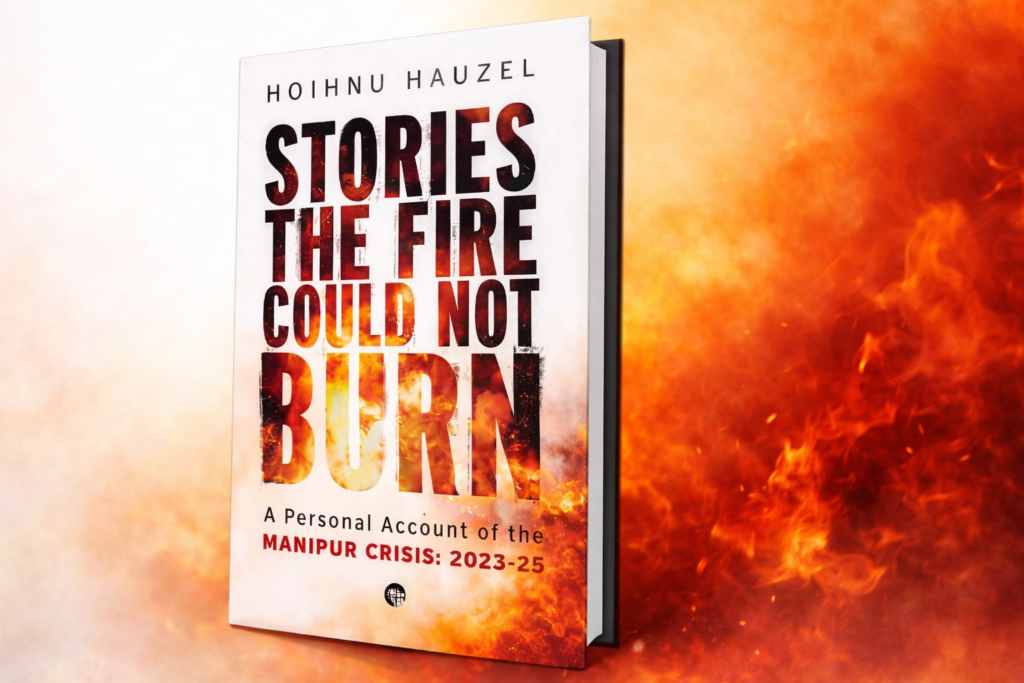
New Delhi: Within the growing literature on the ethnic conflict in India’s northeastern peripheries, Stories the Fire Could Not Burn by Hoihnu Hauzel stands out as an invaluable addition. It goes beyond typical journalistic narration to become something more disturbing: a confession that does not allow one to take comfort in distinctions.
This work, published by Speaking Tiger Books at the beginning of 2026, is timely, almost three years after the violence that hit Manipur on 3 May 2023, a date that has become inseparable in the regional consciousness as much as it has remained peripheral in the national consciousness.
Known to many as a 20-year-old with bylines in The Indian Express, Hindustan Times, and The Telegraph, Hauzel is not only a journalist with the trained eye of a reporter but also the aggrieved eye of someone whose own family fell prey to the very fires she records.
What results is a piece of writing that functions as memoir, political critique, and group elegy, a hybrid genre uniquely suited to describing, with carefully practiced modesty, the incredible pain of never seeing it again.
The book’s greatest value is that it does not present the Manipur crisis as atavistic tribal bloodshed, a clichéd colonial framework still used to shape metropolitan understanding of northeastern conflict.
Instead, Hauzel carefully digs through the layers of grievance that led to the May 2023 conflagration, tracing the fault lines back to 1949, when Manipur joined the Indian Union under circumstances that still trouble the state’s political legitimacy.
She recalls the introduction of the Armed Forces Special Powers Act in 1958, noting that it did not impose military control over a peaceful population but merely formalized a relationship of mistrust between the state and its people, a mistrust that would only grow in the following decades.
Yet Hauzel is too savvy a critic to offer a simple story of colonial-capitalist dispossession. She acknowledges real but temporary moments of reconciliation, such as the Go to Village and Go to Hills programmes of 2017, but insists these efforts and their good intentions could not address the structural inequalities rooted in Manipur’s geography.
The widespread fact that Manipur is a 10 per cent valley and 90 per cent hill territory, she claims, is a misleading and unfair framing of the terrain and place of inhabitation.
The hills that form most of the state are not plains waiting to be developed but hard, rocky terrain between 1500 and 1800 metres in altitude. These heights impose physical and material limits on infrastructure, economic activity, and access to resources that valley inhabitants can easily reach. Geography as political economy pervades the book, which makes abstract assertions about structural violence rooted in the physical intractability of altitude, rainfall, and soil composition.
By institutionalised disparity in progress and growth, Hauzel refers to the distance measured in kilometres of road, hours of sunlight, months of accessibility, and the prosaic infrastructure of citizenship that the Indian state has apportioned with the deepest unequal strokes across the territories it has claimed.
This grounding in analysis is one of the sources of the book’s personal testimony. It is not sensational and, in fact, it is rather the lack of sensationalism that gives the account of 3 May 2023 by Hauzel when her parents were burned along with the church of her childhood in the tribal enclave of Imphal its power: the exact record of what was lost.
The twenty-five Kuki-Zomi/Mizo colonies scattered throughout Imphal, some dating back decades, were not abstract communities but specific assemblages of homes, relationships, and memories.
In the flight of Thangi Hmar, a sixty-two-year-old retired health supervisor, who is attacked by an estimated hundred representatives of the radical groups, or the murder of Gouzavung and her son Goulalsang, as they endeavor to escape, Hauzel assures of the specificity of each loss in her effort to show the pattern that links them together.
This is journalism at its best: the belief that every single death diminishes us all, and that the task of testifying is to restore to the statistics of warfare the quality of lives cut short.
However, the passages of the book that haunt the most are not of the dead but of the living, that is, the sixty thousand internally displaced persons who, at the moment of writing, had neither resolution nor subsistence allowance offered to them by the state.
Hauzel’s anger over this desertion is reserved yet clear: “It is the first time in the history of India,” she writes, “that a state burned nearly two years without being resolved.”
The statement may be debated, but its emotional reality cannot be denied. The photo of internally displaced people waiting month after month, receiving no answer, is like a wound that never heals and seeps through the text. That happened when, at last, Prime Minister Narendra Modi did visit Manipur in September 2025; it happened, Hauzel argues, in a mode calculated to exclude rather than include.
His address at Peace Ground, which is all in Hindi with no translation in a country where the language is not commonly spoken, becomes to her a synecdoche of the greater failure: In the event that leaders speak a language people cannot understand, especially during times of trauma, the meaning that will be received is not connectedness, but non-belonging.
The political analysis is more powerful because it is more reserved. Hauzel does not rush to condemn but lets the facts speak for themselves. Announcement of development projects by the Prime Minister (Rs 7,300 crore), which she points out with devastating exactitude, is divided (Rs 4,163 crore) between statewide (initiatives) and just (Rs 23 crore) between Churachandpur, the district which suffered the greatest humanitarian loss.
These statistics are presented without comment, more eloquently than any polemic on the priorities that have shaped the state’s response.
In the same way, neither the Prime Minister’s silence on self-determination nor his refusal to meet with ten Kuki-Zomi/Mizo legislators is framed as neglect, but as the systematic exclusion of tribal political ambitions from legitimate discourse.
The most controversial argument by Hauzel has to be interpreted. It is interesting to see how her proposal to separate hills and valleys has become so sharp that the Kuki-Zomi/Mizo people should demand or request a distinct administration under the provisions of the Indian Constitution, without any separatist reference, because the existing structures have failed to offer security or development.
This is not talk of secession but of federal renegotiation, calling for the constitutional promise of differentiated rights to tribal communities to be upheld.
It will be up to the readers whether these arguments are convincing; however, what cannot be denied is that she has earned the right to make them. Hauzel captures not only the horrifying scene of the two women being stripped and paraded in the streets, an act of such brutal cruelty that it turned into a reckoning, as noted by one witness, but the opposite too, that of the Kuki-Zomi/Mizo women in Churachandpur being linked together in a human chain to safeguard the Meitei neighbours who fled their houses.
These contrasts are not meant to create moral equivalence but to affirm that, even amid violence, choices are made, and that a history of war must include both the worst and the best of what people can do.
This rejection of Manichaean naivete is one of the book’s greatest strengths, giving its condemnations a gravitas they would otherwise lack.
The book is an invaluable case study of the way of ethnic conflict in the unique environment of the northeast of India, which is too frequently being elucidated as an exotic exception, to the conditions of political life in the subcontinent, instead of a point at which the conditions of political life in the subcontinent are pushed to their extremes.
To journalism students, it can be used as an illustration of how long-form narrative can do things that breaking news cannot: the gradual building of context, the integration of personal story into a structural approach, and the rejection of simplicity in favor of a headline.
For laypersons seeking to understand what has happened in Manipur since 2023, it offers more than information: it conveys the experience of becoming homeless and the futility of carrying on when the very soil you live on has been permanently damaged.
Some aspects of the book’s structure can be questioned. The preface materials, based on what seem to be various drafts or versions, sometimes repeat themselves, and the shifts between personal testimony and political analysis are not always smooth.
But these are minor objections to a work that has accomplished such immense labor of witness.
Hauzel bears this dual responsibility in prose that, though as exacting as journalism and as intense as elegy, is neither sentimental nor cold.
After all, the success of Hauzel is to have produced a work of equal witness and at the same time a work of argument on justice. She makes no claims to provide solutions to the crisis that she records, but she states, with each page, each piece of testimony, each well-chosen detail, that the initial step to making things better is the acceptance of what has already happened.
Daanish Bin Nabi can be reached at daanishoffice@gmail.com