New Delhi: Rajasthan, the largest state in India in terms of area, is usually pictured as its deserts, its forts, and its colourful heritage. However, behind that facade is a political environment that has developed over centuries of feudalism, caste systems, and politics that are poorly understood by anyone outside the area.
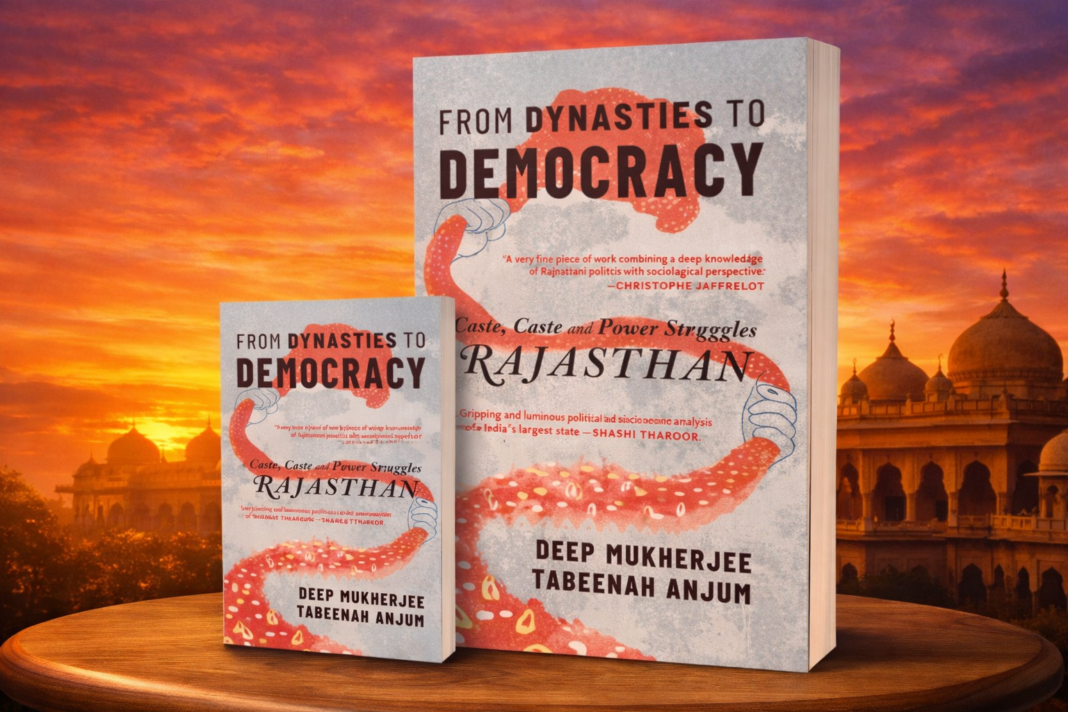
The new book, From Dynasties to Democracy: Politics, Caste and Power Struggles in Rajasthan, has been published by Pan Macmillan to address this key gap.
The volume, co-authored by veteran journalists Deep Mukherjee and Tabeenah Anjum, is based on over ten years of reportage and five years of extensive research, and follows the political development of Rajasthan from its formation in 1949 through the 2024 Lok Sabha elections and beyond.
Historian Christophe Jaffrelot, who credits the book with a very fine piece of work, a deep understanding of Rajasthan politics, and sociological skills, and Shashi Tharoor, who calls the book an enthralling and luminous political and socio-economic history of the largest Indian state, have already praised the book.
Another freedom struggle
The authors believe that Rajasthan’s political process is peculiar compared to other Hindi heartland states due to its long feudal history. When India gained independence, Rajputana was a group of princely states with their respective kings, jagirdars (landowners), and administrative establishments, with little interference from the British.
At the same time as the national freedom movement was in full blast in the rest of the country, Rajputana was experiencing another form of conflict, with kisan sabhas (farmers’ unions) and praja mandals (people’s organisations) opposing the royal power and feudal structures.
The agrarian class, which did not own the land they cultivated, began clamoring to be liberated from the jagirdari system. It was the merger of farmers’ organizations, such as the Marwar Kisan Sabha, that eventually helped the Congress become a viable electoral party in the state.
Royals strike back
Yet, the feudal rulers found an ingenious way back into power. Democracy, the same phenomenon that had thrown them out of their unquestioned dominion, gave them a chance to exercise their centuries-old influence.
In 1952, some of the royals challenged the first assembly and general elections as non-party. They not only conquered but also crippled the fortunes of a Congress which was unconquered elsewhere in the country.
Rajasthan was one of the few states where the largest party had the support of the majority of peasants and the working classes, but could not secure a thumping majority in the first assembly elections.
The Congress barely managed to scrape together a government. The jagirdars and the royalties entrenched themselves in state politics forever, using their ideological bias in Hindutva to lay down the roots and then bolster the foundations of the anti-Congress politics.
A number of the original members of the Jan Sangh, which later developed into the Bharatiya Janata Party (BJP), originated in the state of Rajasthan.
Anti-incumbency equilibrium
The book carefully studies important historical events: caste violence and Dalit agitations, Adivasi self-assertion, riots, and lynchings. It also examines the tough tests that leaders such as Bhairon Singh Shekhawat, Baldev Ram Mirdha, Ashok Gehlot, Sachin Pilot, and Vasundhara Raje have faced.
The authors observe that since the late 1990s, a strange balance has been attained in Rajasthan. The incumbent party had been regularly defeated after every five years for over 27 years. This is a very obvious anti-incumbency trend, unlike the situation in other Indian states, and it is a sign that the state’s political environment is highly volatile and disputed.
Gaps bridged
Learned but clear, From Dynasties to Democracy provides its readers with an in-depth examination of the conversion of a feudal society into an active electoral democracy.
The book offers uncommon insights for policymakers, journalists, and ordinary readers who want to learn more about one of India’s most politically important states, based on scientific archival research and personal accounts.
Daanish Bin Nabi can be reached at daanishnabi@gmail.com