


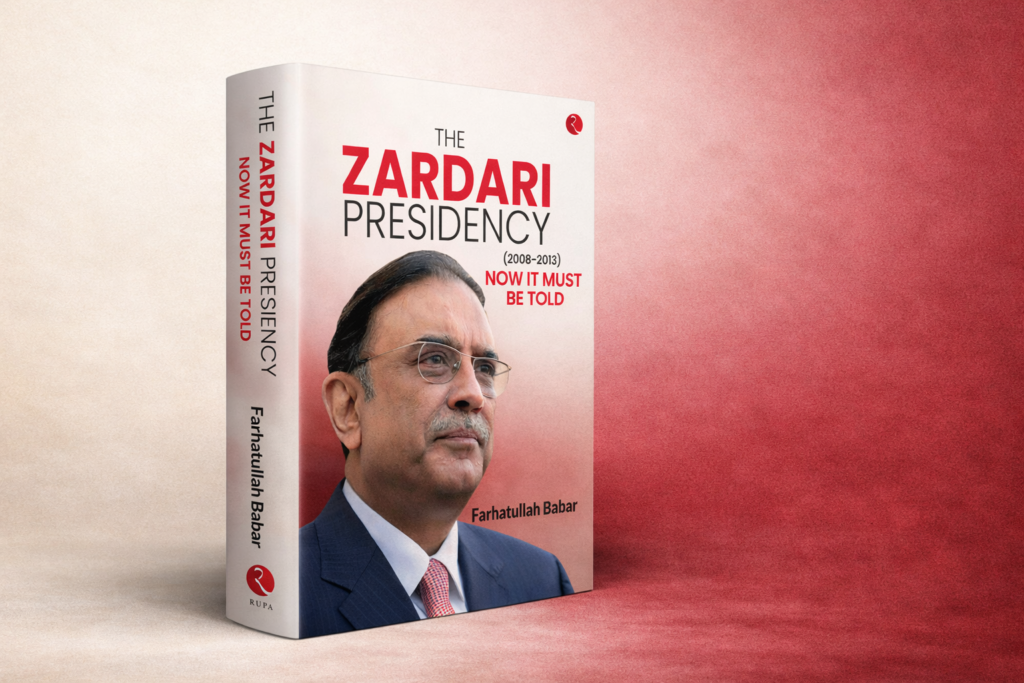
New Delhi: Asif Ali Zardari has the distinction of being the first President in Pakistan’s tumultuous history to complete a full five-year term. He was the man who defied all odds, a political survivor rising from obscurity to become Pakistan’s most enigmatic and possibly most controversial President. Yet his presidency, from 2008 to 2013, was marked by relentless battles with the deep state, a partisan judiciary, and even his own allies.
A new memoir, The Zardari Presidency: Now It Must Be Told by Farhatullah Babar, published by Rupa Publications, offers an explosive insider account of this high-stakes drama. Babar served as presidential spokesperson throughout Zardari’s tenure and had previously worked as official speechwriter and spokesperson to Benazir Bhutto for nearly two decades. He is a recipient of Pakistan’s national award Hilal-i-Imtiaz and has chaired the Parliamentary Commission on the new South Punjab province.
A witness to history
Babar describes his book as “a personal recollection of a witness and participant, from a privileged vantage point, of the momentous events that shaped the Zardari Presidency.” These included the deep state breathing down Zardari’s neck, a partisan Chief Justice hounding him, fabrications and intrigues like the Memogate scandal following the Osama bin Laden raid, and even troops of the 111 brigade thudding into the Presidency at night to browbeat a defiant Zardari.
“It is an attempt to catalogue some cat-and-mouse games played in an imbalanced power structure,” Babar writes, “marked by the de-jure and accountable government ceding space ceaselessly to the de-facto but unaccountable deep state.”
The author seeks to delve into the extraordinary presidency of a man who “defied the odds, endured jeers and ridicule, and navigated a treacherous course in dealing with the ambitious elements within the state apparatus distrustful of democracy and democratic institutions.”
Making of a President
Babar’s early encounters with Zardari were unremarkable. He worked closely with Benazir Bhutto and had only nominal acquaintance with her spouse. “Our interactions were limited to exchanging greetings; he showed little interest in prolonged conversation, and I did not attempt to engage him further,” he writes.
Zardari had the reputation of pursuing hobbies typical of wealthy businessmen, tending to farms, playing polo, keeping ponies, and maintaining a small private zoo. Party leaders did not speak highly of him. The media painted a negative image, portraying him as corrupt and street-smart rather than a political leader. Yet Zardari appeared unconcerned, taking criticism in his stride.
Babar notes that Zardari’s own style, casual, unostentatious, a sincere friend, and always wearing a broad smile, was not enough to overcome negative perceptions. His disdain for media coverage and refusal to court powerful media barons earned him the ire of influential journalists accustomed to pandering by the high and mighty.
Osama Bin Laden fallout
One of the most dramatic episodes of Zardari’s presidency was the US Navy SEALs raid on Abbottabad on 2 May 2011, which killed Osama bin Laden. Babar writes that bin Laden “had been hiding in a military cantonment for years.” The US took him out “as completely and as secretly as he had been sheltered, without informing Pakistan.”
The official press release’s claim that intelligence-sharing with the US had made the operation possible “looked hollow and unconvincing.” Babar adds: “The web of lies and deceit had been exposed and failed to arouse any conviction.”
Prime Minister Yousuf Raza Gilani dealt a further blow to Army Chief General Ashfaq Kayani when he questioned on the floor of Parliament how bin Laden had lived in a military cantonment for six years while the whole world searched for him. “On what type of visa was he living here?” Gilani asked, in remarks that Babar says “haunted Kayani and the ISI chief.” Gilani also warned that a “state within a state” was unacceptable.
Memogate scandal
In the aftermath of the bin Laden raid, the Memogate scandal erupted. Pakistani-American businessman Mansoor Ijaz had long been accusing the ISI of being a rogue institution. In late 2011, the army and ISI chiefs, along with opposition leader Nawaz Sharif, took their case against President Zardari to the Supreme Court. Babar describes this as “no ordinary ambush of the President; it was akin to a suicide attack on the supreme commander of the armed forces.”
Babar argues that in their eagerness to confront Zardari, the generals failed to recognise how foolish they appeared. By embracing Mansoor Ijaz, whom they had previously dismissed, they inadvertently boxed themselves into a tight corner. Admiral Mike Mullen, chairman of America’s Joint Chiefs of Staff and the intended recipient of the alleged memo, dismissed it as not credible.
When Zardari collapsed in the first week of December 2011, he refused treatment in medical institutions under General Kayani’s control. “Could there be a greater display of distrust towards the Army Chief by his supreme commander?” Babar asks.
The Survivor
Despite being badly bruised in the fight picked against him, Zardari completed his five-year term with significant achievements. Babar lists them: he peacefully removed a military dictator from the Presidency in August 2008; in April 2010, he restored the 1973 Constitution and transferred most powers to Parliament; in April 2011, he filed a reference in the Supreme Court urging it to revisit its 1979 verdict executing former Prime Minister Zulfikar Ali Bhutto; in 2013, he oversaw a general election and the peaceful transition from one civilian government to another.
He also administered the oath of office to his political rival, Nawaz Sharif, as Prime Minister and exited the Presidency with a guard of honour. A few weeks before leaving, he laid the foundations for the China-Pakistan Economic Corridor (CPEC).
Babar notes that Zardari lived to see the day in March 2024 when the Supreme Court issued its mea culpa verdict, acknowledging that the trial of Zulfikar Ali Bhutto forty-four years ago was “unfair and lacked due process.” This rare acknowledgement brought many, including Bhutto’s son Bilawal, to tears. A few days later, Zardari went on to be re-elected President, a distinction never before earned by a civilian president.
Babar writes that while the judges finally showed humility, “the powerful military did not show any humility nor give up its indulgence in politics.” Zardari, he suggests, may be hoping that “someday the powerful army will also bow before the people.”
The author concludes by invoking Dostoevsky’s Crime and Punishment. The novel’s central character, Raskolnikov, worships “the triumph of human endurance, and the strength of the human spirit, which could withstand so much and bear so much.” Babar writes: “Those who, in the words of General Musharraf, have played ‘cat-and-mouse’ have lost their game to human endurance.”
This account, Babar emphasises, does not ask readers to see Zardari as a whitewashed hero. “It invites them to see him as he was: a leader, more sinned against than sinning.” For anyone seeking to understand Pakistan’s turbulent democracy, the power of its deep state, and the man who survived it all, The Zardari Presidency offers an indispensable, unflinching insider’s view.
Daanish Bin Nabi is a New Delhi-based journalist and can be reached at daanishoffice@gmail.com